SEO Migration Checklist: Redesigns, Domain Changes, and URL Moves

SEO migration checklist matter because SEO work should produce decisions, not just busy activity. When a site grows, the team needs a repeatable way to decide what to publish, what to fix, what to keep, and what to ignore.
This guide focuses on practical execution for SEO migration checklist. It is written for site owners, developers, and content teams that want cleaner search visibility without turning every page into a checklist exercise.
SEO migration checklist: the practical definition
A redesign or domain move can erase years of SEO progress when URL mapping, metadata, internal links, canonicals, and sitemap updates are treated as afterthoughts.
The simplest way to think about SEO migration checklist is to connect the search goal with the page experience. A strong page is discoverable, technically accessible, focused on one intent, and useful enough that a reader can take the next step with confidence.
For search-engine guidance, use Google site move documentation. For WordPress-oriented implementation habits, Rank Math redirections documentation is a helpful Rank Math reference. Use these sources as guardrails, then adapt the work to the site, audience, and page type.
Why this topic affects rankings and revenue
A migration is a controlled handoff from old URLs to new URLs. The goal is to preserve relevance signals while making the new site easier to crawl and maintain.
Search performance is rarely changed by one isolated setting. SEO migration checklist usually touches content quality, crawlability, internal links, metadata, templates, and measurement. If one part is weak, the page can still be indexed but fail to earn meaningful clicks or conversions.
That is why the best workflow starts with the user problem, then checks the technical signals. You want a page that answers the query clearly, sends consistent signals to search engines, and points readers toward a useful next action.
A reliable SEO migration checklist workflow
- Crawl the old site and export every indexable URL.
- Map each old URL to the best new destination.
- Implement one-hop 301 redirects.
- Update internal links, canonicals, and sitemaps.
- Monitor crawl errors and rankings after launch.
Do the work on a small set of priority URLs first. A narrow review makes patterns visible: weak titles, missing internal links, duplicate intent, slow templates, stale examples, or pages that get impressions but not clicks.
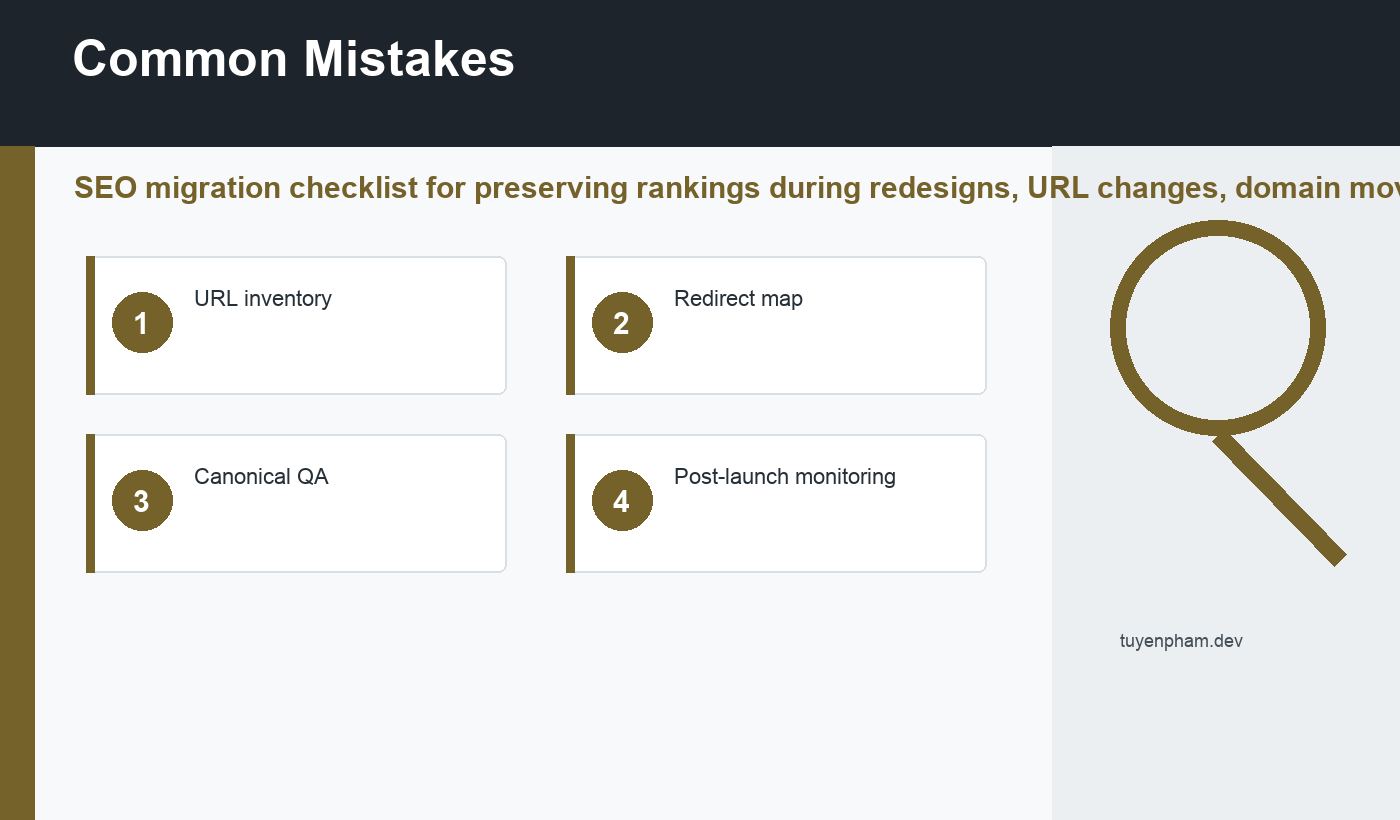
Once the pattern is clear, turn it into a reusable checklist for future publishing. The checklist should include URL inventory, Redirect map, Canonical QA, and Post-launch monitoring. It should be short enough that writers and developers will actually use it.
What to check before publishing
Before a new page goes live, confirm that the focus keyword fits the search intent and appears naturally in the title, URL, introduction, at least one relevant heading, and the SEO description. The keyword should guide the page, not crowd the writing.
Add internal links to related pages such as canonical tags SEO and robots.txt SEO when they help the reader go deeper. Internal links are not filler; they explain the site’s structure and move readers from one useful answer to the next.
Use external sources sparingly but deliberately. One good source can support a technical point, prevent guesswork, and keep the article aligned with current search documentation. That matters especially for SEO because platform behavior, reporting labels, and recommended practices change over time.
Common mistakes
- Redirecting everything to the homepage.
- Launching with no staging crawl.
- Changing design and content at the same time.
- Forgetting images, PDFs, and campaign URLs.
The deeper mistake is treating SEO as a one-time publication step. SEO migration checklist should become part of an operating rhythm: plan, publish, inspect, improve, and measure again. That rhythm turns search work from random optimization into a compounding system.
A monthly maintenance rhythm
Review the pages that already have impressions first. These pages have a signal from Google, so small improvements can matter quickly. Look for pages with high impressions and low click-through rate, pages losing clicks, and pages that rank for queries slightly different from the original topic.
Then review indexability and freshness. Make sure important pages are in the sitemap, not blocked by robots rules, not marked noindex, and not canonicalized to an unrelated URL. Update outdated screenshots, examples, statistics, pricing references, and product details before they quietly reduce trust.
How to measure the result
After changes go live, avoid judging results too early. Search engines need time to recrawl, reprocess, and test pages in real search results. Use Search Console, analytics, and Rank Math-style pre-publish checks together: one shows search behavior, another shows on-site behavior, and the checklist reduces avoidable publishing mistakes.
Useful measurements include non-branded clicks, query diversity, pages with rising impressions, conversion paths, indexed URL count, crawl errors, and the number of updated pages that actually improved. The report should end with a decision: keep monitoring, update again, merge pages, improve internal links, or create a new supporting page.
Final recommendation
Use SEO migration checklist as a practical habit. Start with intent, confirm the technical signals, improve the page experience, and keep a record of what changed. That small discipline makes future SEO work faster, clearer, and easier to trust.
Discussion
Join the conversation