SEO Testing: Measure Changes with a Hypothesis and a Useful Baseline

SEO testing evaluates whether a deliberate change is associated with a useful search outcome. A higher click count after an edit is encouraging, but it does not by itself prove the edit caused the increase. Seasonality, query mix, ranking shifts, demand, and search presentation can all change at the same time. A sound test defines the expected effect, records a baseline, and chooses a comparison suited to the site. Small sites can still learn from structured observations while being honest about limited statistical evidence.
SEO testing: a practical decision process
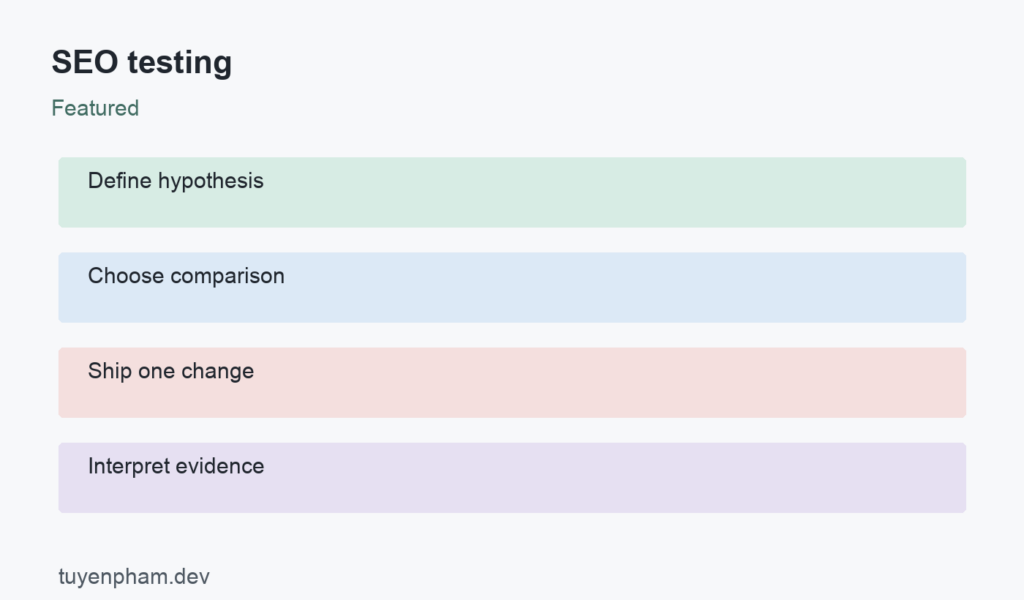
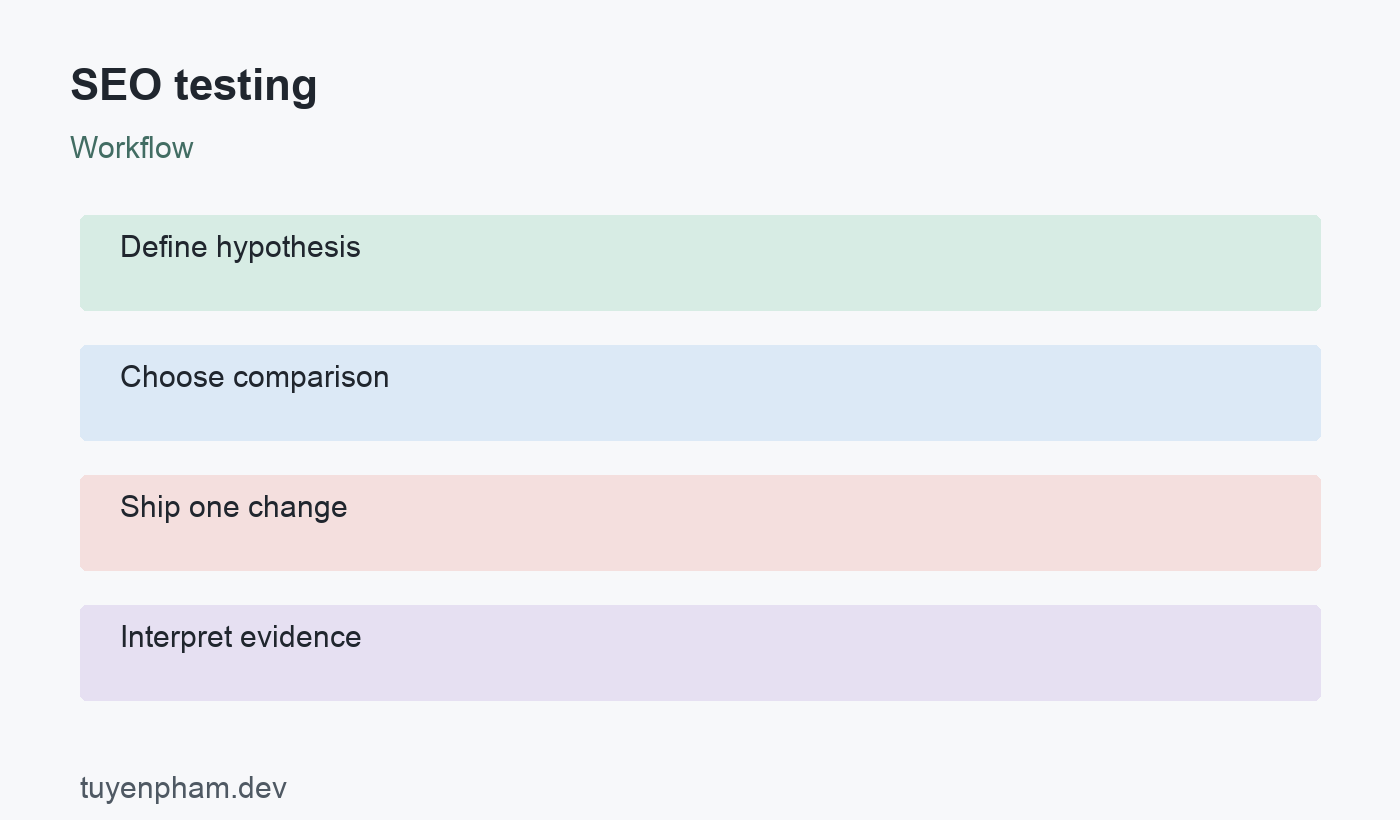
Follow this sequence: Define hypothesis → Choose comparison → Ship one change → Interpret evidence. Use it to organize the work, then verify the editorial and technical choices described below. The example is hypothetical and illustrates the decision rather than claiming a measured ranking result.
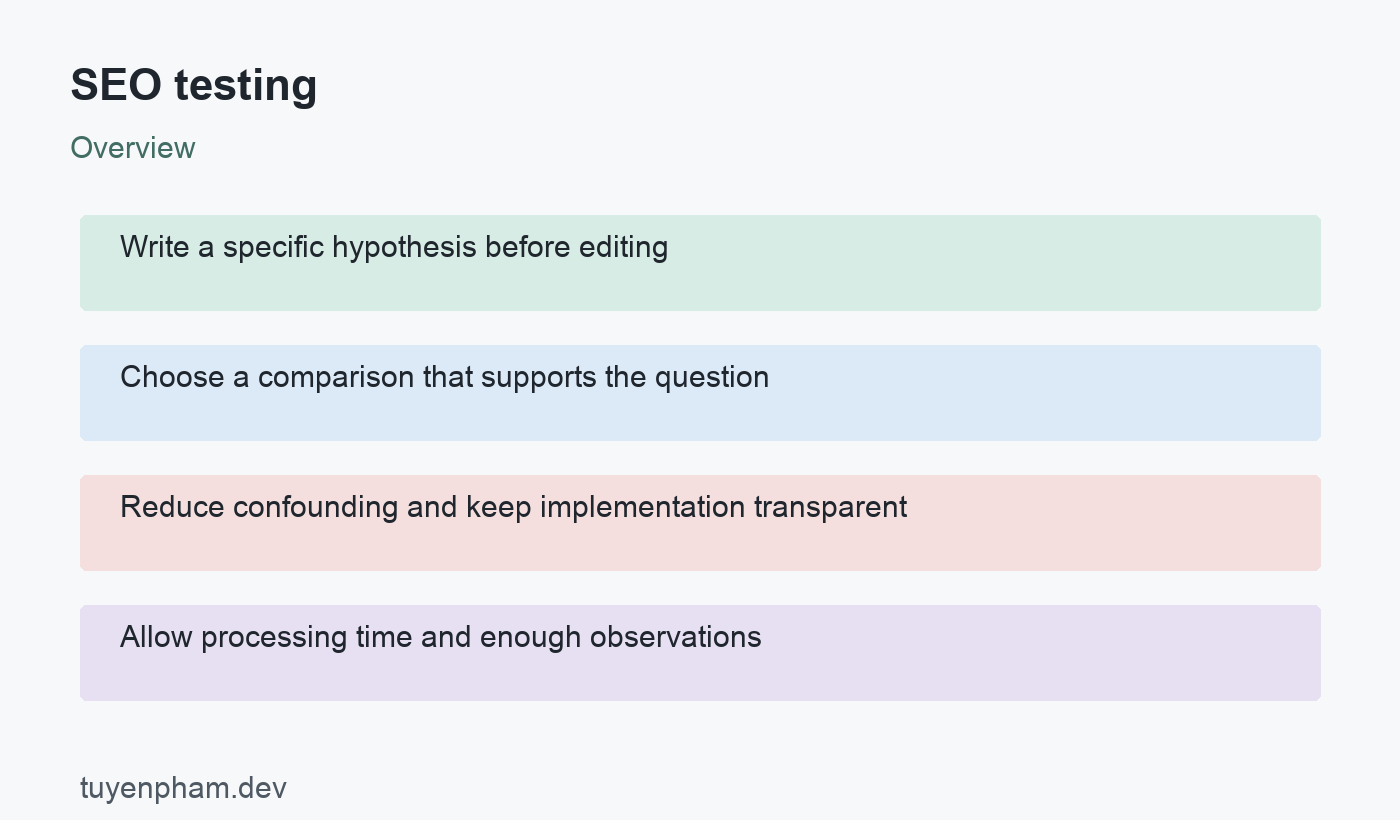
Write a specific hypothesis before editing
Describe the change, affected pages, expected outcome, and reason. For example, clarifying a service-page title may improve relevant clicks if the old title failed to communicate the offer. Choose the primary metric and useful guardrails before reading the result. A title test might monitor clicks and conversions while checking impressions and query mix. Avoid an undefined goal such as improving SEO generally. Record the start date and what would count as a practically meaningful improvement for the business.
Choose a comparison that supports the question
For a large set of similar pages, a page-group test with comparable control and treatment groups can be useful. For one small page, a before-and-after comparison is easier but weaker evidence of causation. Compare consistent countries, devices, search types, and time periods. A user-level conversion A/B test is not automatically a search-ranking experiment. Crawlers do not behave like visitors assigned to every variation. Rank Math explains A/B testing ideas; adapt them to the outcome you are measuring rather than applying one setup to every SEO question.
Reduce confounding and keep implementation transparent
Change a focused variable or clearly document a combined intervention. Avoid launching a title change, a redesign, and new internal links simultaneously if you intend to attribute the effect to the title. Track marketing campaigns, outages, migrations, and major search changes that overlap the test. Do not show different content to a search engine simply because it is a crawler. If a web experiment uses alternate URLs or redirects, follow current search guidance and remove temporary test mechanisms when the experiment ends.
Allow processing time and enough observations
Search-related changes may need recrawling before results reflect them. There is no universal number of days that makes every test reliable. Traffic volume, effect size, variation, and seasonality determine what can be inferred. Avoid stopping as soon as a favorable day appears or repeatedly checking for a winning result without a planned method. Very low-volume pages may not support a precise conclusion. Keep the change if it improves clarity or accessibility, but distinguish that editorial judgment from a proven traffic effect.
Report the result with its uncertainty
Compare the chosen metric and guardrails, then inspect query and page composition for alternative explanations. A CTR increase caused by losing low-position impressions may not mean the title became more persuasive. A clicks increase with fewer qualified conversions may not help the business. Record whether the hypothesis was supported, contradicted, or inconclusive. Keep a change history and a rollback path. The valuable output is a documented decision and a better understanding of the site, not a guaranteed winner from every experiment.
Worked example
A service page receives 200 clicks in one period and 240 after a title change. During the second period, impressions also rise sharply because demand increased. Comparing click counts alone would overstate the evidence for the title. The team checks CTR by query group, device, and country, compares an appropriate reference group, and reviews qualified leads. If those views disagree or sample size is small, the honest conclusion is inconclusive rather than a precise percentage improvement caused by the edit.
Implementation checklist
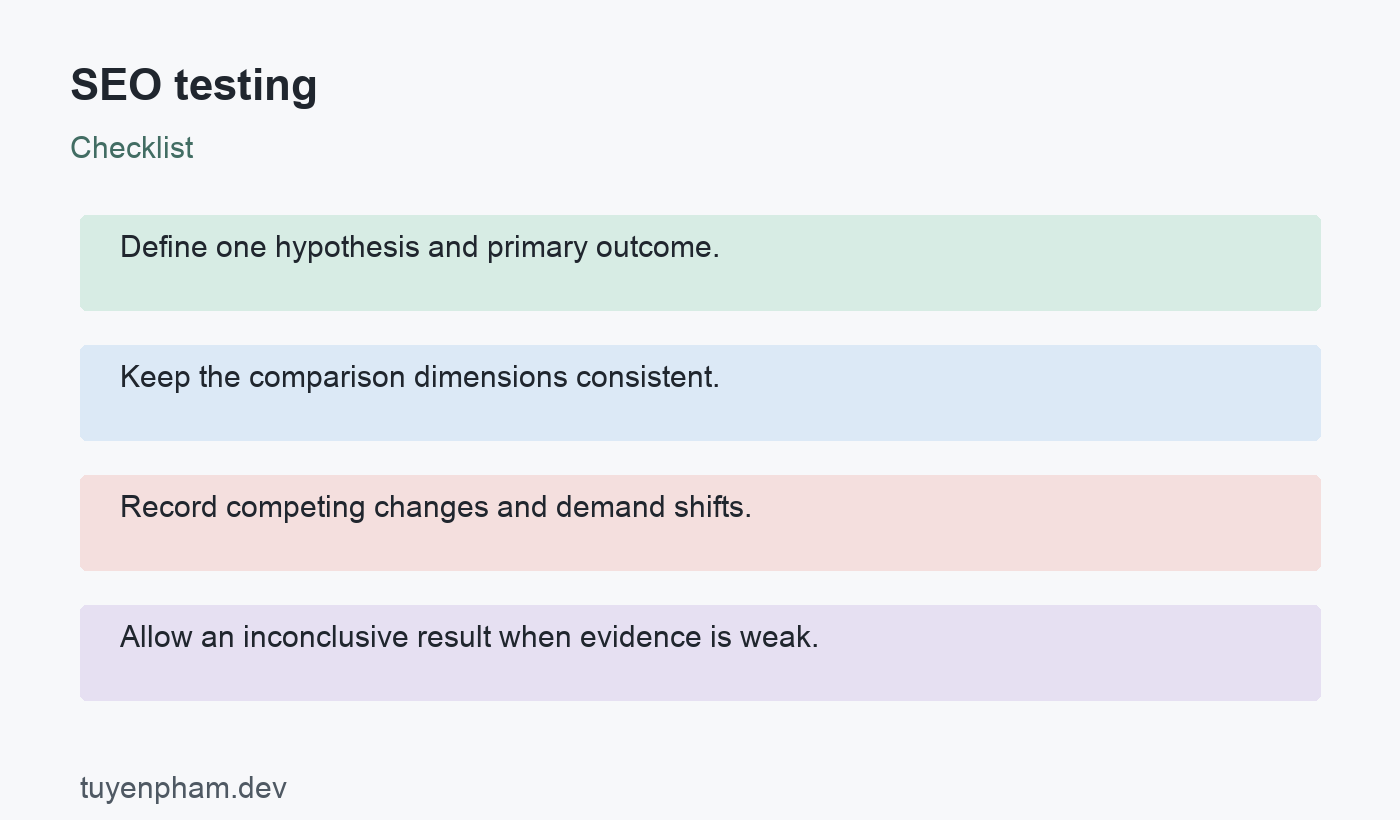
- Define one hypothesis and primary outcome.
- Keep the comparison dimensions consistent.
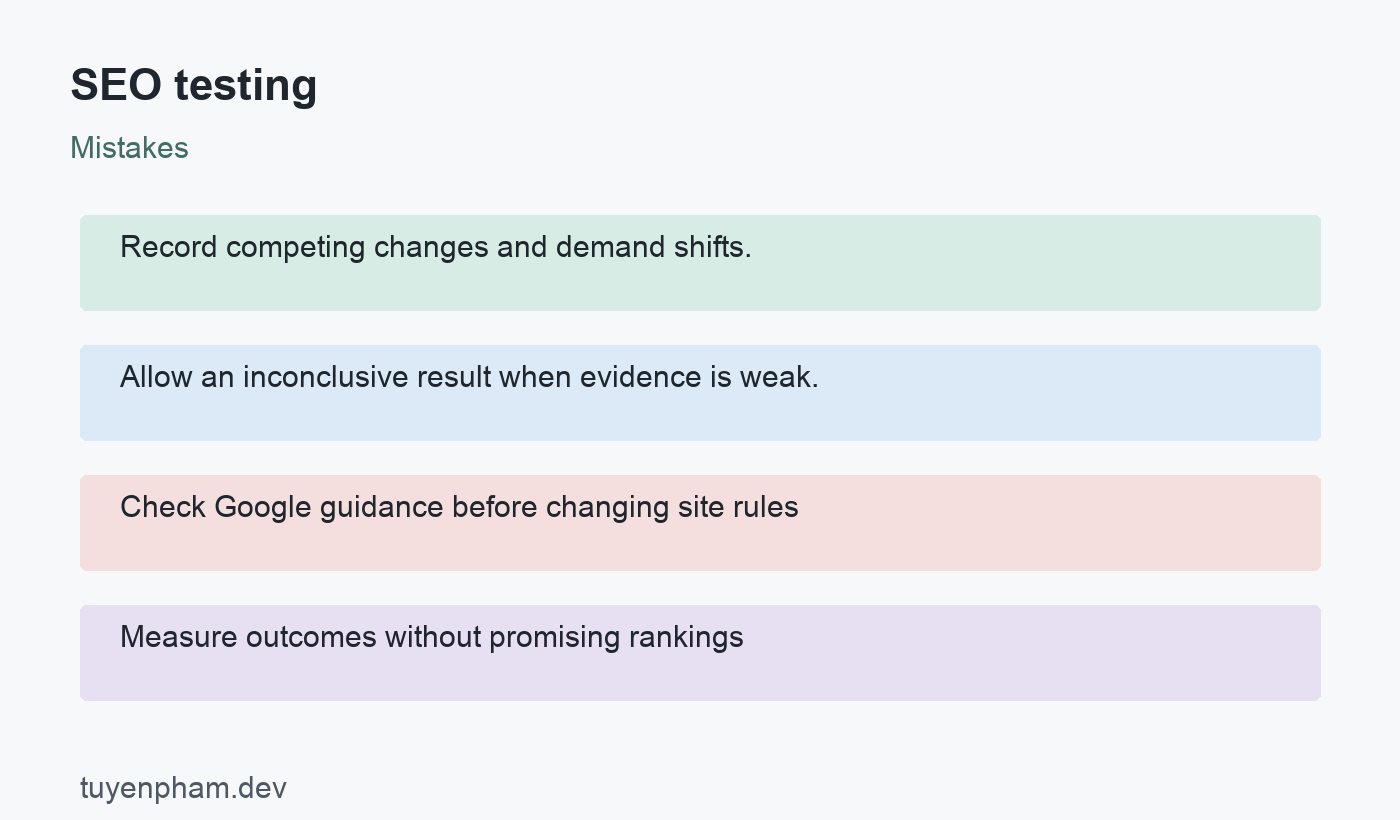
- Record competing changes and demand shifts.
- Allow an inconclusive result when evidence is weak.
A focused task for your website
Choose a modest title or internal-link improvement for a small page group. Write the hypothesis, baseline period, primary metric, guardrails, and review plan before editing. Save the previous configuration and annotate the release. At review, compare like-for-like segments and note external changes. Write a short result statement that separates observation from attribution. Keep the improvement if it serves readers, but do not call it a successful ranking experiment without adequate evidence.
References and next steps
Consult Google Search Central documentation for the relevant search requirements and Rank Math guidance on this topic for practical workflows. Continue with Seo Kpis and the SEO audit checklist for related implementation checks.

Discussion
Join the conversation