SEO Forecasting: Build Scenarios with Clear Assumptions and Limits

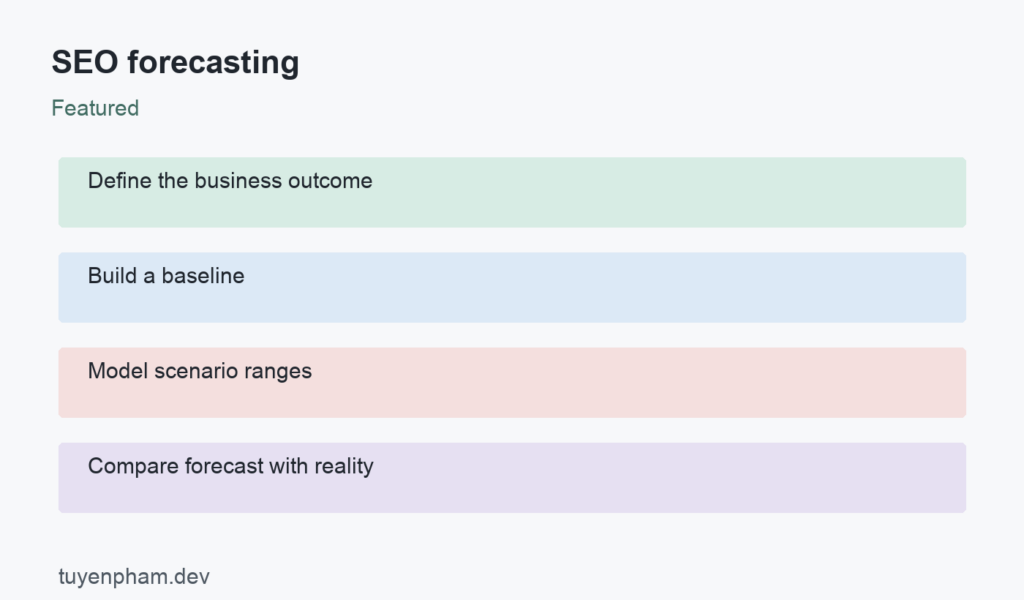
SEO forecasting estimates possible future outcomes under stated assumptions. It can help plan resources and connect search work with business goals, but it cannot guarantee rankings, traffic, or revenue. A forecast should distinguish what the site might achieve without the proposed work from the additional effect being modeled. Use ranges and explain the uncertain inputs. A spreadsheet becomes more useful when a reader can see why the assumptions were chosen and what would change the conclusion.
SEO forecasting: a practical workflow
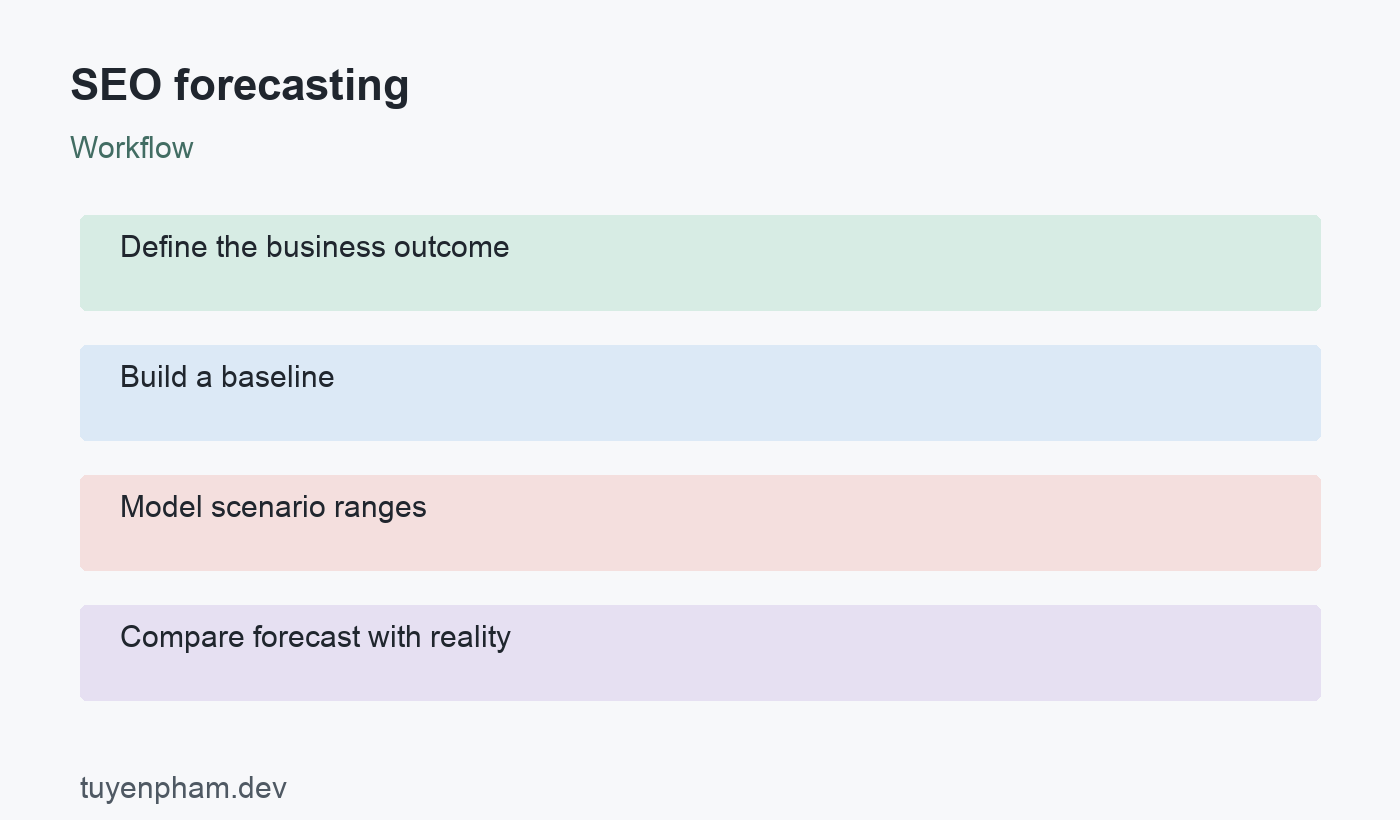
Use this sequence to organize the work: Define the business outcome → Build a baseline → Model scenario ranges → Compare forecast with reality. The sections below explain the evidence, decisions, and limitations at each stage. The worked example is hypothetical and illustrates a process rather than a measured result from this website.
Start with a stable, relevant baseline
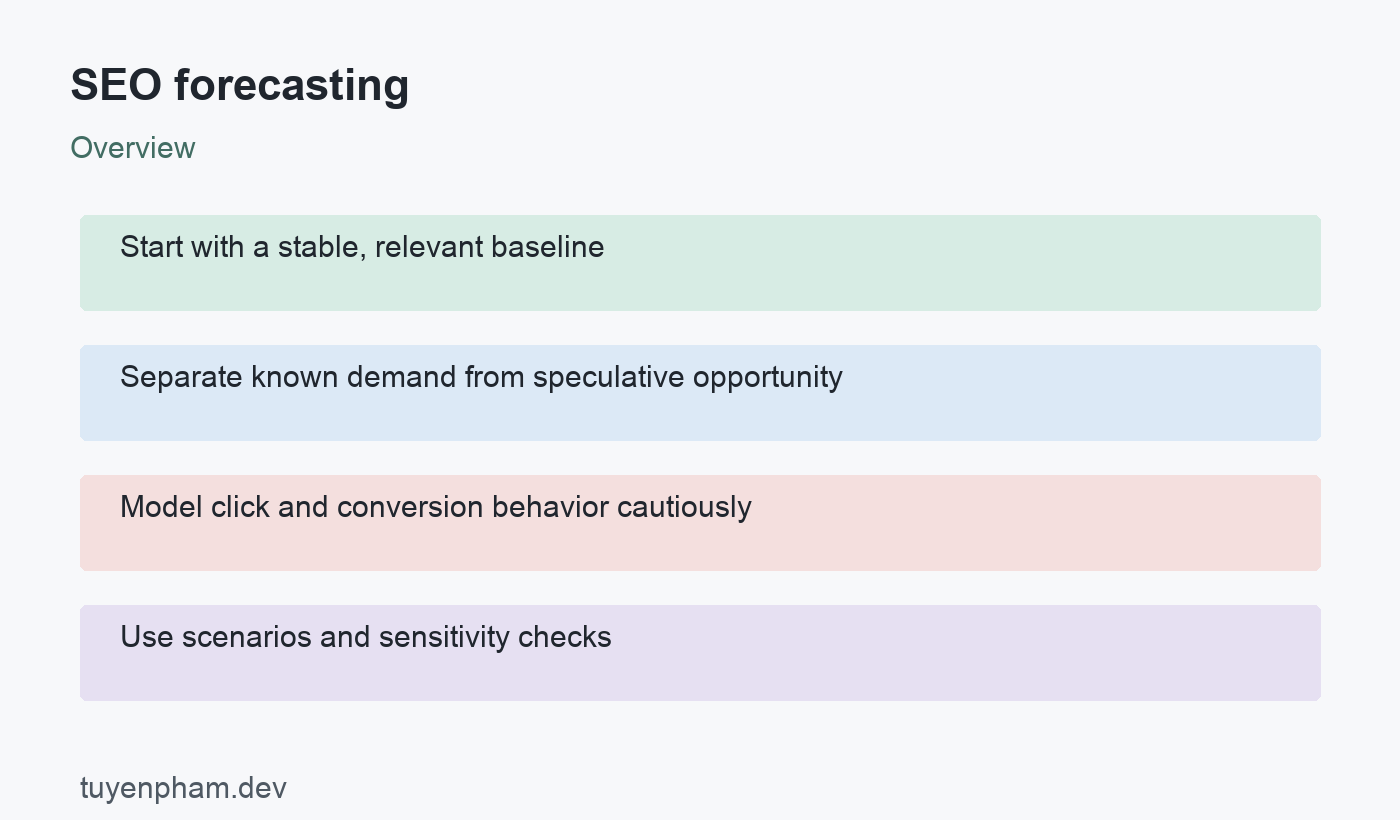
Collect an appropriate history of organic visits, search performance, and conversions. Separate branded and non-branded demand where that distinction matters. Review seasonality, tracking changes, launches, and outages that affect comparability. A short spike is a weak basis for an annual projection. Google’s traffic-drop guidance highlights demand and technical changes as possible explanations for performance shifts. Use that perspective to avoid attributing every rise or fall to the content plan you intend to forecast.
Separate known demand from speculative opportunity
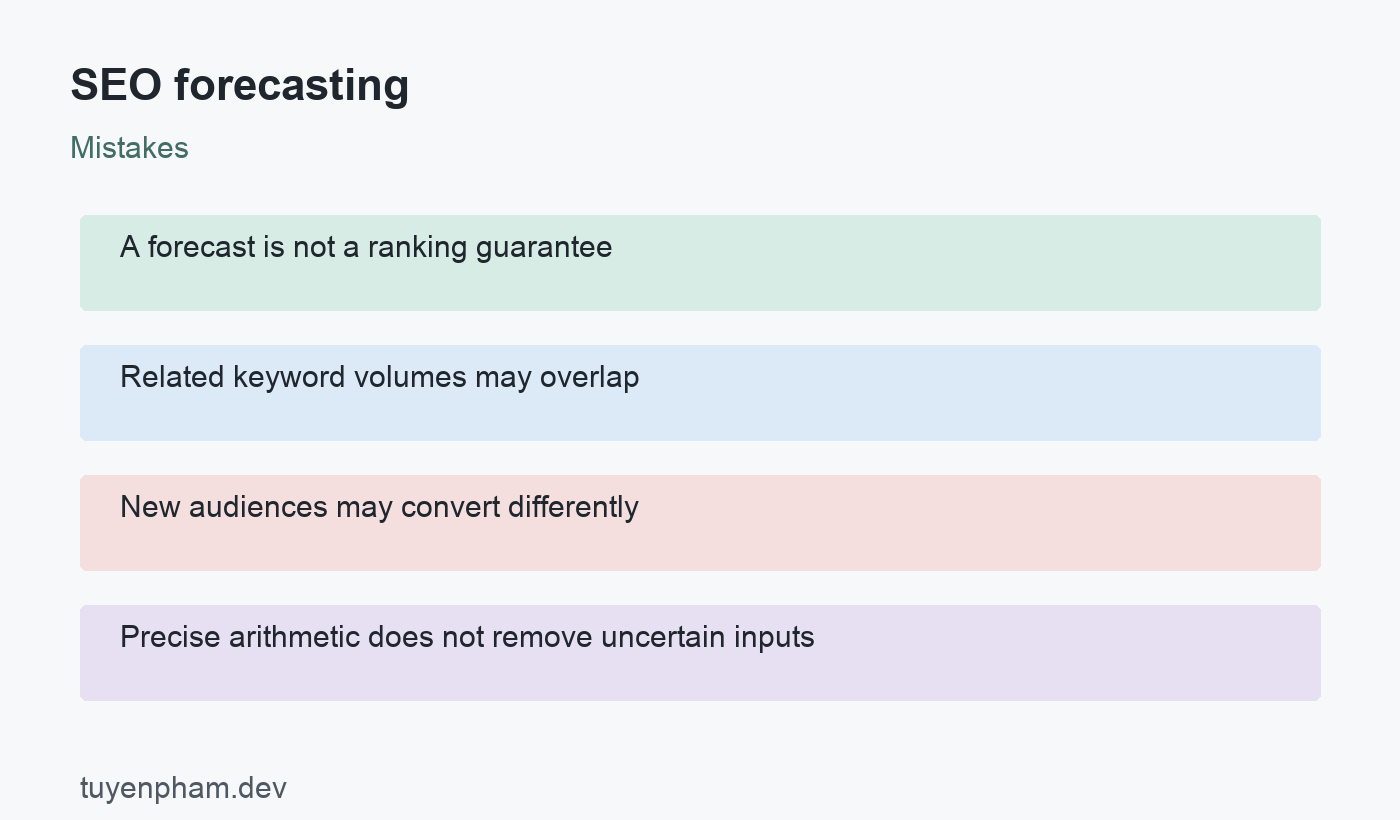
Keyword estimates can suggest opportunity, but they vary by source and may overlap across synonymous queries. Do not simply sum all reported volumes and call the result a unique available audience. A page can serve several queries, while one query can have several intents. Rank Math introduces forecasting through traffic and conversion models; use such models as planning tools with explicit assumptions. State the target market, period, and query group so the model has a defined scope.
Model click and conversion behavior cautiously
A search-volume model may combine potential impressions with assumed visibility and click-through rates, then apply a relevant conversion rate. Those assumptions depend on query type, device, search presentation, and the offering. A site’s average conversion rate may not represent a new informational audience. Do not use a single public CTR curve as a universal rule. Include the time needed for creation, discovery, and processing. Make the arithmetic transparent so stakeholders can inspect the assumptions rather than trusting a precise-looking total.
Use scenarios and sensitivity checks
Create conservative, base, and optimistic cases using explainable ranges for uncertain inputs. Change one assumption at a time to identify what drives the result most strongly. A large forecast improvement may depend primarily on an unproven visibility assumption rather than the number of articles. Record implementation capacity and dependencies, including technical fixes and reviewer time. If the plan cannot be delivered at the assumed cadence, the forecast needs revision. Treat uncertainty as part of the model rather than a footnote.
Review accuracy and update the model
Compare actual outcomes with the same definitions and period used in the forecast. Distinguish demand changes, measurement changes, delivery shortfalls, and incorrect assumptions. Keep earlier forecast versions so the team can learn rather than rewriting history. A forecast miss is useful when it reveals a specific assumption to improve. Avoid making a traffic guarantee to justify a budget. The decision should reflect expected value, uncertainty, costs, and the usefulness of the planned resources even when rankings develop slowly.
Worked example
In a hypothetical model, a page group receives 20,000 relevant impressions in a month. A scenario using a 3% click rate gives 600 clicks; at an assumed 2% lead rate, that gives 12 leads. A 2% click rate gives 400 clicks and 8 leads under the same conversion assumption. These numbers are illustrations, not benchmarks. The exercise exposes how the outcome changes with the assumptions. It does not prove the pages will receive those impressions or convert that audience at the chosen rate.
Verification checklist
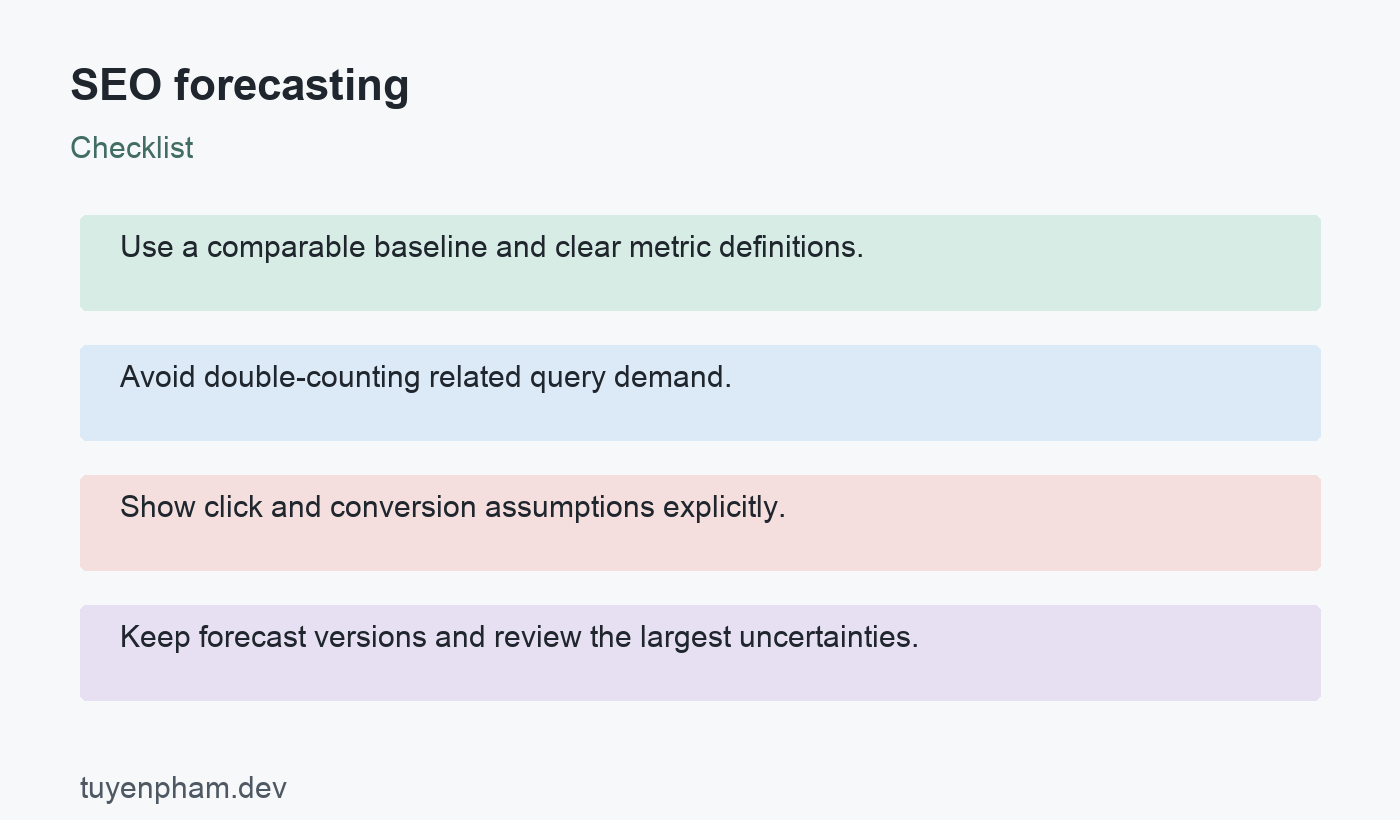
- Use a comparable baseline and clear metric definitions.
- Avoid double-counting related query demand.
- Show click and conversion assumptions explicitly.
- Keep forecast versions and review the largest uncertainties.
A focused task for your website
Build a small scenario model for an existing page group. Record the baseline, time period, expected work, costs, and outcome being modeled. Choose conservative and optimistic assumptions grounded in available evidence. Change the most uncertain input and note the effect on the result. Write a paragraph explaining what would invalidate the forecast. At review, compare like-for-like outcomes and update the assumptions without deleting the original estimate.
References and related reading
Review Google Search Central documentation for the relevant platform guidance, and Rank Math guidance for the related workflow for practical SEO checks. Continue with Seo Kpis and the SEO audit checklist to connect this task with the rest of your site review.
Discussion
Join the conversation