HTTPS SEO: Maintain Secure Delivery and Consistent URL Signals

HTTPS SEO combines secure delivery with consistent search and navigation signals. HTTPS protects communication between a client and server using TLS when configured correctly. It does not prove that every claim on the page is trustworthy or guarantee a ranking improvement. A site also needs working certificates, relevant redirects, and page references that agree on the preferred secure URL. When moving from HTTP, treat the change as a URL migration with explicit testing rather than merely enabling a certificate and assuming every path now works.
HTTPS SEO: a practical workflow
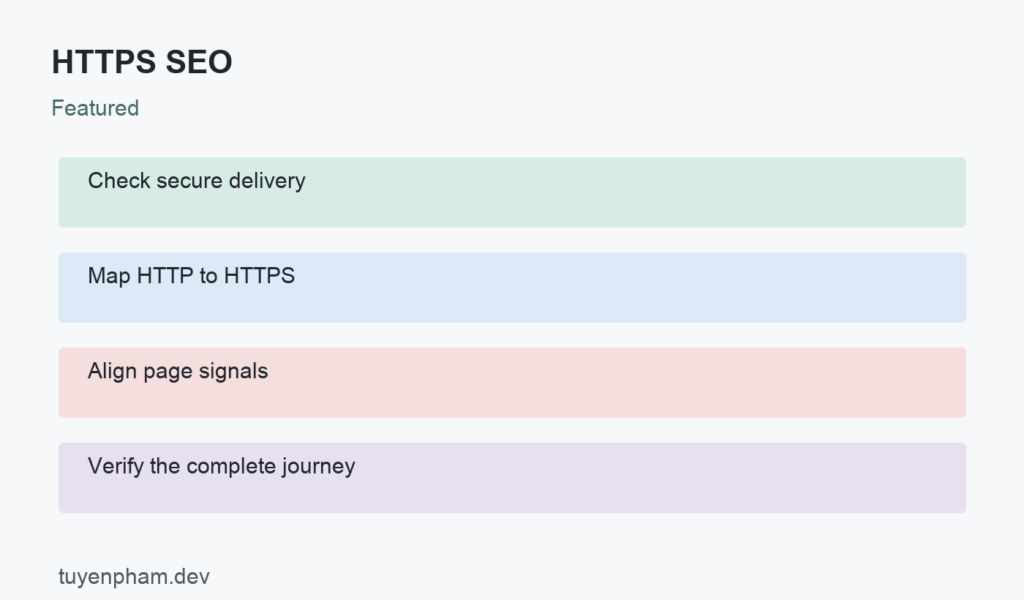
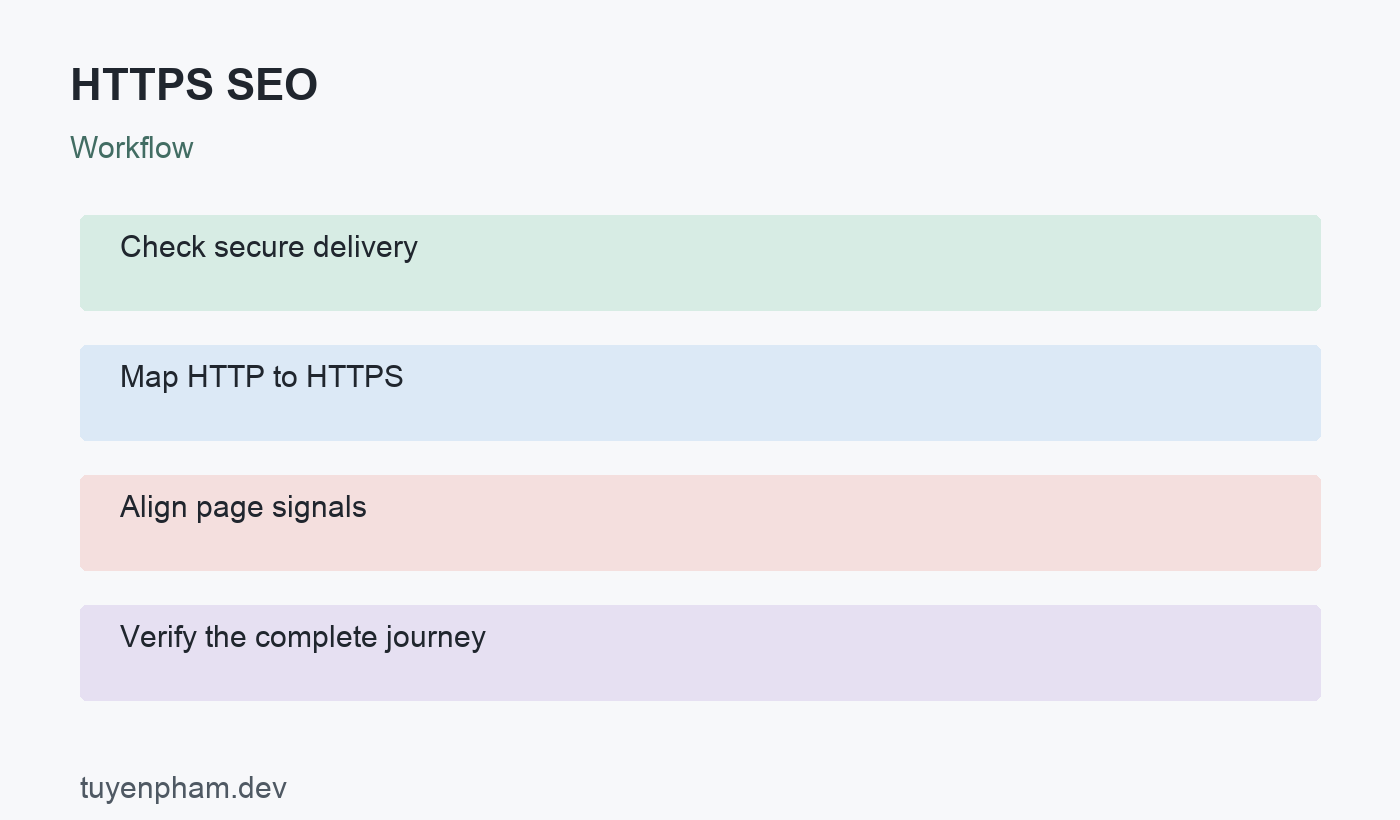
Use the following sequence to organize the review: Check secure delivery → Map HTTP to HTTPS → Align page signals → Verify the complete journey. The sections below explain the decisions and evidence needed at each stage. The worked example is hypothetical and illustrates the process rather than claiming a measured result from this website.
Verify the secure endpoint and its maintenance
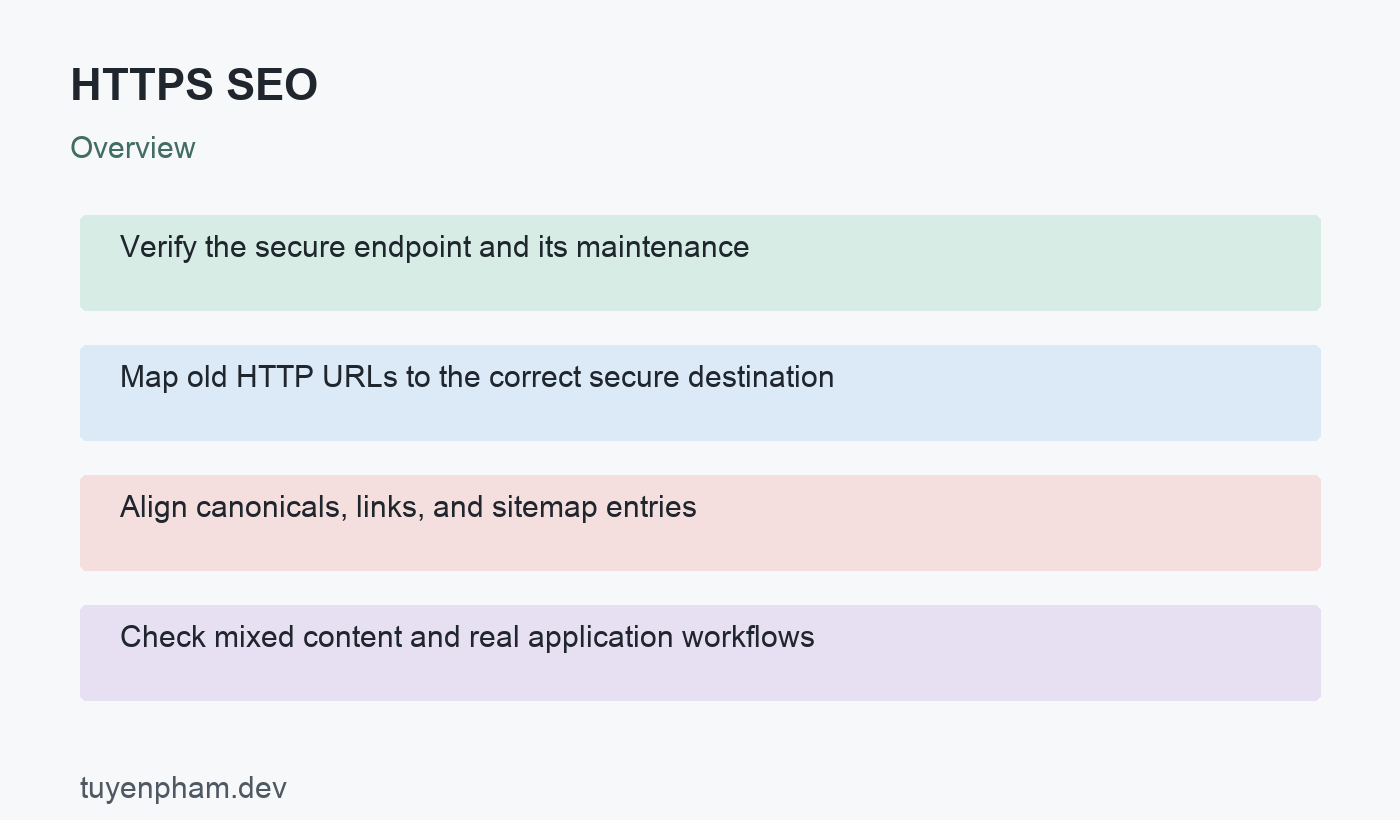
Confirm that the certificate covers the intended hostname, has a valid trust chain, and will renew before expiry. Test representative public paths, not just the homepage. Monitor renewal and routing so an infrastructure change does not expose a certificate warning to visitors. If a CDN terminates TLS, understand the connection to the origin as well. Rank Math explains the role of HTTPS in secure communication; use that context to distinguish transport security from the quality of the content itself.
Map old HTTP URLs to the correct secure destination
For a permanent move, use appropriate permanent redirects from existing HTTP routes to their corresponding HTTPS resources. Preserve relevant paths and query behavior rather than sending every request to the root page. Google’s site-move guidance describes mapping changed URLs and processing the move. Check hostname normalization and application redirects together so the route does not develop unnecessary chains or loops. A missing secure destination cannot be repaired merely by adding a redirect from its old version.
Align canonicals, links, and sitemap entries
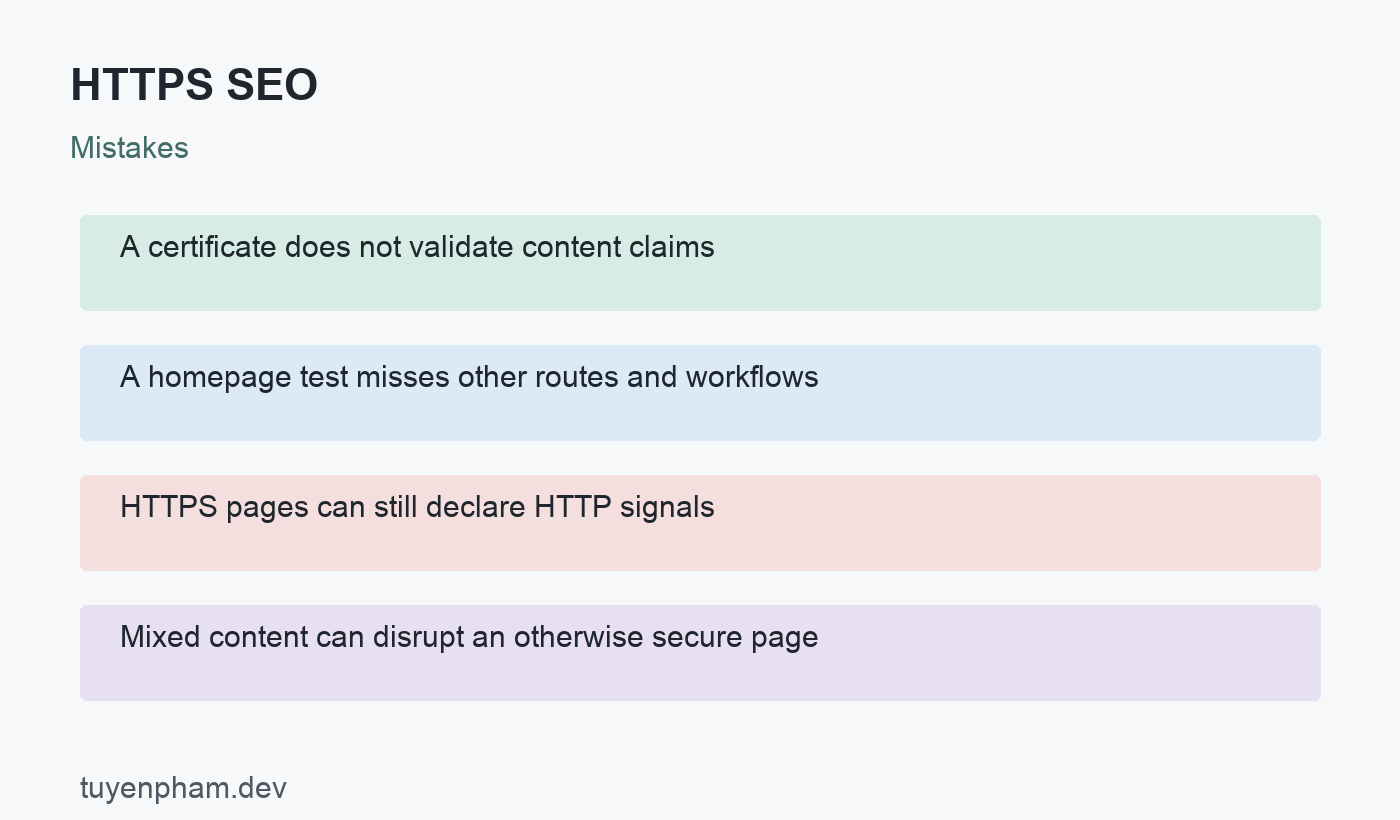
Inspect rendered canonical links, internal anchors, structured-data URLs, and sitemap entries for the intended secure destination. A page served over HTTPS can still point to an old HTTP canonical or load templates with outdated links. Update the relevant configuration and content after identifying the owner of each output. Keep legacy routes working for outside links where appropriate. A consistent set of signals helps communicate the preferred representation, but it does not force immediate search replacement or remove unrelated content issues.
Check mixed content and real application workflows
A secure page may reference scripts, styles, images, or requests over HTTP. Browser handling varies by resource type and can result in blocking or upgrading. Inspect the browser console and network behavior rather than assuming the page’s padlock proves every component works. Test forms, login, checkout, analytics, and downloadable files as relevant. Fix references at their source where possible. An HTTPS migration that breaks a critical script or service call can damage the experience even when the main HTML returns successfully.
Monitor the migration and keep evidence
Record the original mapping, release date, and representative tests. Check old URLs, final status, canonical output, and application outcomes after deployment. Search signals can take time to be reprocessed, and unrelated demand changes can affect traffic at the same time. Avoid promising a ranking lift from the protocol change. Keep monitoring certificate health and secure references after the migration is complete. The durable outcome is reliable secure access with clear routes and maintained configuration.
Worked example
A site enables HTTPS, but a product template still declares an HTTP canonical and an embedded form calls an insecure API URL. The homepage certificate test passes while the product journey remains inconsistent. The team updates the template and request endpoint, maps the old product URL directly to the secure destination, and tests a complete form submission. It also checks sitemap output and renewal monitoring. The work addresses the whole delivery path rather than assuming one successful homepage request is sufficient.
Verification checklist
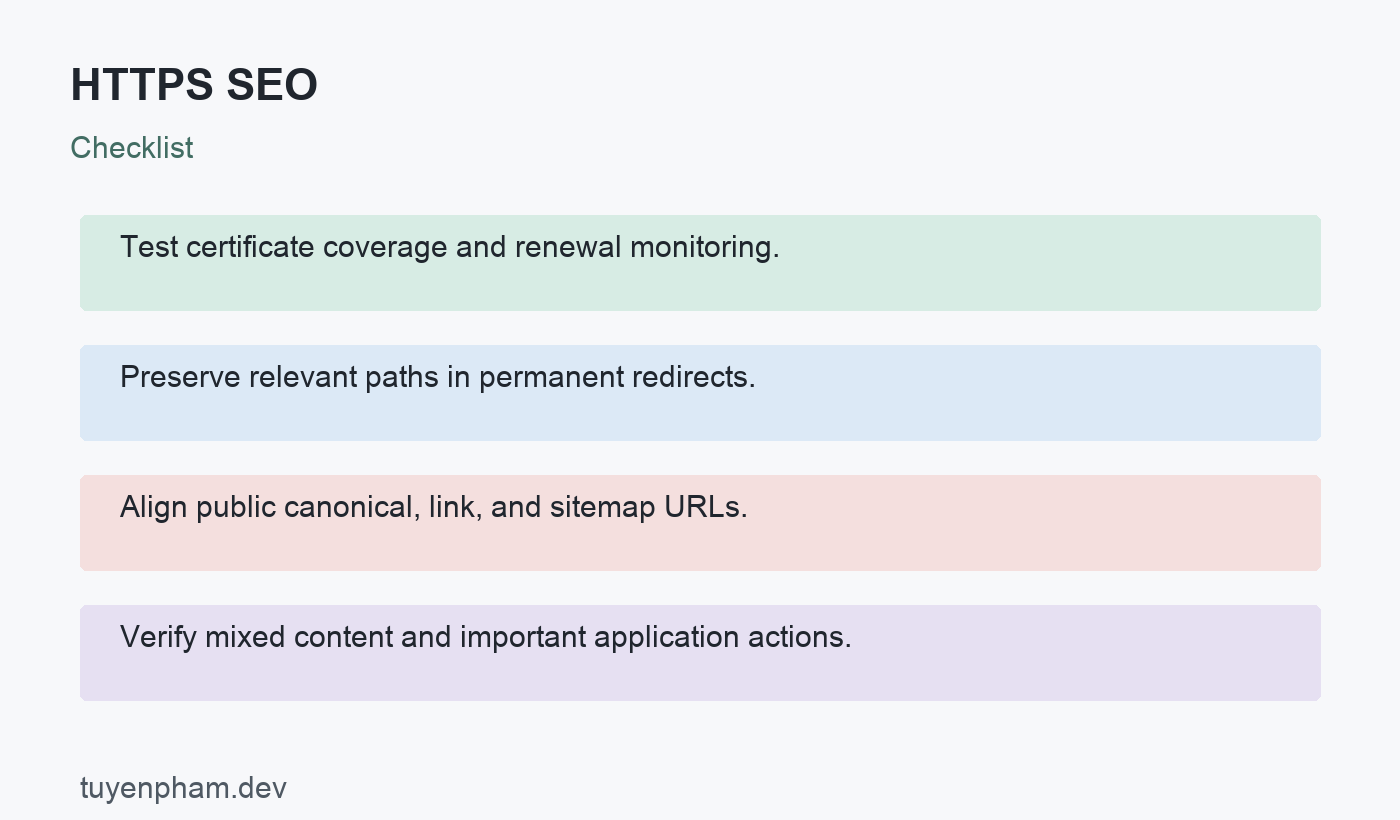
- Test certificate coverage and renewal monitoring.
- Preserve relevant paths in permanent redirects.
- Align public canonical, link, and sitemap URLs.
- Verify mixed content and important application actions.
A focused task for your website
Audit five page types and their HTTP equivalents. Record each redirect route, final status, canonical, and insecure resource reference. Include one interactive workflow and one file download. Test the proposed configuration in an appropriate environment and save the prior setup. After release, repeat the affected path checks and review infrastructure monitoring. Interpret search changes with the migration timeline and other site events rather than a guaranteed protocol-related ranking effect.
References and related reading
Review Google’s official guidance and Rank Math’s related explanation or workflow for the relevant requirements and tool details. Continue with Seo Migration Checklist and the SEO audit checklist to connect this review with the rest of your website.
Discussion
Join the conversation