Internal Linking for SEO: Build Topic Clusters That Rank

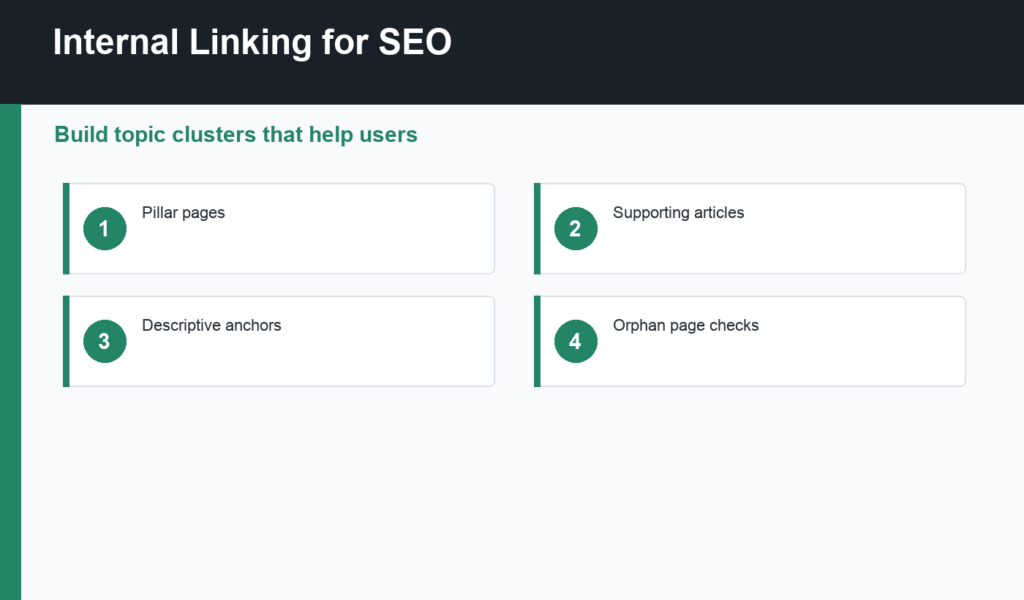
Internal linking for SEO helps users and search engines move through your website. Links show relationships between pages, pass context through anchor text, and reduce the chance that useful content becomes orphaned.
Good internal links are not random. They connect topic clusters, guide readers to the next useful step, and help important pages receive more visibility. If your site already has SEO content, internal linking can improve it without publishing anything new.
Internal linking for SEO starts with page roles
Every page should have a role. Pillar pages cover broad topics. Supporting articles answer specific questions. Conversion pages help users take action. Glossary pages define terms. Comparison pages help with decisions. Once you know each page’s role, links become easier to plan.
A broad SEO basics article can link to technical SEO, on-page SEO, keyword research, and search intent guides. Those supporting guides can link back to the pillar and to each other when the next step is natural.
Use descriptive anchor text
Anchor text should explain what the linked page is about. “Read our technical SEO checklist” is more useful than “click here.” Descriptive anchors help readers decide whether to open the link and give search engines additional context about the destination page.
Do not over-optimize every anchor with the exact same keyword. Use natural variations. A page about on-page SEO can be linked with anchors such as “on-page SEO checklist,” “page optimization checklist,” or “pre-publish SEO review.”
Find orphan and underlinked pages
An orphan page has no internal links pointing to it. Search engines may still discover it through a sitemap, but users cannot reach it naturally. Review new posts after publishing and add links from older relevant pages. Also add links from the new post back to useful older pages.
Rank Math and other SEO tools can help surface internal link opportunities, but human judgment matters. The link should help the reader, not just satisfy a counter.
Build topic clusters
A topic cluster groups related pages around a central idea. For example, an SEO cluster might include keyword research, search intent, on-page SEO, technical SEO, local SEO, ecommerce SEO, and JavaScript SEO. Each page answers a specific part of the broader topic.
Google’s SEO Starter Guide encourages clear navigation and helpful links. Internal linking is the practical version of that advice inside your own site.
Internal linking checklist
- Assign every important page a role.
- Link from pillars to supporting articles.
- Link from supporting articles back to relevant pillars.
- Use descriptive anchor text.
- Avoid exact-match anchor repetition.
- Fix orphan pages after publishing.
- Update older pages when new content goes live.
- Prioritize links that help the reader continue.
Internal link maintenance
Internal linking should be maintained after publishing. When a new article goes live, search your own site for related phrases and add links from older pages. When an old page is removed or redirected, update internal links so users do not travel through unnecessary redirects.
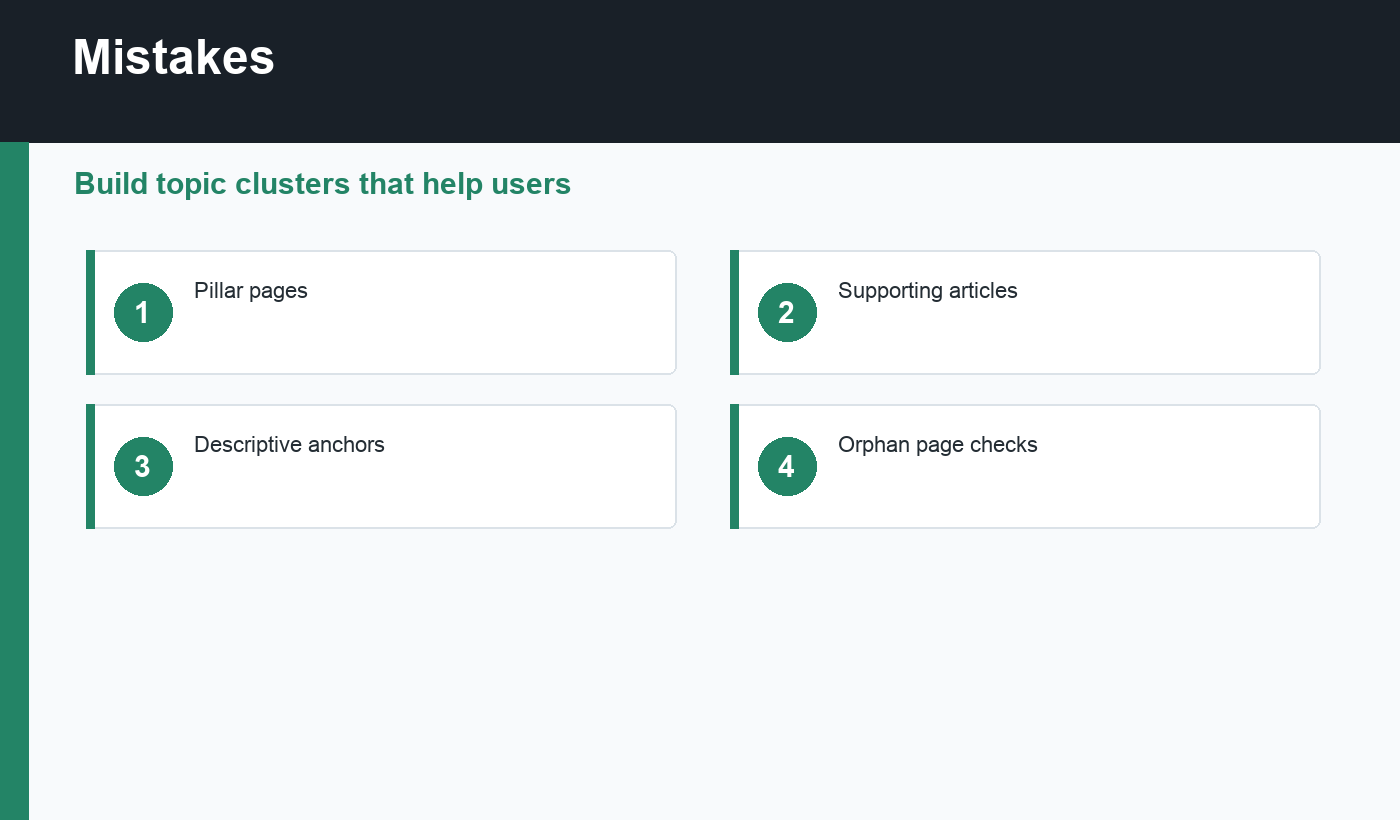
Review anchor text during this process. The goal is not to force keywords into every link. The goal is to make the next useful page obvious to readers while giving search engines a clearer map of topic relationships.
Use analytics and Search Console to choose pages worth strengthening. If a page already earns impressions but has weak supporting links, adding relevant internal links can help both discovery and topical clarity.
Do this during every content refresh. A new internal link from a relevant older page can help readers find the newer article and keep the whole cluster feeling current.
Final recommendation
Use internal linking for SEO as part of publishing, not as cleanup months later. Each new page should strengthen the map of the whole site.
Discussion
Join the conversation