HTTP Status Codes: Design Clear API Success and Error Responses

HTTP status codes describe the outcome of an HTTP request before a client reads the response body. A consistent API uses them to distinguish successful operations, client mistakes, authentication problems, and service failures. This allows browser clients, monitoring tools, and integrations to react sensibly. The response body supplies details; it should support the status rather than contradict it. Choosing a small, documented set of codes is more useful than assigning a different code to every internal exception.
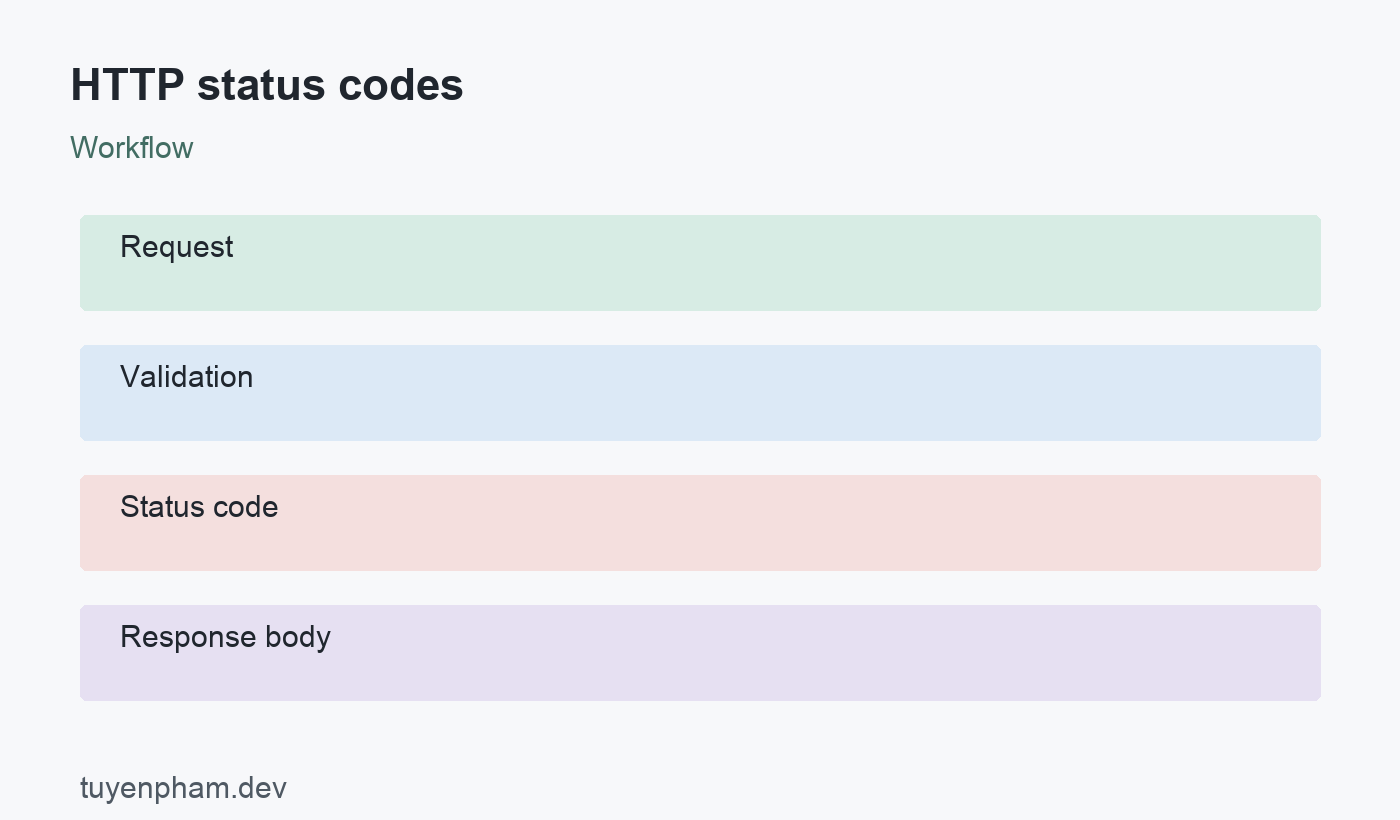
HTTP status codes: a practical workflow
The sequence is Request → Validation → Status code → Response body. The sections below explain what each decision changes, which failure cases deserve attention, and how to verify the result in a small project. Use the example as a starting point, then adapt the interfaces and error policy to your own application.
Choose success codes around resource behavior
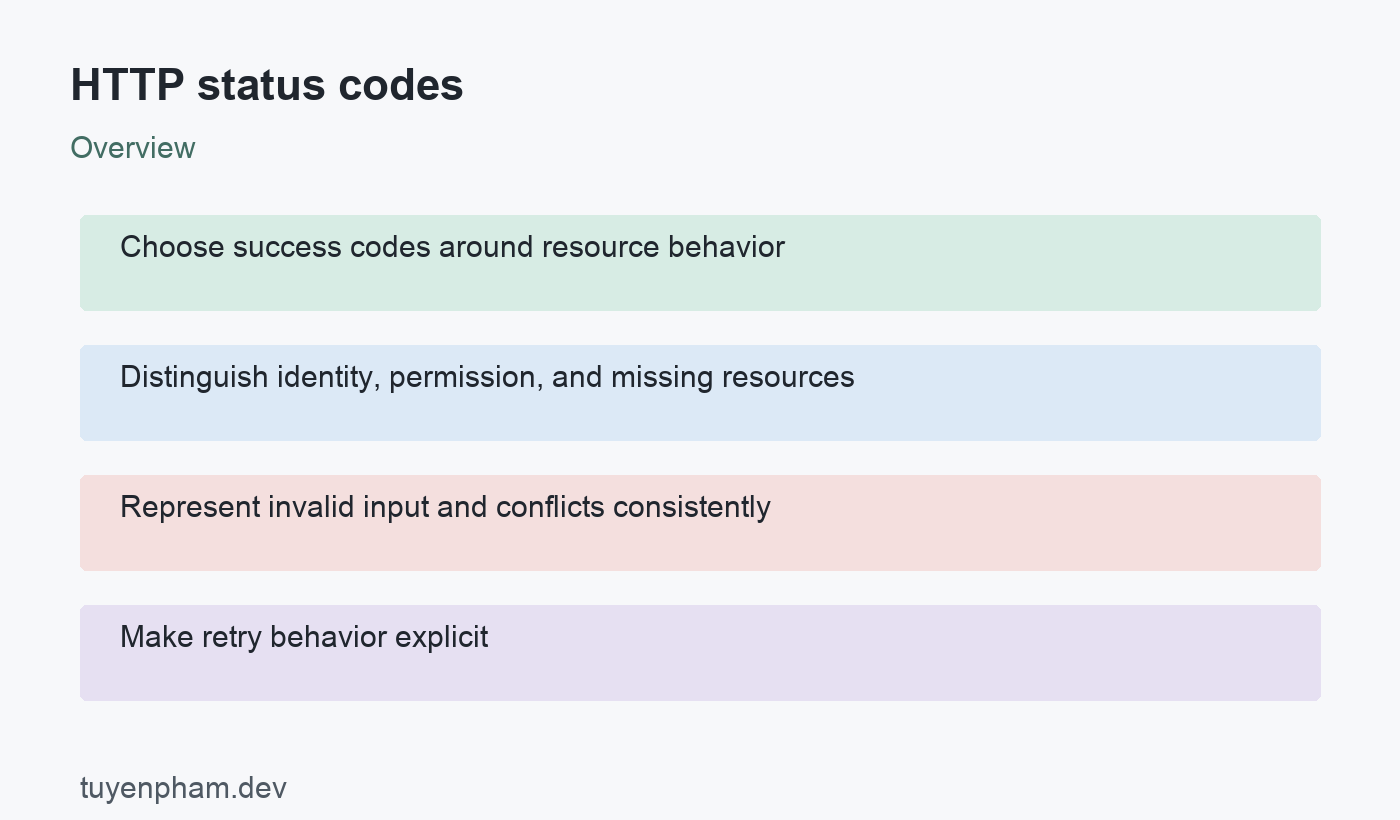
Use 200 for a successful response with a representation, 201 when the request creates a resource, and 204 when there is no response content. For a creation response, include a Location header when appropriate so the client can find the new resource. A 204 response must not contain a body. If a job has only been accepted and will finish later, 202 can describe that state, but the API should also provide a way to inspect its progress or receive completion information.
Distinguish identity, permission, and missing resources
A 401 response indicates missing or invalid authentication credentials and requires an applicable authentication challenge. A 403 response means the server refuses the request; repeating it with the same credentials usually will not help. A 404 response means the target resource is not found or the server chooses not to disclose its existence. Apply authorization before exposing private resource details. Do not use 500 for an expected access denial, since monitoring would then report a product decision as a service incident.
Represent invalid input and conflicts consistently
A malformed request can receive 400. Some APIs use 422 for syntactically valid input that cannot be processed, such as a failed business validation. A 409 is useful for a conflict with current resource state, such as a version mismatch. Choose conventions and document them so clients do not guess. Include stable error identifiers and field-level details where useful. Avoid embedding raw SQL errors, stack traces, session tokens, or internal hostnames in the public error response.
Make retry behavior explicit
A 429 response communicates rate limiting and can include Retry-After. A 503 response can represent temporary service unavailability. Clients should consider request semantics before retrying: an uncertain response to a payment request does not prove that no payment occurred. Idempotency keys or an operation lookup may be necessary. A 500 response should trigger investigation, but it should not automatically cause unlimited retries. Add bounded backoff and a maximum elapsed time when retrying transient failures.
Example and implementation notes
HTTP/1.1 201 Created
Location: /api/tasks/42
Content-Type: application/json

{"id":42,"title":"Review pull request"}

HTTP/1.1 409 Conflict
Content-Type: application/json

{"code":"VERSION_CONFLICT","message":"Reload before saving."}
This example illustrates the core contract rather than a complete production application. Connect it to your real inputs, authentication rules, and failure-handling paths before using it. Check the expected output first, then change one input at a time to verify the assumptions. Keep those checks alongside the implementation so future changes do not silently weaken the behavior.
Verification checklist
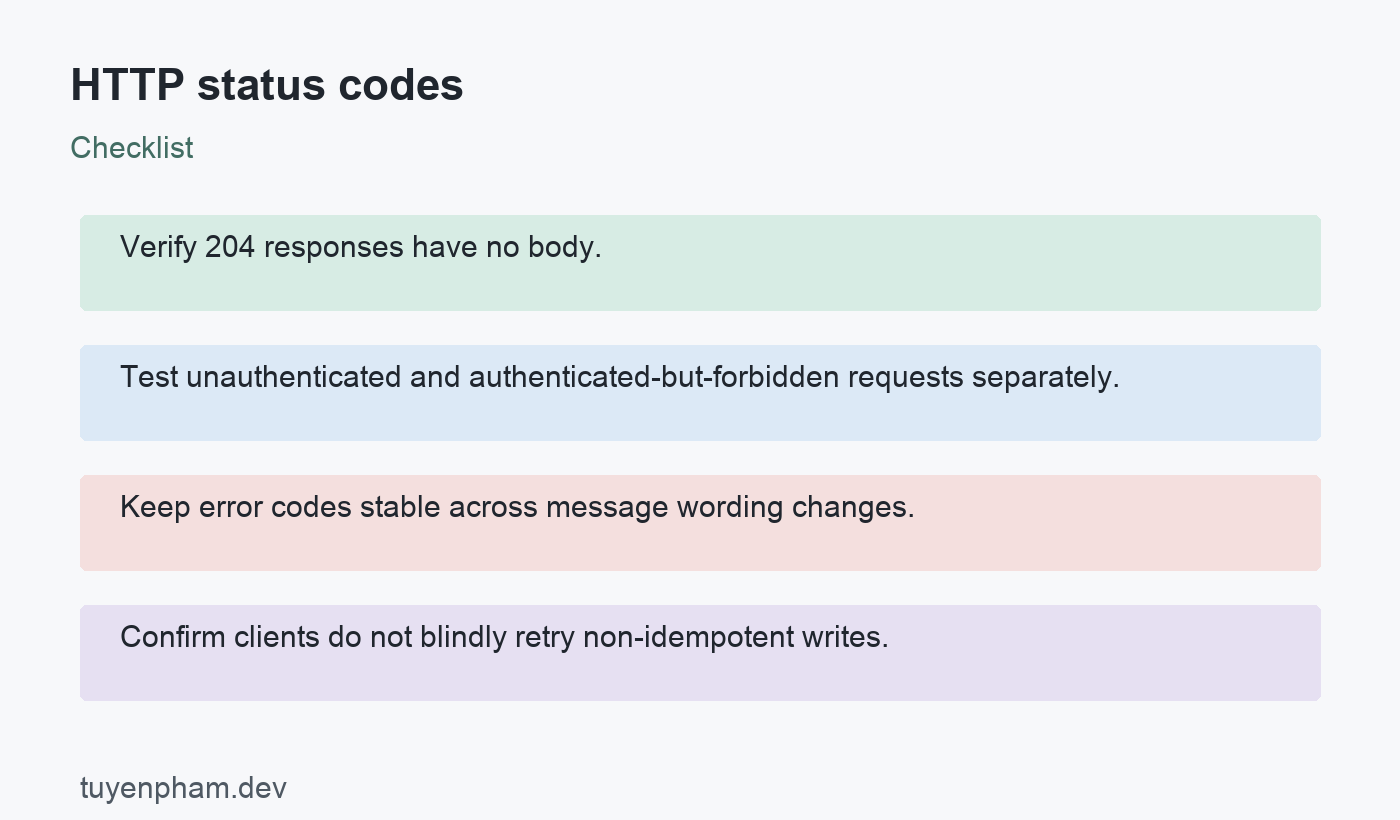
- Verify 204 responses have no body.
- Test unauthenticated and authenticated-but-forbidden requests separately.
- Keep error codes stable across message wording changes.
- Confirm clients do not blindly retry non-idempotent writes.
Practice exercise
Design a task API with create, read, update, and delete endpoints. Write down the status and response shape for a successful operation, missing task, invalid title, absent authentication, and conflicting version. Test these contracts with an HTTP client. Include at least one case where the server completes a write but the client loses the response. Decide how a client can discover the outcome without performing the same operation twice.
Review the result
After completing the exercise, describe the successful path and one failure path in plain language. Record the input, expected result, actual result, and the evidence you used to compare them. A passing demonstration should remain repeatable after a dependency update or a refactor. If you cannot reproduce the result, reduce the example until the source of uncertainty is visible. Keep the smallest useful regression check rather than depending on memory.
References and related reading
Consult the official reference for HTTP status codes for exact platform behavior. Continue with a practical debugging workflow and unit testing basics to turn these decisions into repeatable checks.
Discussion
Join the conversation