Database Indexes: Speed Up Queries Without Guessing

Database indexes help a database find rows without inspecting every row in a table. They can improve filters, joins, sorting, and uniqueness checks, but they consume storage and add work to writes. An index is useful only in relation to queries and data distribution. The right starting point is a slow query with realistic parameters and a recorded execution plan. Adding an index to every column is unlikely to produce a balanced or maintainable database.
database indexes: a practical workflow
The sequence is Real query → Execution plan → Candidate index → Measured result. The sections below explain what each decision changes, which failure cases deserve attention, and how to verify the result in a small project. Use the example as a starting point, then adapt the interfaces and error policy to your own application.
Read the execution plan with realistic data
Use EXPLAIN to inspect the plan and, where safe, EXPLAIN ANALYZE to measure execution. ANALYZE actually executes the statement, so take care with writes or expensive production queries. Compare estimated and actual row counts, time spent in each operation, and the number of rows filtered out. A sequential scan is not automatically bad: it can be faster for a small table or a query returning a large portion of the table. Measure the workload rather than judging one plan node in isolation.
Design composite indexes for the access pattern
A common B-tree use case combines an equality filter with a range or sort requirement. For example, filtering orders by customer and ordering by creation time can benefit from a composite index with customer_id followed by created_at and a stable tie-breaker. Column order matters, but the exact planner behavior depends on the database and version. Avoid reducing all index decisions to a rigid slogan. Consider the full WHERE clause, ORDER BY, join conditions, and the number of rows the endpoint returns.
Understand write cost and selectivity
Each insert or update may need to maintain multiple indexes. Extra indexes can slow ingestion, increase disk use, and make maintenance more expensive. A low-cardinality flag often has limited value as a standalone index, though a selective partial index may help a specific workload. PostgreSQL partial indexes can include only rows satisfying a predicate. Check that your query conditions allow the planner to use the index. Uniqueness indexes also serve a correctness purpose, so do not remove them merely because a read report shows little activity.
Deploy and evaluate indexes carefully
On a busy PostgreSQL table, concurrent index creation can reduce blocking, but it has restrictions and can leave an invalid index if it fails. Follow the database documentation and your migration tooling rules. Compare latency, buffer activity, write throughput, and storage before and after the change. Use realistic query parameters and enough samples to avoid relying on cache warmth alone. Remove redundant indexes only after checking constraints, related queries, and production workload evidence.
Example and implementation notes
CREATE INDEX orders_customer_created_idx
ON orders (customer_id, created_at DESC, id DESC);

EXPLAIN ANALYZE
SELECT id, created_at FROM orders
WHERE customer_id = 42
ORDER BY created_at DESC, id DESC
LIMIT 20;
This example illustrates the core contract rather than a complete production application. Connect it to your real inputs, authentication rules, and failure-handling paths before using it. Check the expected output first, then change one input at a time to verify the assumptions. Keep those checks alongside the implementation so future changes do not silently weaken the behavior.
Verification checklist
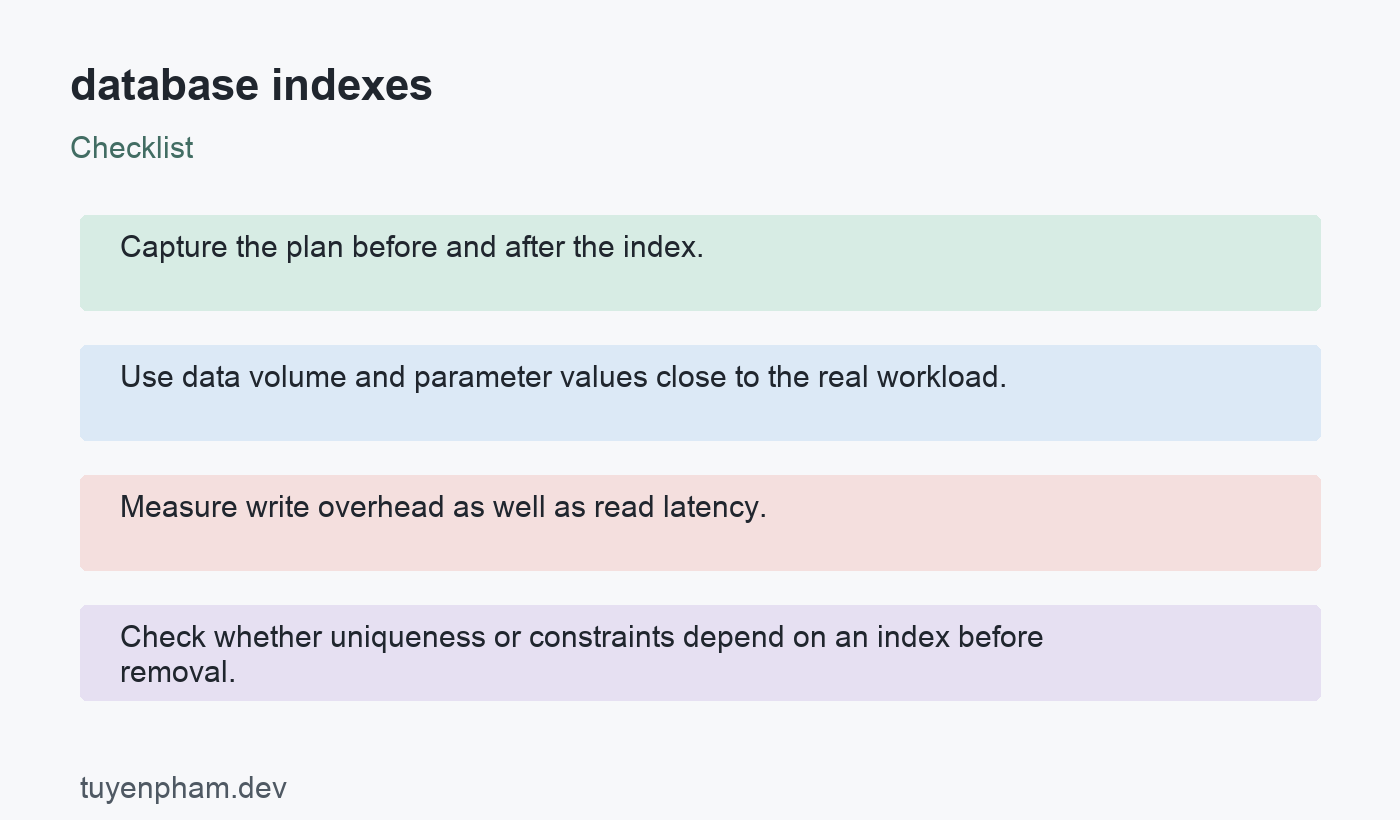
- Capture the plan before and after the index.
- Use data volume and parameter values close to the real workload.
- Measure write overhead as well as read latency.
- Check whether uniqueness or constraints depend on an index before removal.
Practice exercise
Generate a disposable orders table with many customers and uneven order counts. Measure a recent-orders query for both a frequent customer and an infrequent customer. Add the composite index and compare plans and execution times. Repeat after warming the cache to understand why one timing is not enough. Measure insert throughput with and without the index. Write down the benefit, the additional storage, and the workload under which you would keep it.
Review the result
After completing the exercise, describe the successful path and one failure path in plain language. Record the input, expected result, actual result, and the evidence you used to compare them. A passing demonstration should remain repeatable after a dependency update or a refactor. If you cannot reproduce the result, reduce the example until the source of uncertainty is visible. Keep the smallest useful regression check rather than depending on memory.
References and related reading
Consult the official reference for database indexes for exact platform behavior. Continue with a practical debugging workflow and unit testing basics to turn these decisions into repeatable checks.
Discussion
Join the conversation