Cache Invalidation: Keep Fast Responses Consistent with Data

Cache invalidation decides when a stored response or computed value stops being trustworthy. Caching can reduce latency and backend load, but it introduces another copy of data with its own lifetime. A useful policy starts with the maximum staleness the product can tolerate. A public article can often tolerate a short delay after an edit; permissions or account balances may need much stronger freshness. Identify the cache layer before changing settings, because browser, CDN, application, and database caches obey different controls.
cache invalidation: a practical workflow
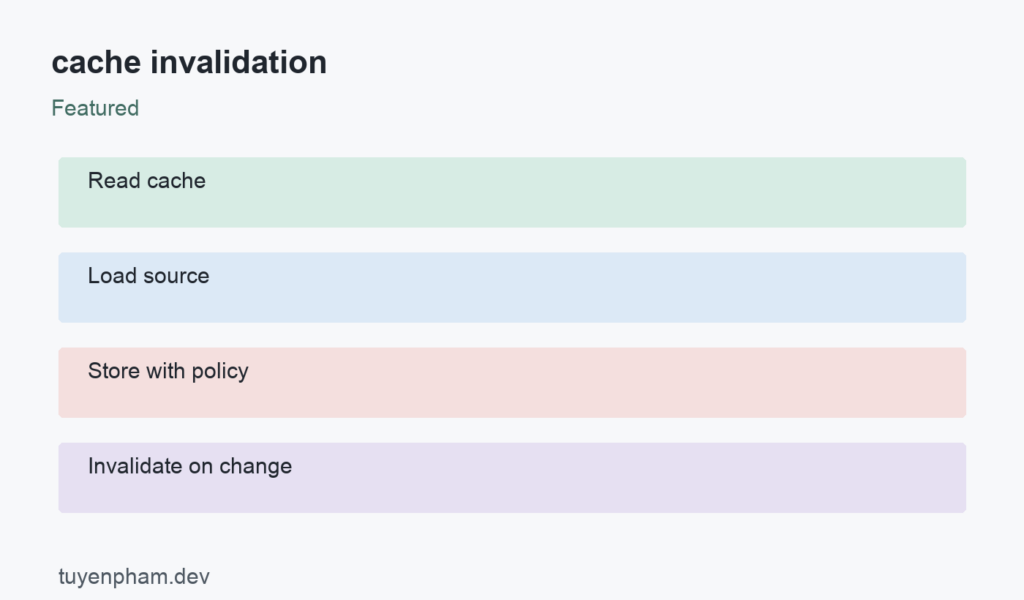
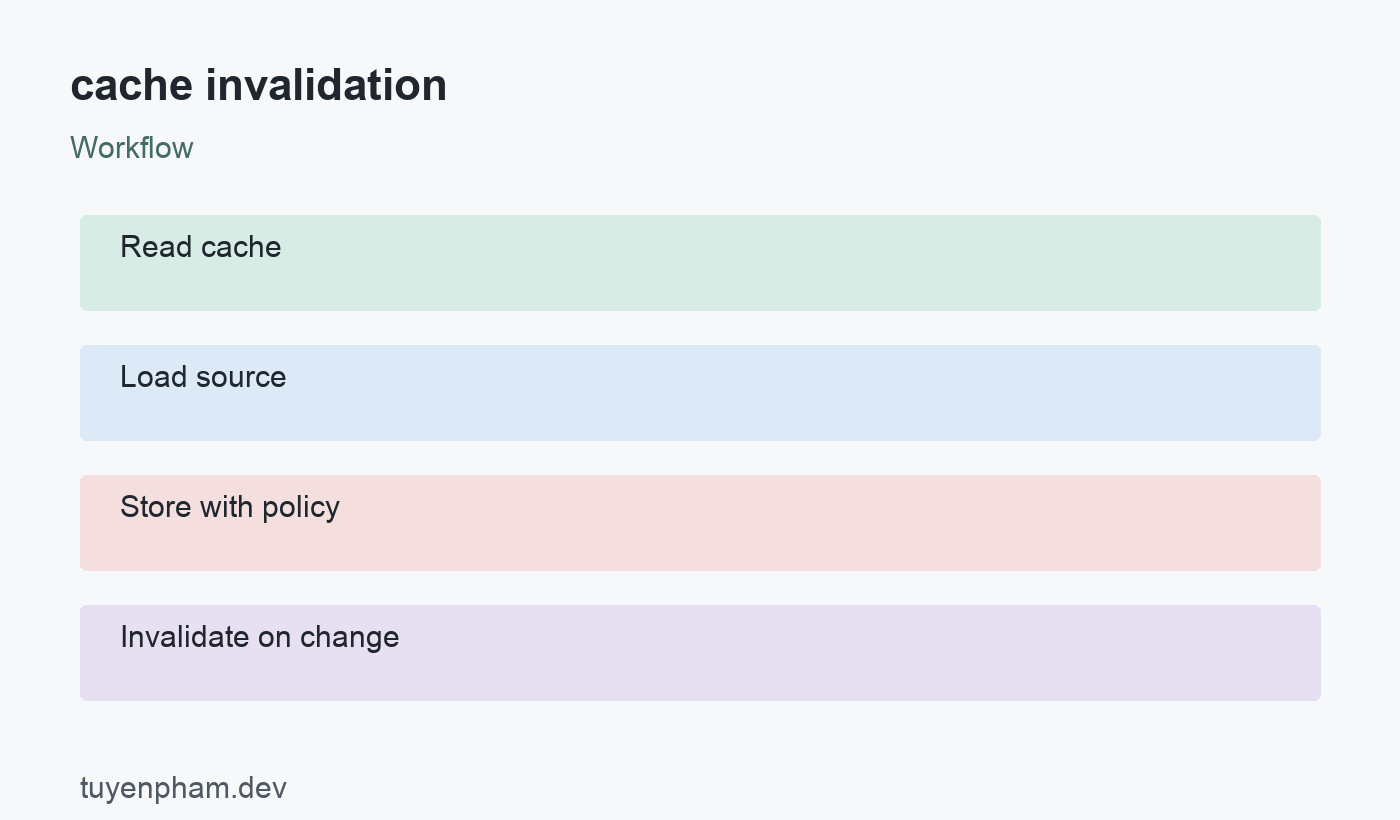
The sequence is Read cache → Load source → Store with policy → Invalidate on change. The sections below explain what each decision changes, which failure cases deserve attention, and how to verify the result in a small project. Use the example as a starting point, then adapt the interfaces and error policy to your own application.
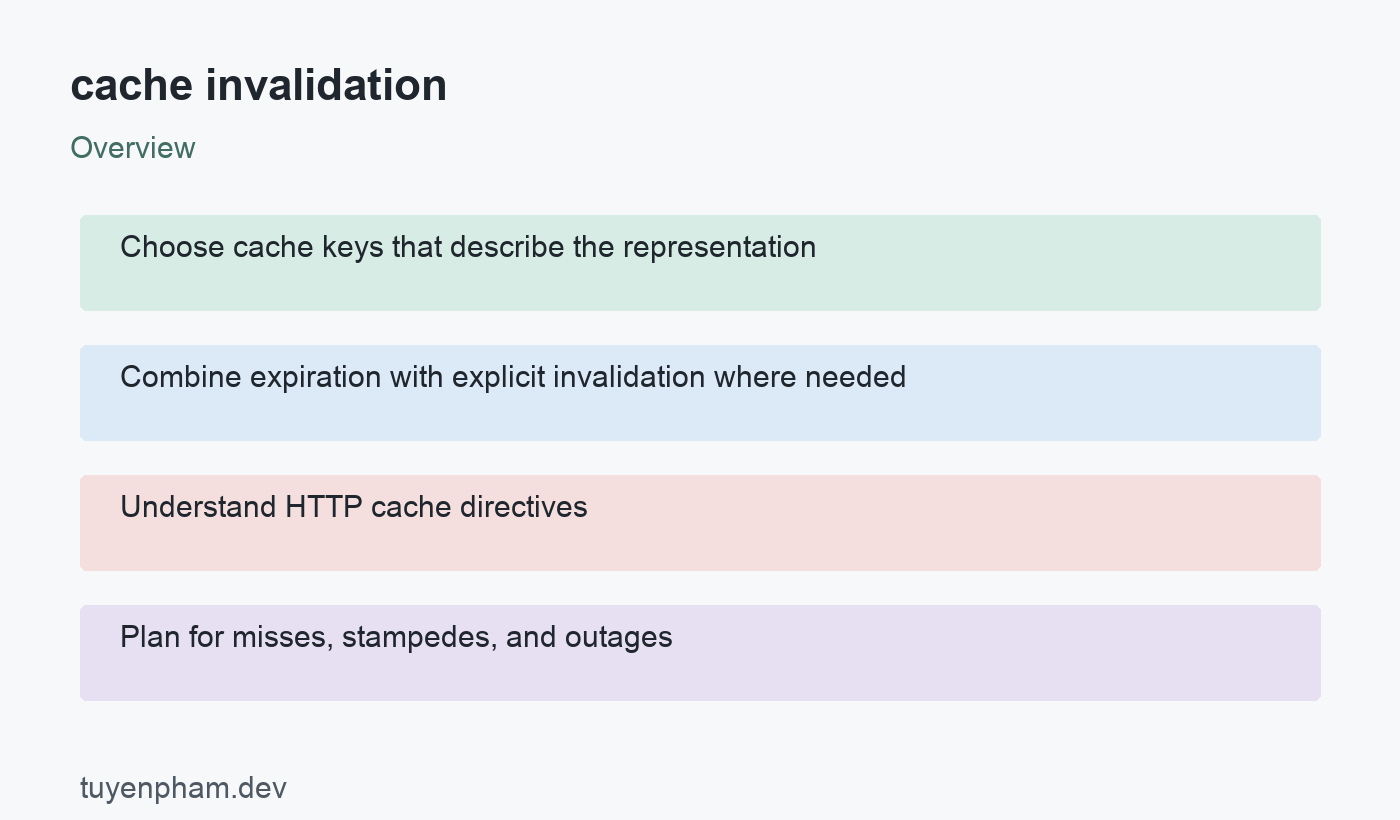
Choose cache keys that describe the representation
A key must distinguish every input that changes the cached result. That may include resource identifier, locale, filter parameters, and permission scope. Omitting a user or tenant boundary can leak private information across requests. Normalize equivalent query parameters to avoid unnecessary duplicate entries. Add a version when the cached payload schema changes. A hash can shorten a long key, but it does not fix an incomplete definition of what makes two responses different.
Combine expiration with explicit invalidation where needed
A time-to-live limits how long a value survives, but it does not guarantee immediate freshness after a write. Explicit invalidation can remove affected entries when source data changes. Coordinate invalidation with successful persistence so a failed write does not incorrectly advertise new state. Deleting a cache key can race with another request that is loading older data. For stronger consistency, consider versioned keys or a design that makes the source version part of the read and write process.
Understand HTTP cache directives
Cache-Control: no-cache allows storage but requires validation before reuse; no-store tells caches not to store the response. Private prevents shared caches from storing a response intended for one user. Public content can use max-age and validators such as ETag, with a 304 response when the representation is unchanged. Avoid assuming these directives control an application-level Redis entry. Inspect Age, Cache-Control, and conditional requests to determine which layer is serving a stale response.
Plan for misses, stampedes, and outages
If a popular entry expires, many requests can hit the origin at once. Request coalescing, carefully bounded locks, TTL jitter, or stale-while-revalidate policies can reduce the spike. Serving stale data is a product decision and is inappropriate for some sensitive state. Decide whether a cache outage should bypass the cache or fail the request. Monitor hit ratio together with response latency and origin load; a high hit ratio is not success if the cached content is incorrect.
Example and implementation notes
async function getProduct(id) {
  const key = `product:v1:${id}`;
  const cached = await cache.get(key);
  if (cached !== null) return JSON.parse(cached);
  const product = await database.findProduct(id);
  if (product !== null) {
    await cache.set(key, JSON.stringify(product), { ttlSeconds: 60 });
  }
  return product;
}
// After a successful product update: invalidate the affected key.
This example illustrates the core contract rather than a complete production application. Connect it to your real inputs, authentication rules, and failure-handling paths before using it. Check the expected output first, then change one input at a time to verify the assumptions. Keep those checks alongside the implementation so future changes do not silently weaken the behavior.
Verification checklist
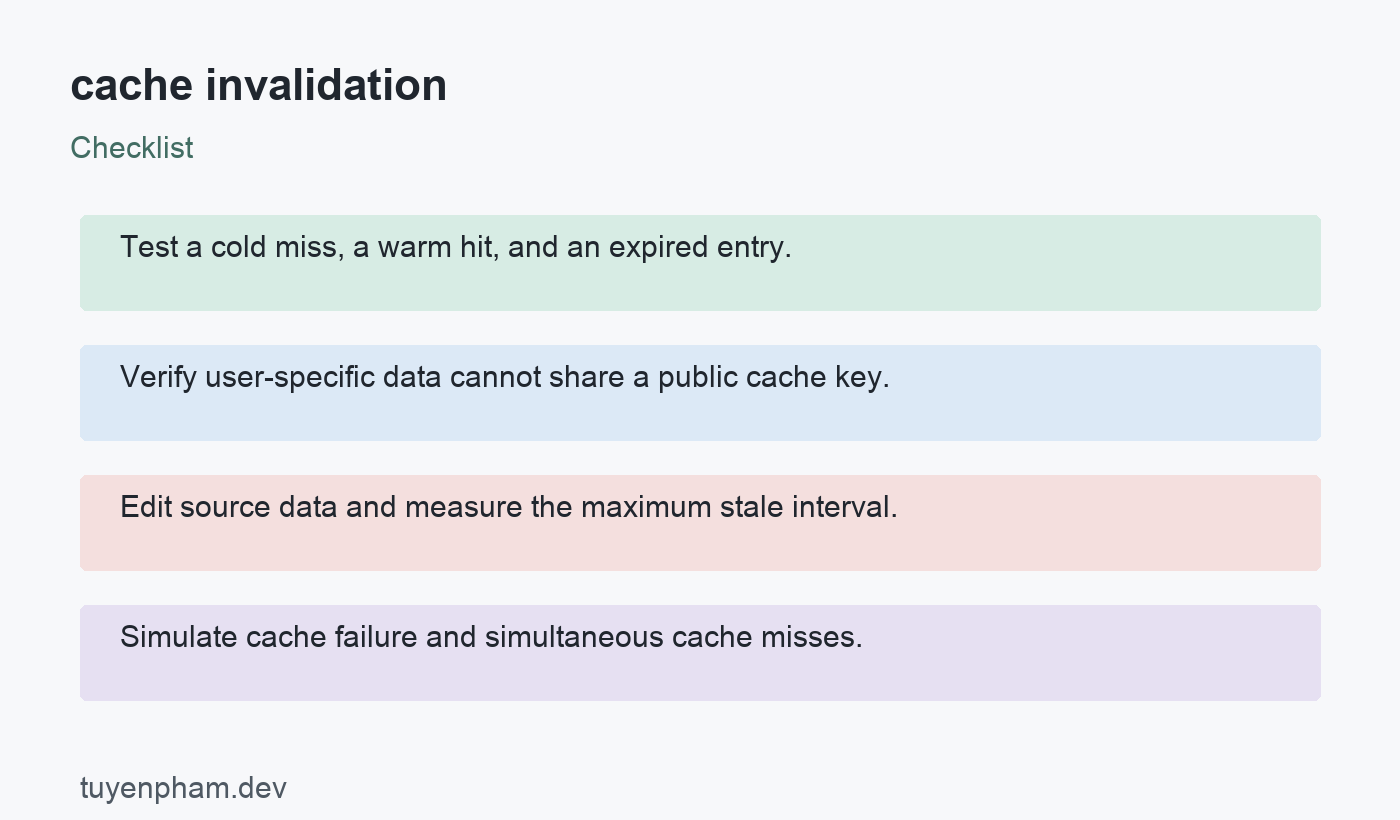
- Test a cold miss, a warm hit, and an expired entry.
- Verify user-specific data cannot share a public cache key.
- Edit source data and measure the maximum stale interval.
- Simulate cache failure and simultaneous cache misses.
Practice exercise
Cache a product detail endpoint with a short TTL. Add an update operation that invalidates its entry after the database write succeeds. Trigger a slow read at the same time as an update and inspect whether the older read repopulates the cache. Document the race and choose an acceptable policy. Then clear the popular key under concurrent load and measure backend requests. This experiment shows why freshness and load control need separate evidence.
Review the result
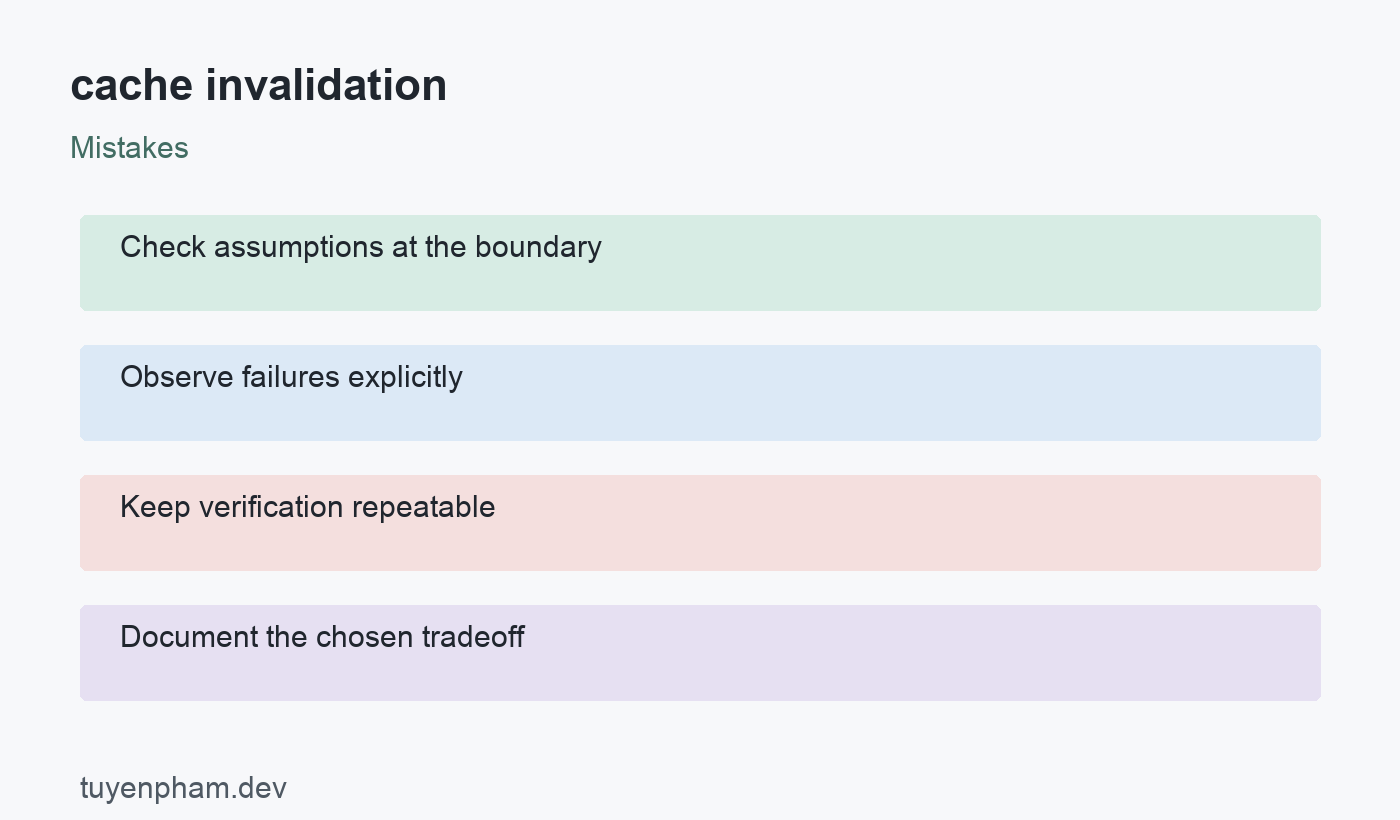
After completing the exercise, describe the successful path and one failure path in plain language. Record the input, expected result, actual result, and the evidence you used to compare them. A passing demonstration should remain repeatable after a dependency update or a refactor. If you cannot reproduce the result, reduce the example until the source of uncertainty is visible. Keep the smallest useful regression check rather than depending on memory.
References and related reading
Consult the official reference for cache invalidation for exact platform behavior. Continue with a practical debugging workflow and unit testing basics to turn these decisions into repeatable checks.
Discussion
Join the conversation