Pagination SEO: Make Every Useful List Page Discoverable

Pagination SEO makes a multi-page collection understandable and discoverable. Blog archives and product categories often split a long list into manageable pages. A visitor can click a next button, but a crawler needs accessible URLs and links to reach the remaining items. Infinite scrolling and load-more controls can improve a user interface without replacing that discovery requirement. Treat the collection as a set of useful pages, then verify that deeper items remain reachable through the rendered links.
pagination SEO: a practical decision process
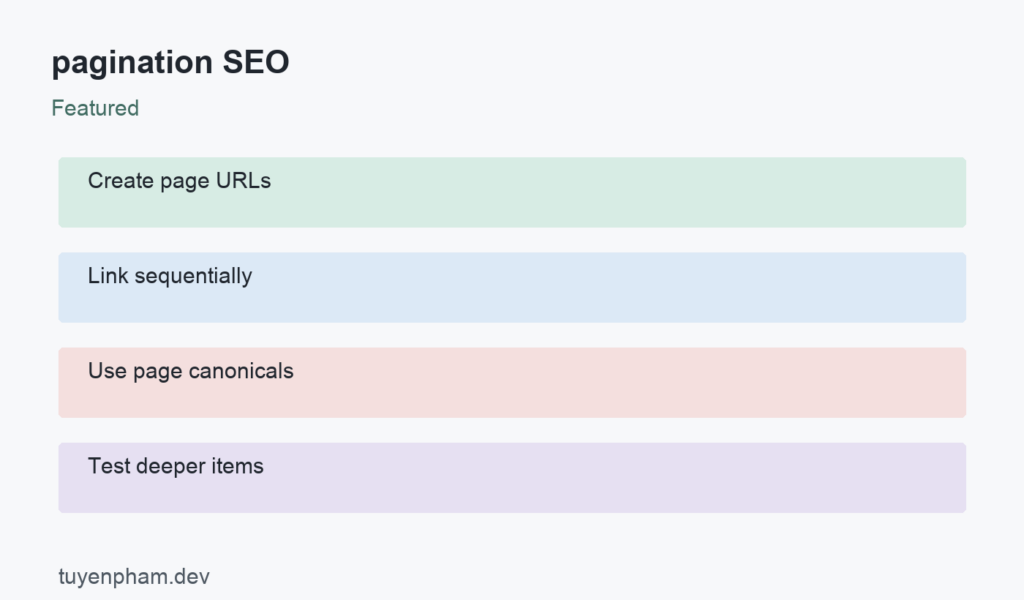
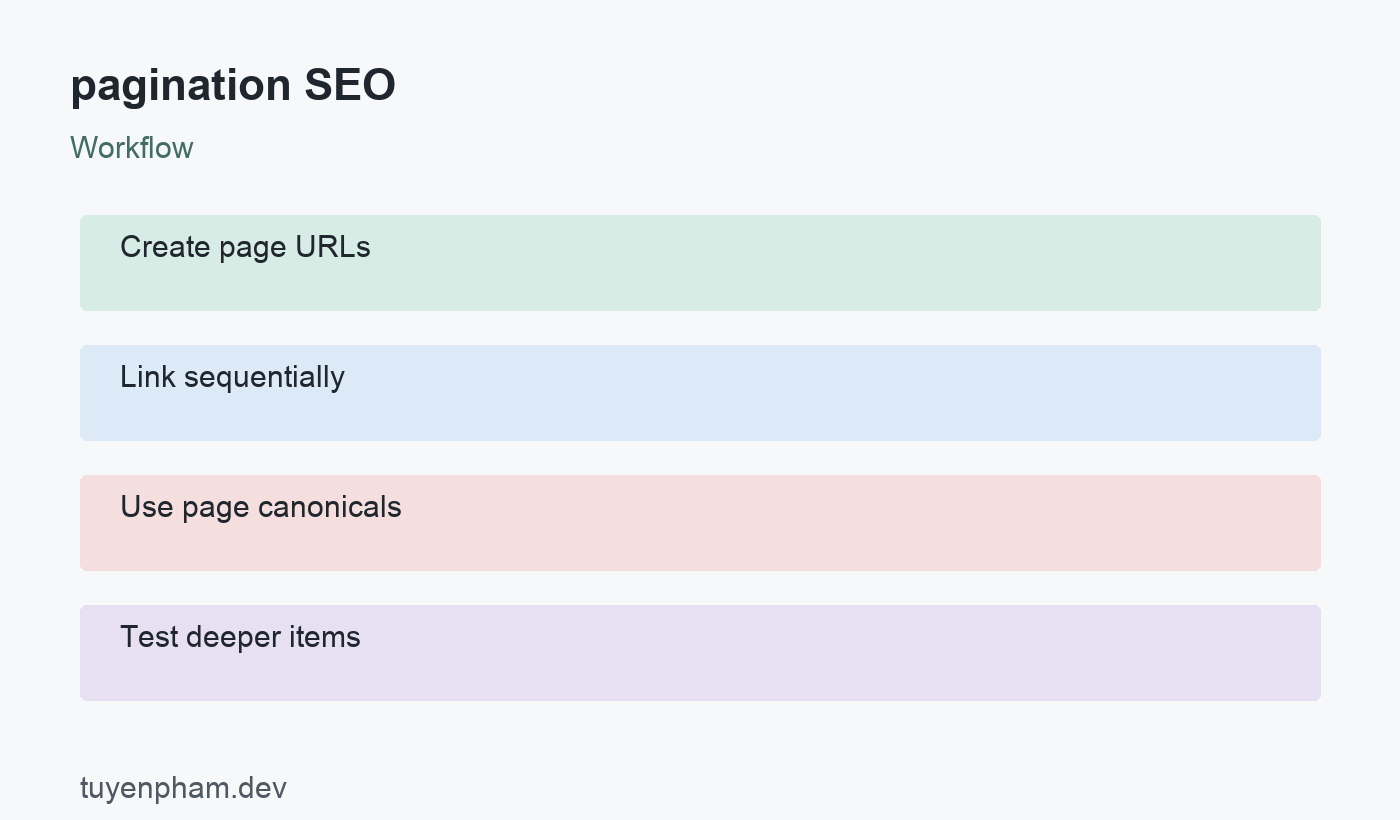
Follow this sequence: Create page URLs → Link sequentially → Use page canonicals → Test deeper items. Use it to organize the work, then verify the editorial and technical choices described below. The example is hypothetical and illustrates the decision rather than claiming a measured ranking result.
Give each segment an accessible URL
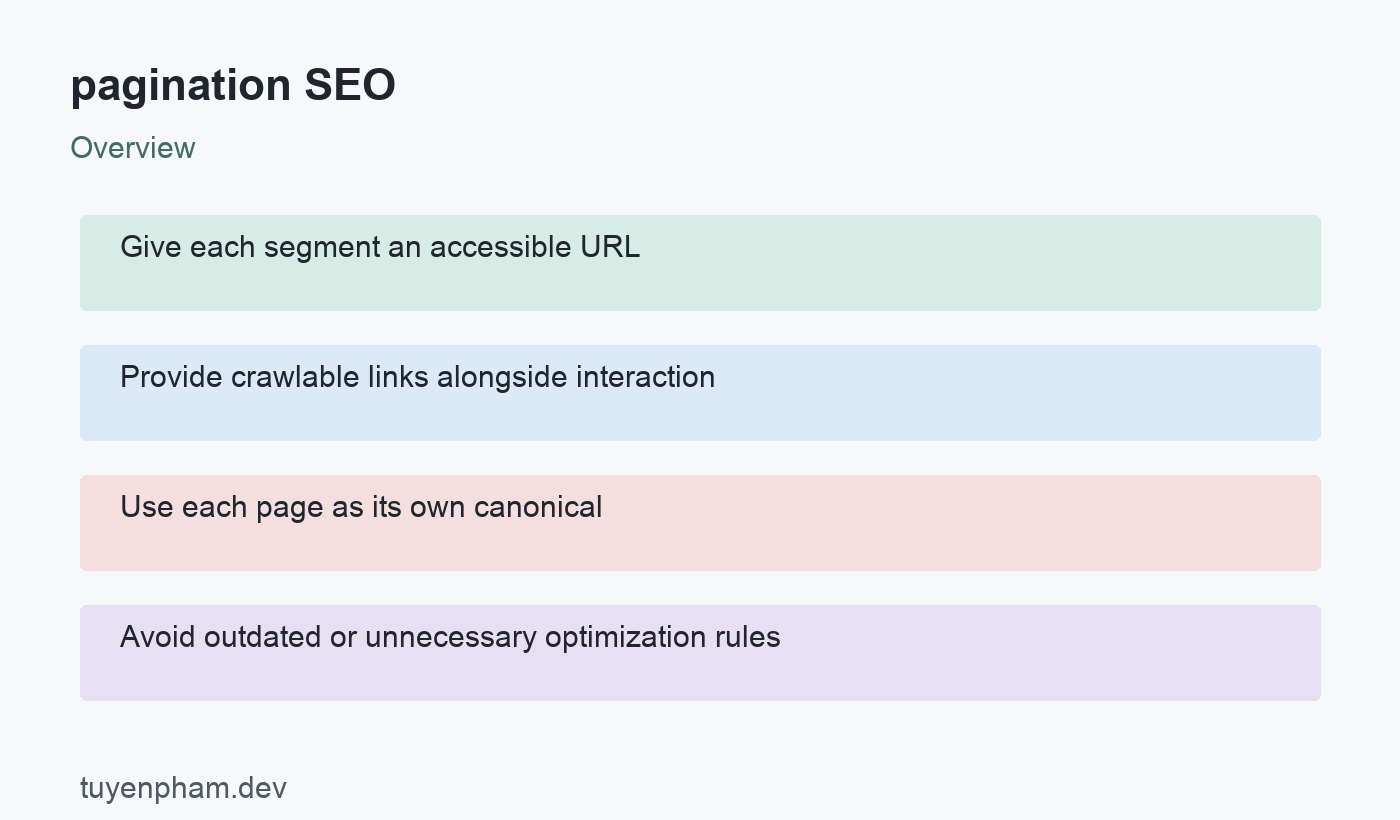
Use a unique URL for each page in the sequence, such as /articles/?page=2 or a consistent path-based equivalent. Do not rely only on fragment identifiers for page numbers; Google generally ignores fragments when identifying separate pages. Opening a page URL directly should return its intended segment, not silently reset to page one. Check invalid page numbers and pages beyond the end of the sequence. Maintain stable behavior as items are added, removed, or reordered.
Provide crawlable links alongside interaction
Link to the next page with ordinary anchors containing href values. Previous-page and first-page links can also help visitors understand the sequence. A button that only triggers JavaScript does not provide the same discovery path. For infinite scroll, expose paginated component URLs and links that work independently of a scroll action. Google generally does not trigger interactive controls like a user would. Test the rendered HTML and direct requests rather than assuming visual scrolling proves all content is discoverable.
Use each page as its own canonical
Google recommends that a page in a paginated sequence have its own canonical URL instead of pointing every page to the first page. Page two contains different items, so declaring it a duplicate of page one can work against the intended discovery strategy. Distinguish true duplicate parameter variants from genuine pagination. Sort-order and incidental filter URLs may need a separate policy. Keep canonical signals consistent with internal links and avoid treating canonicalization as a replacement for a working page sequence.
Avoid outdated or unnecessary optimization rules
Google no longer uses rel next and rel prev link tags to identify pagination relationships, though other consumers may use them. They do not replace crawlable anchors. Google also says pages in a sequence can share titles and descriptions; unique wording for every numbered page is not a universal requirement. Rank Math explains self-referencing canonicals and WordPress pagination checks. Use that practical guidance with the current Google documentation instead of assuming that repeated archive metadata automatically creates a penalty.
Check item discovery and maintain the experience
Choose items on later pages and verify a crawl path from the collection to those item URLs. Sitemaps can support discovery but do not repair broken navigation. Watch for duplicate items, gaps, slow page requests, and mobile controls that shift unexpectedly. If ordering changes frequently, design a predictable visitor experience without claiming pagination creates a permanent snapshot. Evaluate indexability according to the usefulness of the pages and the site structure rather than setting every deeper page to noindex by habit.
Worked example
A blog archive has a working Load More button, but its initial HTML contains no link to page two. Articles after the first segment can only be loaded through an interactive request. The fix exposes /blog/page/2/ with a normal next link while retaining the button for users. Page two returns its own article segment and canonical. A test follows the link sequence to a late article and confirms the article URL can be reached without scrolling or clicking a script-only control.
Implementation checklist
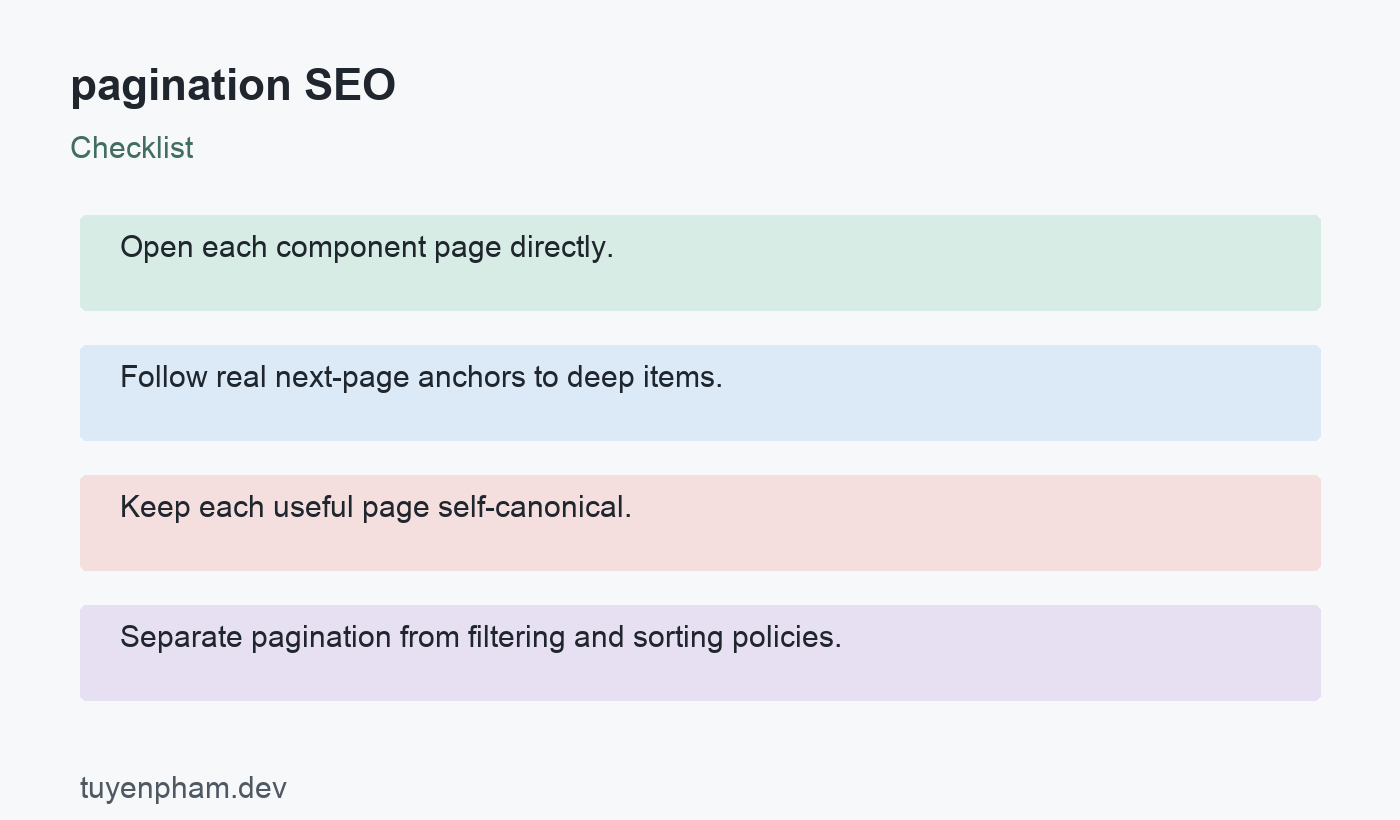
- Open each component page directly.
- Follow real next-page anchors to deep items.
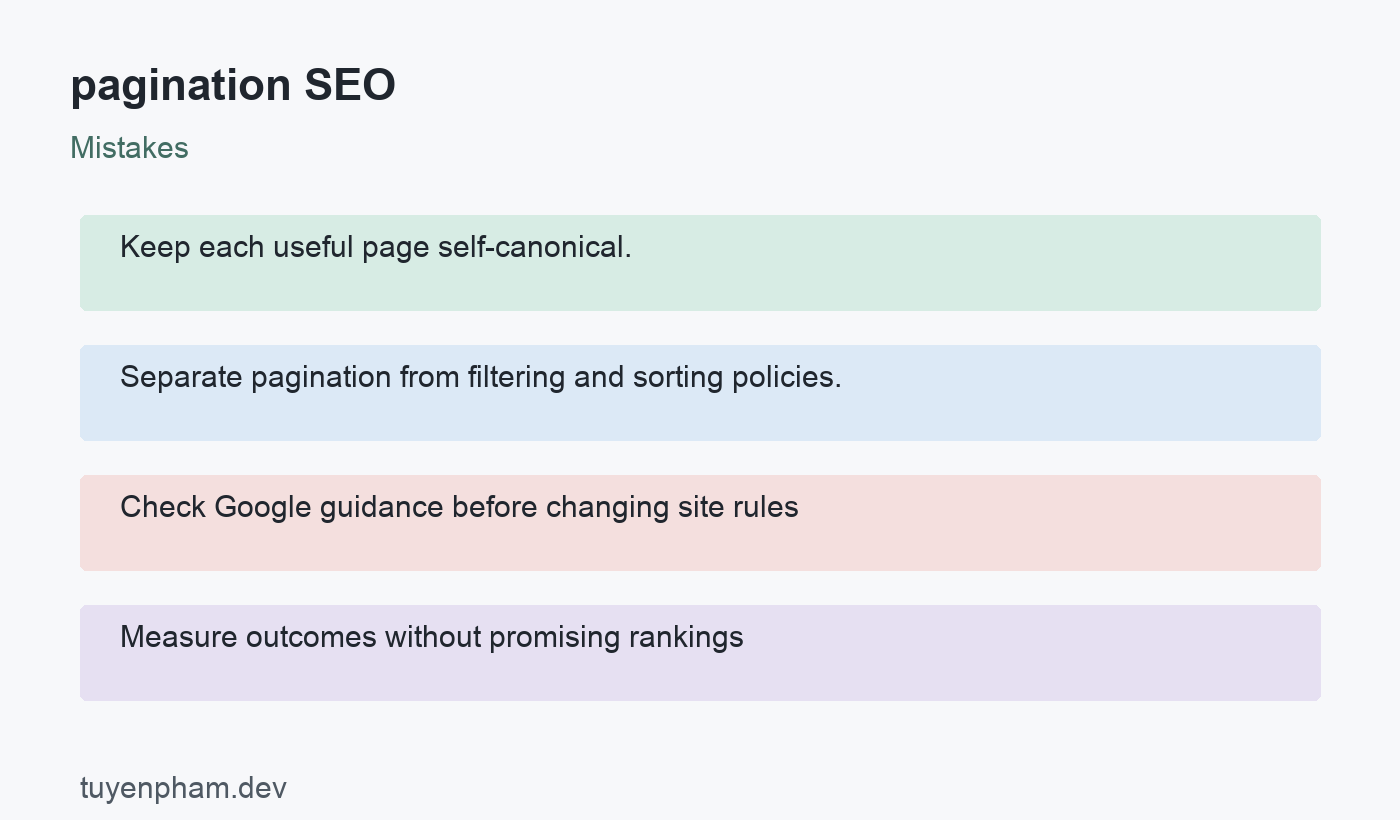
- Keep each useful page self-canonical.
- Separate pagination from filtering and sorting policies.
A focused task for your website
Audit a collection with at least four pages. Request page one, page two, and the final page directly. Inspect next links and canonical output, then disable JavaScript or use a crawler to test item discovery. Check behavior for a missing page and a page beyond the end. Record whether load-more behavior has an independent URL fallback. Recheck the sequence after inserting or removing items so the pagination implementation remains useful as the collection changes.
References and next steps
Consult Google Search Central documentation for the relevant search requirements and Rank Math guidance on this topic for practical workflows. Continue with Javascript Seo and the SEO audit checklist for related implementation checks.
Discussion
Join the conversation