Broken Links SEO: Prioritize Real Failures and Repair the Right URLs

Broken links SEO starts with a user problem: a link no longer reaches the resource it promises. The cause may be a deleted page, a typing error, a server failure, or an external destination that changed. Not every reported failure needs a redirect, and not every 404 is a site-wide SEO emergency. Identify the source link, verify the response, and choose a repair that preserves a useful path. Prioritization should reflect reader impact and the importance of the affected destination.
broken links SEO: a practical workflow
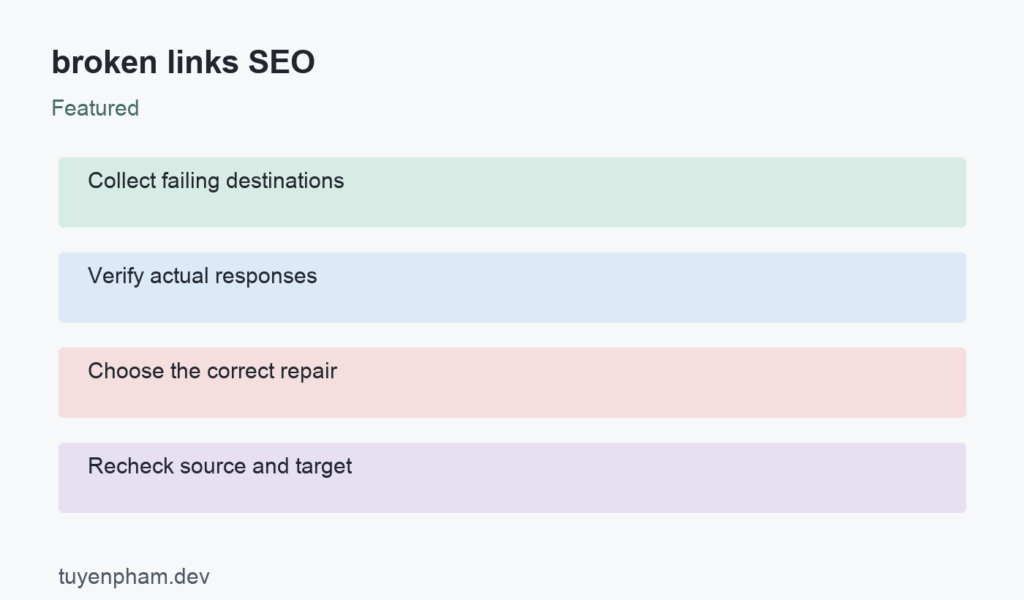
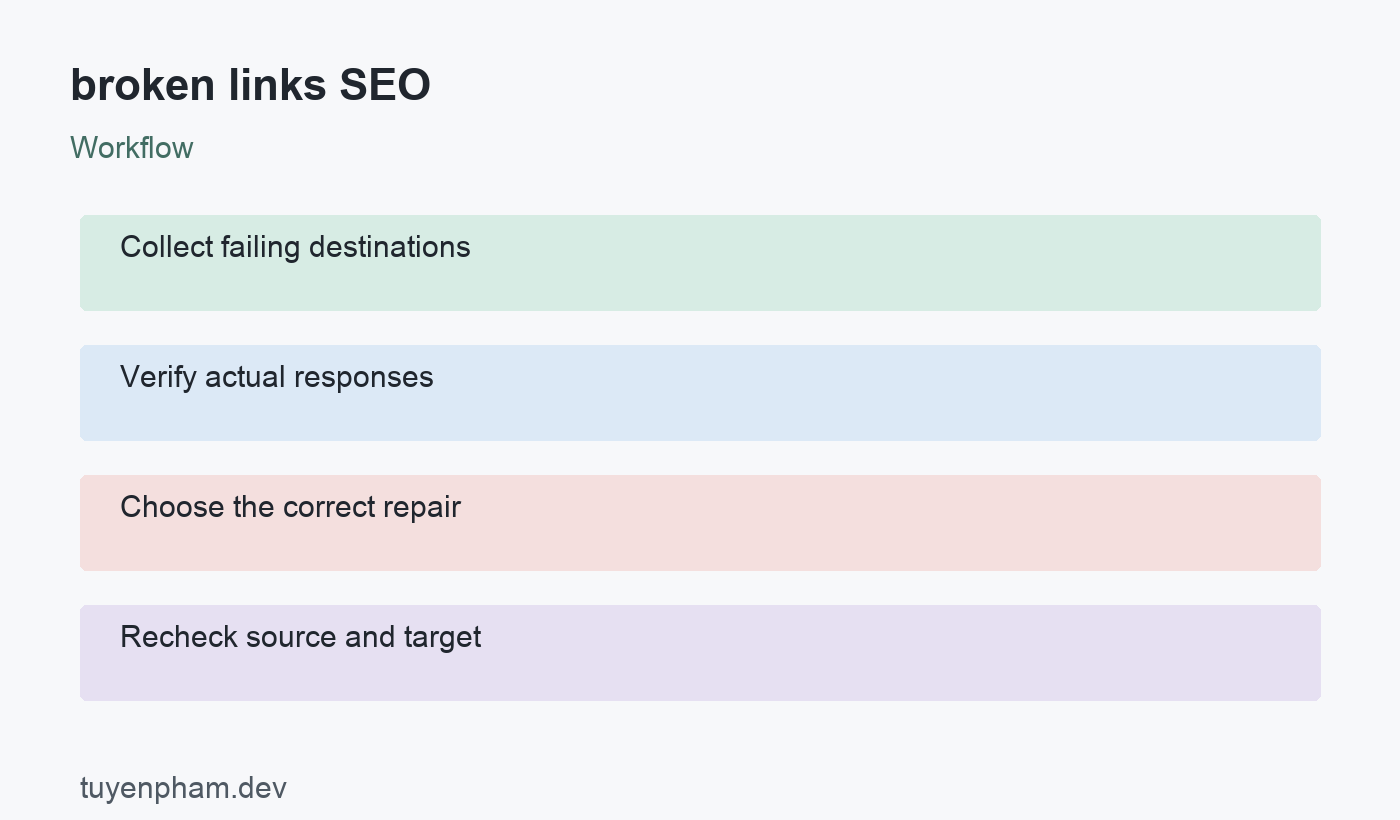
Use this sequence to organize the work: Collect failing destinations → Verify actual responses → Choose the correct repair → Recheck source and target. The sections below explain the evidence, decisions, and limitations at each stage. The worked example is hypothetical and illustrates a process rather than a measured result from this website.
Collect findings from more than one signal
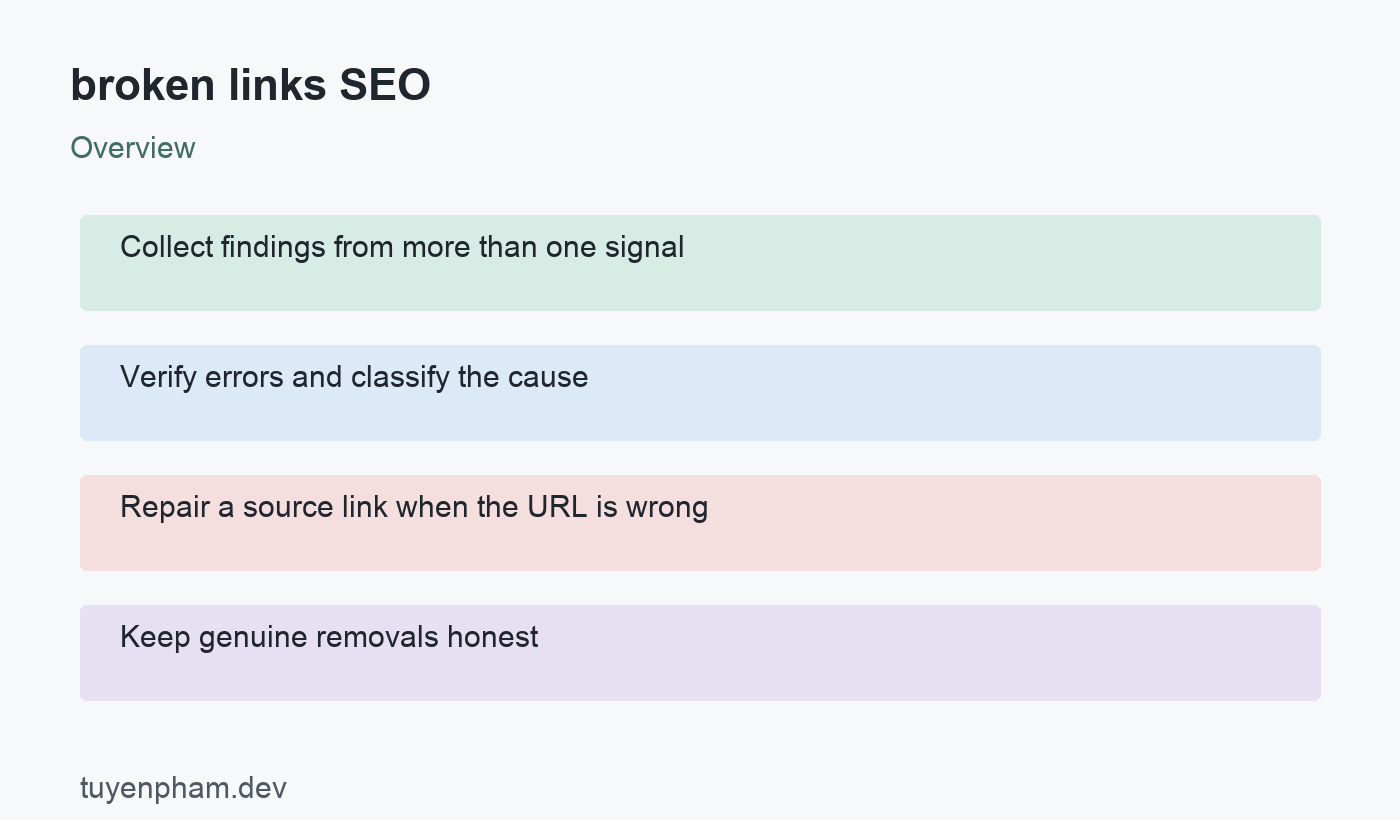
A crawl can identify links from reachable pages to failing destinations. Server or CDN logs can show requests for old paths, while a WordPress 404 monitor records errors that reach its application layer. Search Console and external references may expose additional URLs. These signals answer different questions: a requested missing URL is not necessarily linked from your site. Keep the source page and referrer where available. Avoid calling an error report a complete outbound-link audit unless it actually checks the source links.
Verify errors and classify the cause
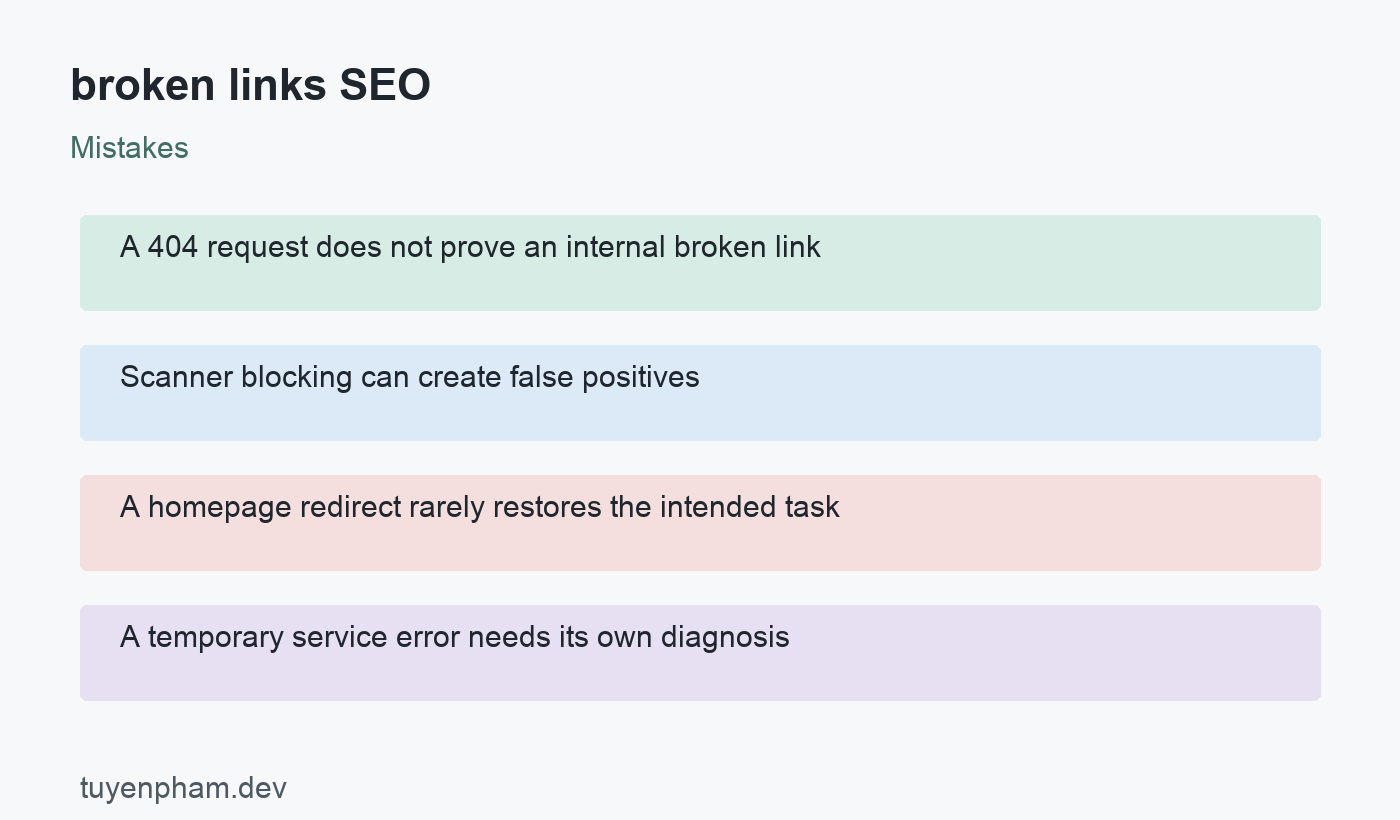
Request the destination and inspect the final status and content. A transient timeout or rate limit may require a recheck rather than an editorial change. Some external sites block automated scanners while remaining accessible to normal visitors. A soft 404 can return 200 while displaying a missing-content message, so status alone is not sufficient. Google documents how different HTTP responses affect crawling and indexing. Distinguish missing content from access restrictions, redirect loops, and server errors before choosing a fix.
Repair a source link when the URL is wrong
If the intended resource exists at another address, update the link on the source page to its final correct URL. For an external reference, confirm that the replacement still supports the claim. Remove or rewrite the surrounding statement if no suitable source remains. For internal legacy URLs, a permanent redirect may also be appropriate for old bookmarks and external links. Updating the source avoids repeatedly sending visitors through a redirect when the current destination is already known.
Keep genuine removals honest
When a resource has disappeared with no relevant replacement, a proper not-found or gone response can be appropriate. Do not redirect every error to the homepage or an unrelated category; that gives visitors a destination that does not fulfill the original link. A helpful error page can offer navigation while preserving the correct HTTP status. Rank Math provides 404 monitoring and redirect workflows, but each mapping still requires a semantic decision. A cleaner report is not useful if the redirects become misleading.
Prioritize and verify the repaired journey
Fix failures in checkout, service evaluation, key navigation, and heavily used reference paths before random bot requests for nonexistent filenames. Investigate repeated infrastructure errors with the technical owner. After a repair, test both source and target, then recheck related templates so the bad link does not return. Review legitimate 404s separately from preventable broken navigation. Avoid claiming a guaranteed ranking increase from reducing the count. The clearest benefit is a more reliable experience and fewer wasted paths.
Worked example
A service article links to an internal guide with a misspelled slug. The guide exists, so the team corrects the source anchor. A deleted historical event page has no equivalent replacement and keeps a helpful 404 response. A third URL returns a temporary 503 because the origin is unavailable; it requires infrastructure diagnosis, not a redirect to another article. Treating all three as the same issue would obscure the real repair and could create new user confusion.
Verification checklist
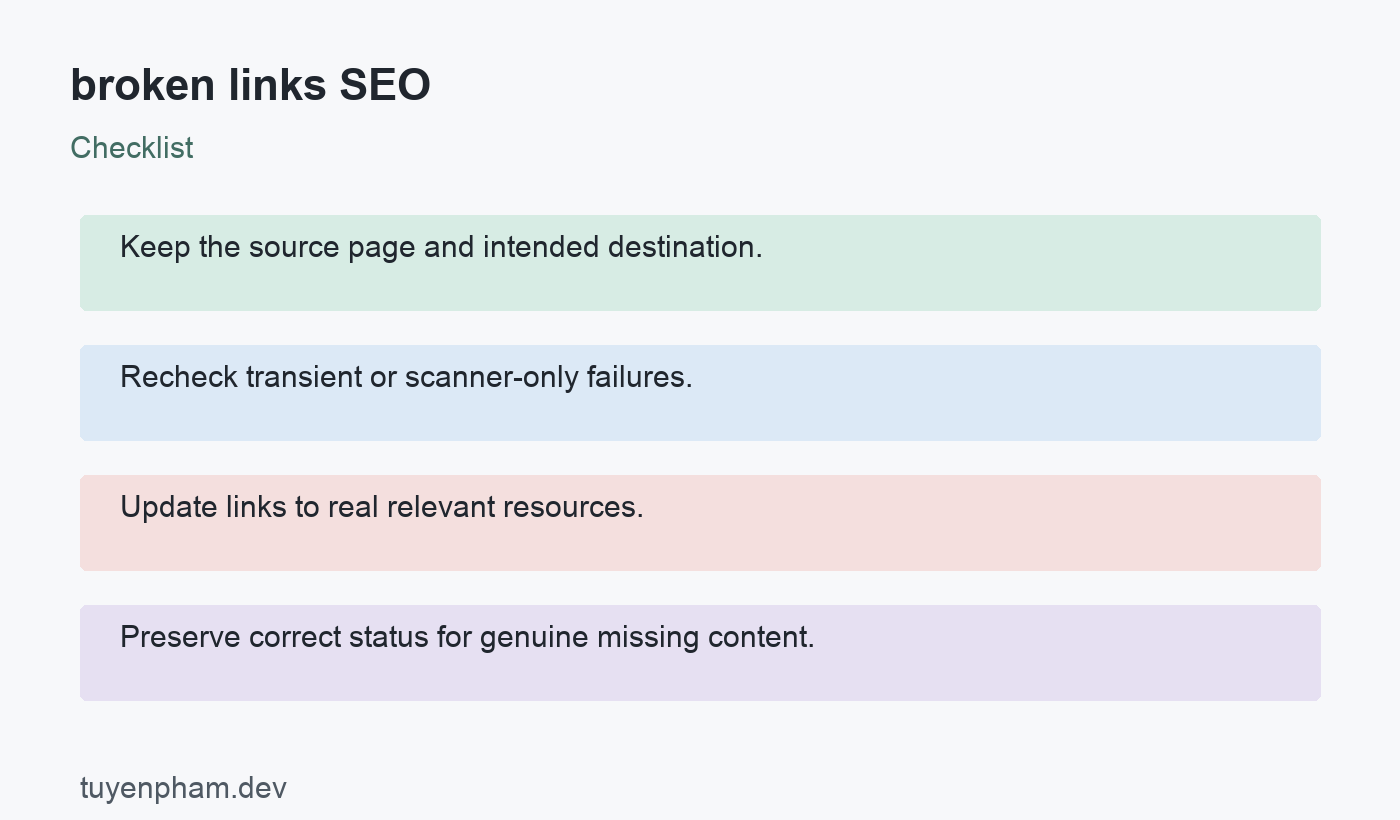
- Keep the source page and intended destination.
- Recheck transient or scanner-only failures.
- Update links to real relevant resources.
- Preserve correct status for genuine missing content.
A focused task for your website
Collect ten failing link findings and classify them as a wrong URL, moved resource, genuine removal, restricted destination, or transient service failure. Prioritize by reader impact. Repair one source link and one justified legacy redirect, then test the full route. Do not alter unrelated missing paths only to reduce a report total. Schedule a focused recheck after major content or template changes and keep responsibility for important navigation paths clear.
References and related reading
Review Google Search Central documentation for the relevant platform guidance, and Rank Math guidance for the related workflow for practical SEO checks. Continue with Redirect Chains Seo and the SEO audit checklist to connect this task with the rest of your site review.
Discussion
Join the conversation