Redirect Chains SEO: Send Old URLs Straight to Relevant Destinations

Redirect chains SEO focuses on URLs that reach their final destination through several redirects. A chain might grow after a domain migration, an HTTPS change, and later slug edits. Redirects can preserve access to moved content, but unnecessary hops add latency and make troubleshooting harder. The objective is a clear route from an old URL to the relevant current page. Do not replace considered redirect mapping with a rule that sends every missing page to the homepage.
redirect chains SEO: a practical decision process
Follow this sequence: Trace every hop → Confirm destination → Shorten route → Update internal links. Use it to organize the work, then verify the editorial and technical choices described below. The example is hypothetical and illustrates the decision rather than claiming a measured ranking result.
Trace the complete route before changing it
Record the response code and Location value for every hop, including protocol and hostname changes. Test representative variants such as HTTP, HTTPS, www, non-www, old paths, and trailing slashes. A browser may hide the intermediate steps, so use a tool that exposes headers. Check for loops and destinations that return errors or redirect again. Note which layer owns each hop: CDN, web server, WordPress, or an SEO plugin. Editing one layer without understanding the others can create a new conflict.
Choose status codes from the actual move
Google documents permanent redirects such as 301 and 308 as strong signals that the target should be canonical. Temporary redirects such as 302 and 307 describe a different relationship. Choose based on whether the move is permanent, not on a simplistic claim that one code always improves rankings. Method handling also differs between redirect types, which matters for application requests. For a normal permanently moved article, map the old URL to its current relevant replacement and test the final response.
Flatten chains where the mapping is still correct
If A redirects to B and B has moved permanently to C, update A to point directly to C when you control that rule and the relationship is still valid. Keep B redirecting for people and links that use it. Avoid dropping old rules just because internal navigation no longer uses those URLs; external bookmarks and links may remain. Review broad patterns carefully, especially when several old paths need different destinations. A compact rule is not useful if it produces semantically wrong redirects.
Use Rank Math without duplicating server rules
Rank Math provides WordPress redirect management and bulk-mapping guidance. It can help implement path-level moves, while protocol or host normalization may be handled earlier by infrastructure. Check both before adding another rule. Update internal links to the final URL and keep only current destinations in the sitemap. The canonical of the destination should agree with the final route. Redirecting an old page is not enough if templates keep sending users and crawlers through the same avoidable chain.
Verify impact without promising instant recovery
Test the old URL, intermediate URLs, and destination after deployment. Review status codes, response time, canonical, and important backlinks where practical. A correct redirect does not guarantee immediate ranking transfer or recovery from unrelated content changes. Search systems need to process the move. Annotate the release and watch the affected URL group. If a destination is unrelated or content has disappeared, investigate relevance rather than repeatedly changing redirect codes in search of a quick result.
Worked example
An old article goes from an HTTP www URL to HTTPS www, then to the preferred hostname, then to a renamed article. The team maps the legacy path directly to the final HTTPS destination where infrastructure permits it and removes unnecessary application hops. Existing intermediate paths still resolve for old links. Internal navigation is updated to the final URL. A header trace confirms there is no loop, the intended page returns 200, and its canonical matches the destination.
Implementation checklist
- Trace protocol, host, and path redirects.
- Map old content to a relevant final resource.
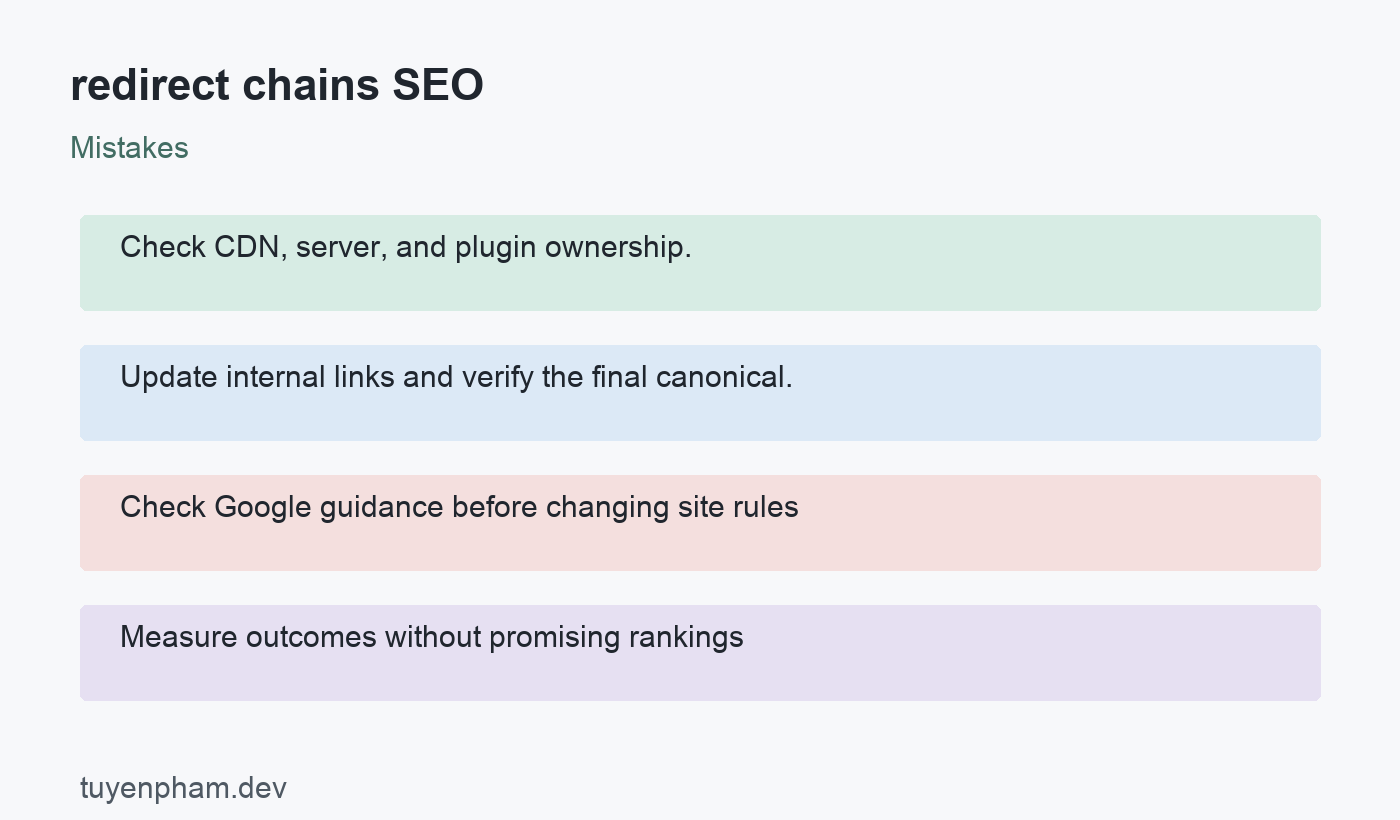
- Check CDN, server, and plugin ownership.
- Update internal links and verify the final canonical.
A focused task for your website
Export ten legacy URLs from a previous site change or a broken-link report. Trace each hop and classify the final destination as relevant, missing, or incorrect. Build a proposed direct mapping and test it on a staging environment. Include query strings and trailing-slash variants that matter to the application. After release, keep a record of the old route and new route. Review errors and destination relevance before assessing aggregate traffic changes.
References and next steps
Consult Google Search Central documentation for the relevant search requirements and Rank Math guidance on this topic for practical workflows. Continue with Seo Migration Checklist and the SEO audit checklist for related implementation checks.

Discussion
Join the conversation