Content Pruning SEO: Decide What to Improve, Consolidate, or Retire

Content pruning SEO is a content-maintenance decision about resources that may be obsolete, repetitive, misleading, or no longer useful. It should begin with a review of purpose and evidence rather than a rule that deletes everything with little traffic. Some low-volume pages support existing customers, earn relevant references, or answer a rare but important task. Improve or consolidate material when that preserves its value. Retire a page only when the decision is justified and its dependencies have been considered.
content pruning SEO: a practical workflow
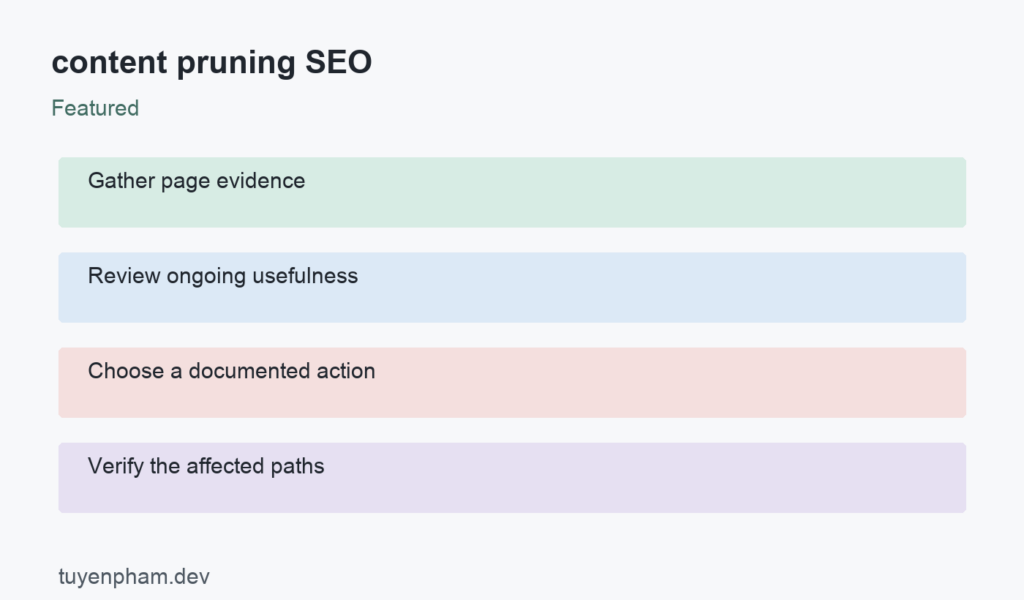
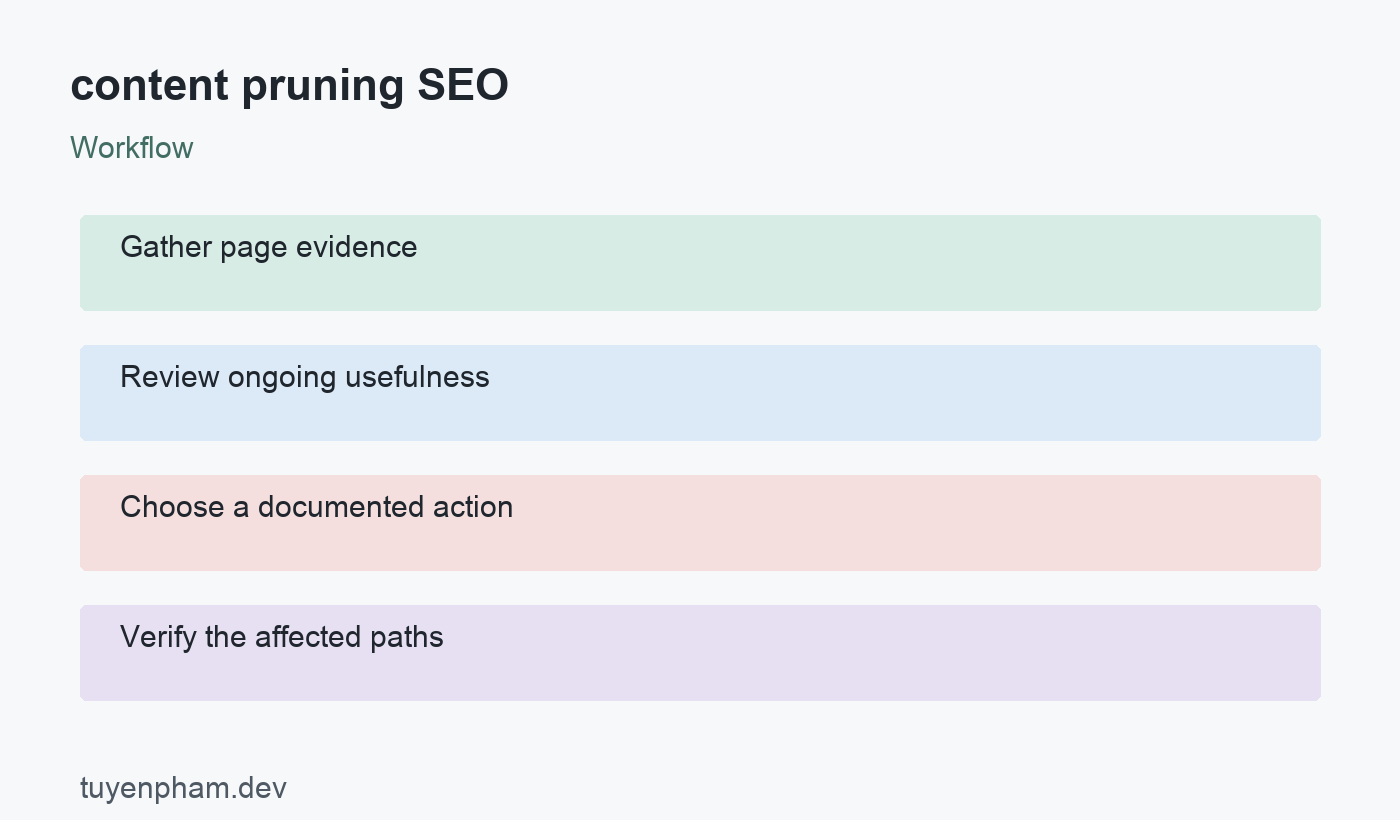
Use the following sequence to organize the review: Gather page evidence → Review ongoing usefulness → Choose a documented action → Verify the affected paths. The sections below explain the decisions and evidence needed at each stage. The worked example is hypothetical and illustrates the process rather than claiming a measured result from this website.
Use a relevant evidence window
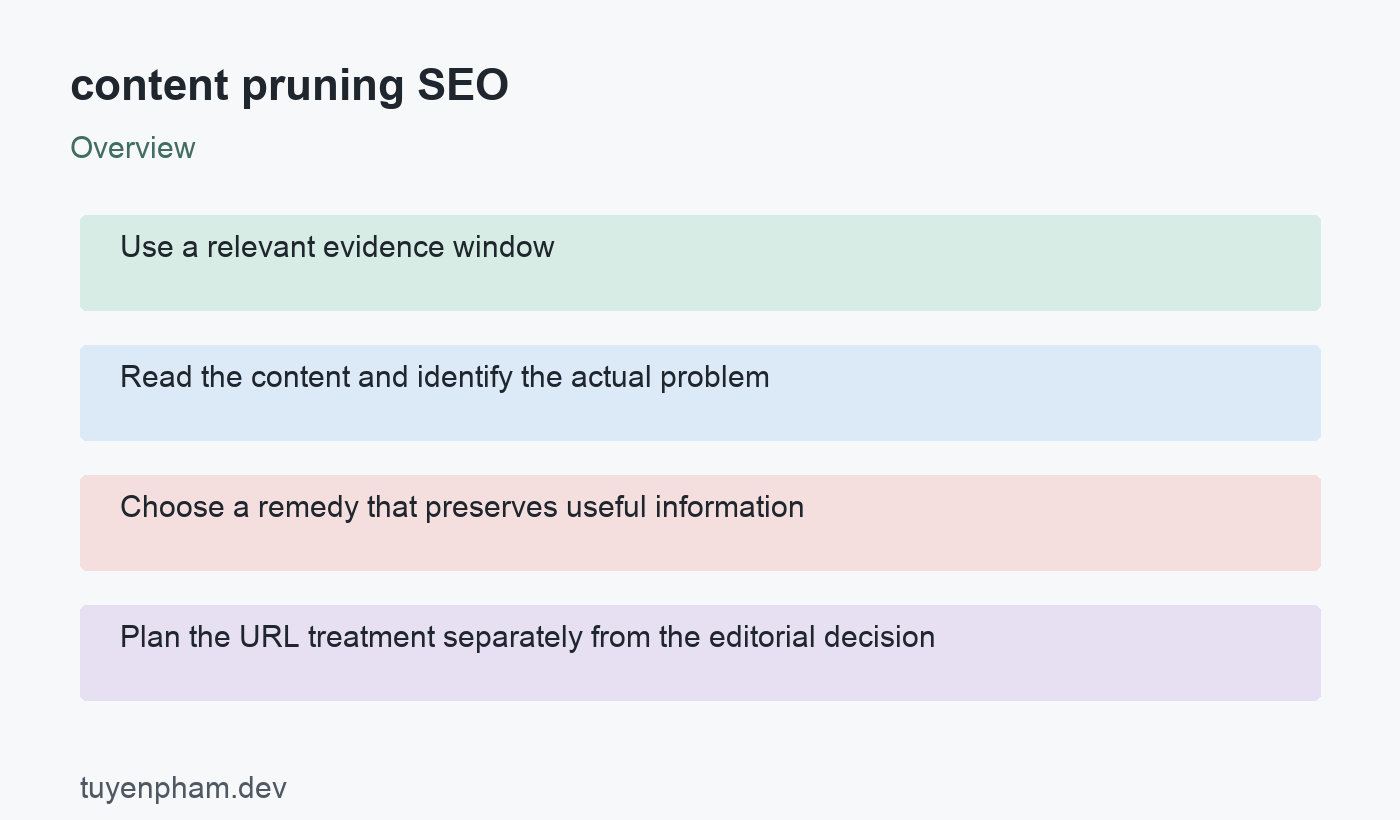
Collect search performance, meaningful conversions, referral use, internal links, and the page’s role in a customer workflow. Account for seasonality and the time a new resource has had to be discovered. A short quiet period does not prove that a page has no purpose. Check whether analytics covers the task and whether consent or tracking changes affect the data. Record why the page exists. A policy page or a technical reference may provide value that is not well represented by ordinary traffic totals.
Read the content and identify the actual problem
Inspect factual accuracy, outdated instructions, missing examples, overlap, and the audience the resource serves. A short answer is not automatically thin, and a long page can still be unhelpful. Decide whether the problem is obsolete subject matter, poor explanation, or duplication of another useful resource. Google’s quality guidance encourages a careful content assessment, while its core-update guidance treats deletion as a last resort in appropriate cases. Avoid turning a quality review into a mechanical word-count or engagement threshold.
Choose a remedy that preserves useful information
Keep accurate resources that still serve a task. Update material that needs current evidence or a clearer explanation. Consolidate overlapping pages when one complete destination would work better. If a resource has no continuing purpose, consider retirement after checking its references and responsibilities. Rank Math describes both the potential benefits and risks of pruning, including lost traffic and broken paths. Treat those risks as decisions to evaluate for the affected content rather than assuming fewer URLs always improve search performance.
Plan the URL treatment separately from the editorial decision
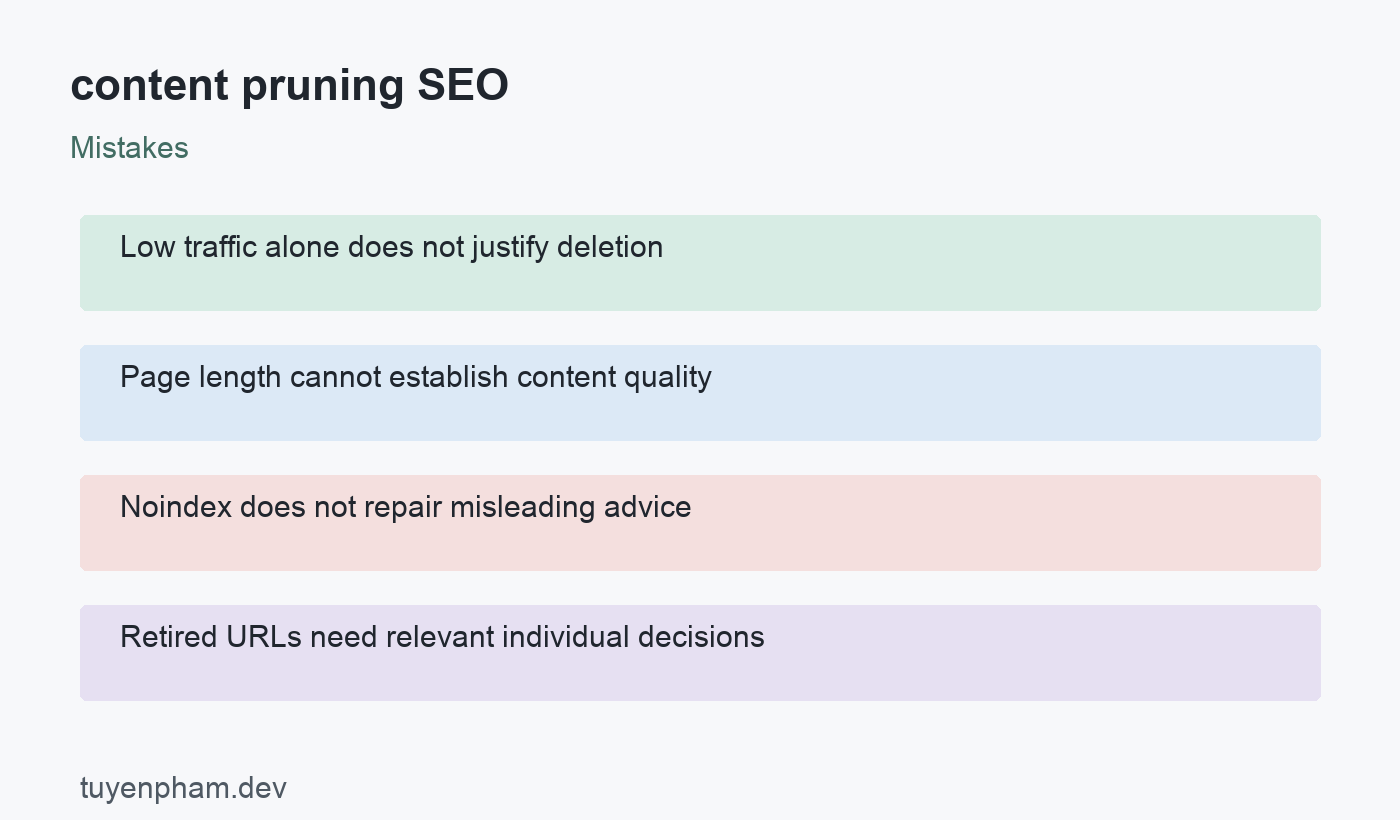
A relevant permanent replacement can justify a direct redirect. A genuine removal without an equivalent replacement may need a proper not-found or gone response. Do not send every retired URL to the homepage. Update internal links and sitemap entries to reflect the outcome. Noindex changes search eligibility but does not remove misleading information from readers who still reach the page. Preserve records and required information where business or legal responsibilities apply. Content retirement and search controls solve different problems.
Release a small reviewed batch and monitor it
Save the prior content and change plan before applying a retirement or consolidation decision. Review the destination and important source links after release. Compare the affected page group and reader tasks over an appropriate period, noting other site changes. A traffic loss on a redirected URL alone does not describe the combined result. A cleanup can improve accuracy and maintainability even when ranking evidence is inconclusive. Keep the reasoning so future editors understand why the resource was changed.
Worked example
A site has an outdated setup tutorial, a current guide covering the same procedure, and a rarely visited reference for a supported legacy version. The outdated duplicate can contribute any useful notes to the current guide and receive a relevant redirect. The legacy reference may remain because real customers still need it, with clear version labeling. Deleting both low-traffic pages by a threshold would ignore their different purposes and could break an important support path.
Verification checklist
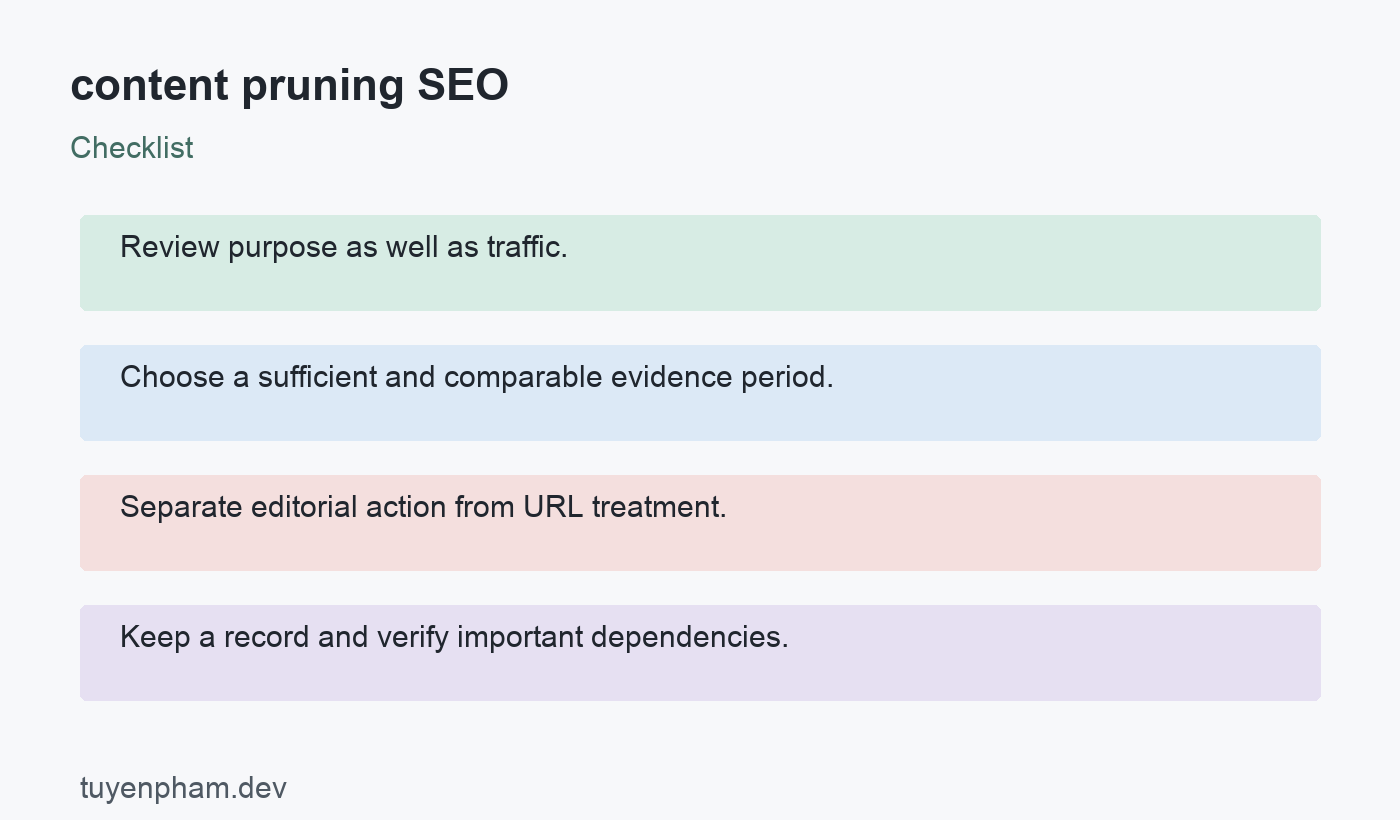
- Review purpose as well as traffic.
- Choose a sufficient and comparable evidence period.
- Separate editorial action from URL treatment.
- Keep a record and verify important dependencies.
A focused task for your website
Review ten older pages without making live removals during the audit. Record usefulness, accuracy, related pages, meaningful outcomes, and references. Assign keep, improve, consolidate, or retire with a short reason. Prepare replacement mappings only where an equivalent resource exists. Take a small proposed batch through editorial review, then verify the released paths. Evaluate the group outcome and maintainability rather than treating a reduced URL count as proof of SEO success.
References and related reading
Review Google’s official guidance and Rank Math’s related explanation or workflow, together with additional Google implementation guidance for the relevant requirements and tool details. Continue with Content Gap Analysis and the SEO audit checklist to connect this review with the rest of your website.
Discussion
Join the conversation