Content Gap Analysis: Find Missing Answers Before Creating More Pages

Content gap analysis identifies questions your audience needs answered but your current content does not handle well. A gap may be a missing topic, an incomplete explanation, outdated instructions, or a lack of evidence behind a claim. It does not automatically mean your site needs another page. Sometimes the best improvement is a clearer section in an existing resource. Begin with reader needs and the purpose of your website, then use search and competitor evidence to help prioritize the work.
content gap analysis: a practical workflow
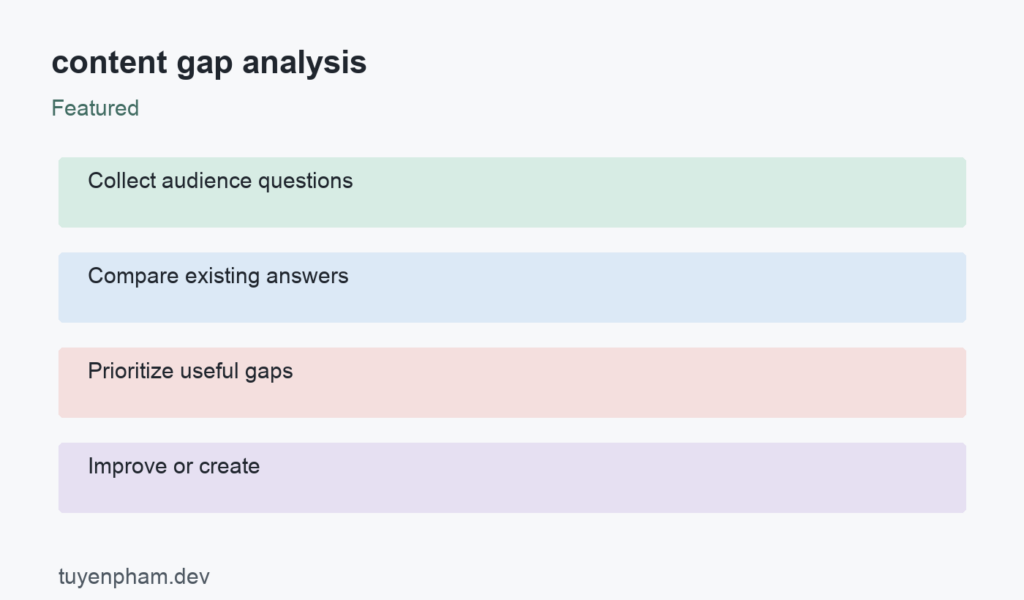
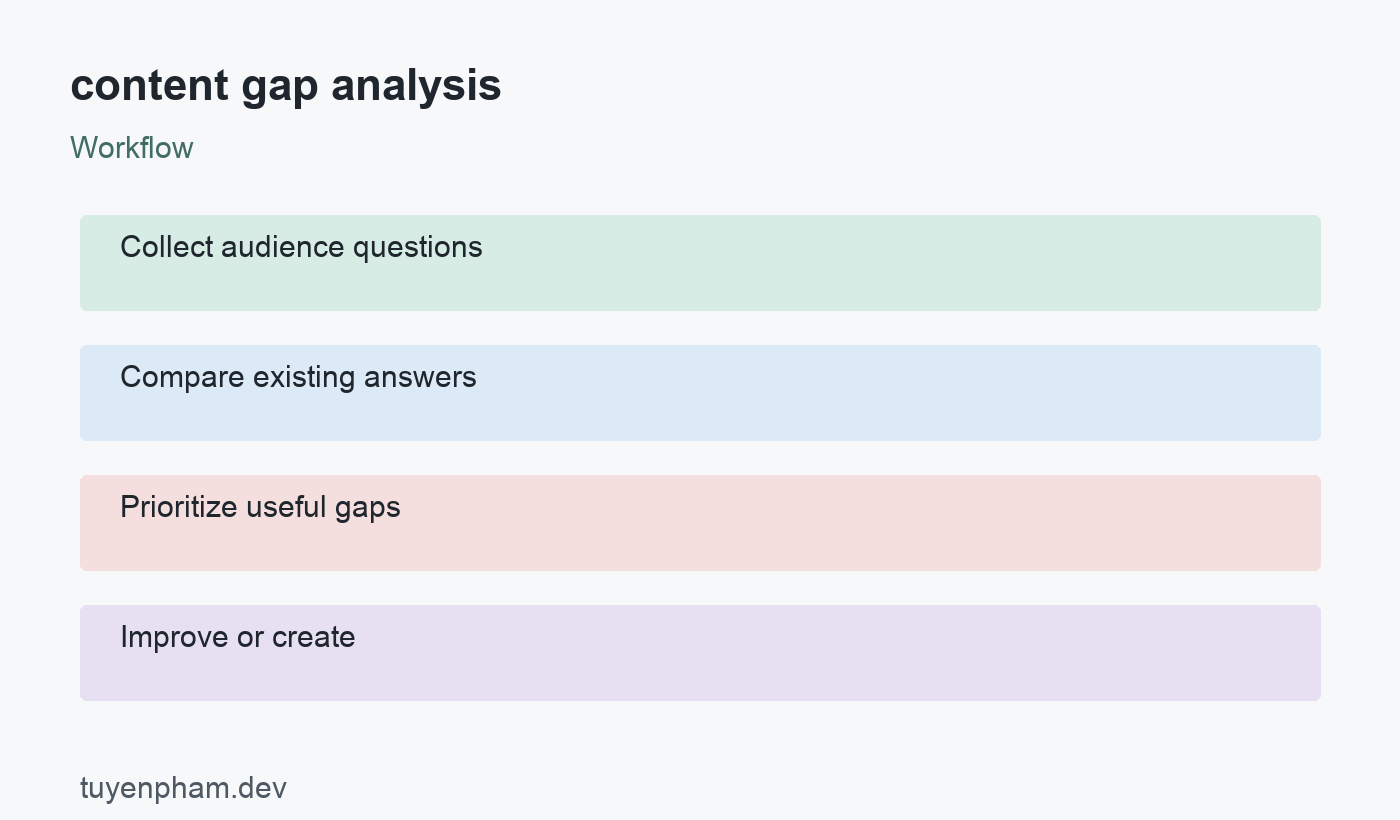
Use this sequence to organize the work: Collect audience questions → Compare existing answers → Prioritize useful gaps → Improve or create. The sections below explain the evidence, decisions, and limitations at each stage. The worked example is hypothetical and illustrates a process rather than a measured result from this website.
Collect evidence from readers and search
Start with support tickets, sales questions, site search, and feedback on existing articles. These sources reveal confusion that a keyword-volume report can miss. In Search Console, inspect relevant queries and landing pages to understand where users arrive. Search performance does not reveal every unmet need, and low impressions do not prove nobody wants an answer. Record the source of each candidate gap. A customer repeatedly asking how to migrate data is stronger evidence of a practical need than an unrelated high-volume phrase.
Audit the answer, not just the presence of a keyword
Read the existing resource and ask whether someone can complete the intended task. A page can mention backups without explaining how to restore one. It can compare software without stating the criteria or limitations. Mark gaps in procedure, evidence, prerequisites, and next steps. Check whether information is accurate for current versions. Avoid treating a phrase absent from the title as proof that the underlying question is unanswered. The assessment should describe what the reader still cannot understand or do.
Use competitors to generate questions, not a copying list
Rank Math describes content gap analysis as a comparison of existing coverage and audience needs. Competitor pages can show common formats, missed questions, and evidence readers expect. Their keyword estimates are directional, and their success does not prove that copying the topic or structure will work for your site. Evaluate the actual answer and your ability to contribute something useful. Discard opportunities that are irrelevant to your audience, outside your expertise, or dependent on a service you do not offer.
Choose between an update, a new page, and consolidation
Add a section when the missing answer belongs within an existing task. Create a separate resource when the question has a distinct intent and enough useful material to stand alone. Consolidate overlapping pages if readers would benefit from one complete destination. Record the preferred URL before drafting so a new article does not create unnecessary competition. Internal links should help readers move between genuine prerequisites and next steps. More indexed pages are not inherently a better outcome than fewer complete resources.
Prioritize by value, confidence, and effort
For each candidate, estimate audience relevance, business usefulness, evidence quality, and the work needed to produce a dependable answer. A simple scoring model can organize discussion, but its numbers are judgments rather than measured ranking probabilities. Favor a small number of gaps where the contribution is clear. Google emphasizes helpful, original, people-first content, so evaluate whether the work adds value instead of merely expanding word count. Revisit the backlog as reader questions, products, and search behavior change.
Worked example
A plugin tutorial explains installation and configuration, while support messages repeatedly ask how to undo a failed configuration change. The content already targets the right topic, so a second generic installation article would not close the gap. A tested rollback section, prerequisites, and a link to backup guidance are more useful. If restoration is a substantial separate task, create a focused restoration guide and link it from the configuration article. The improvement follows the user workflow rather than the size of a keyword list.
Verification checklist
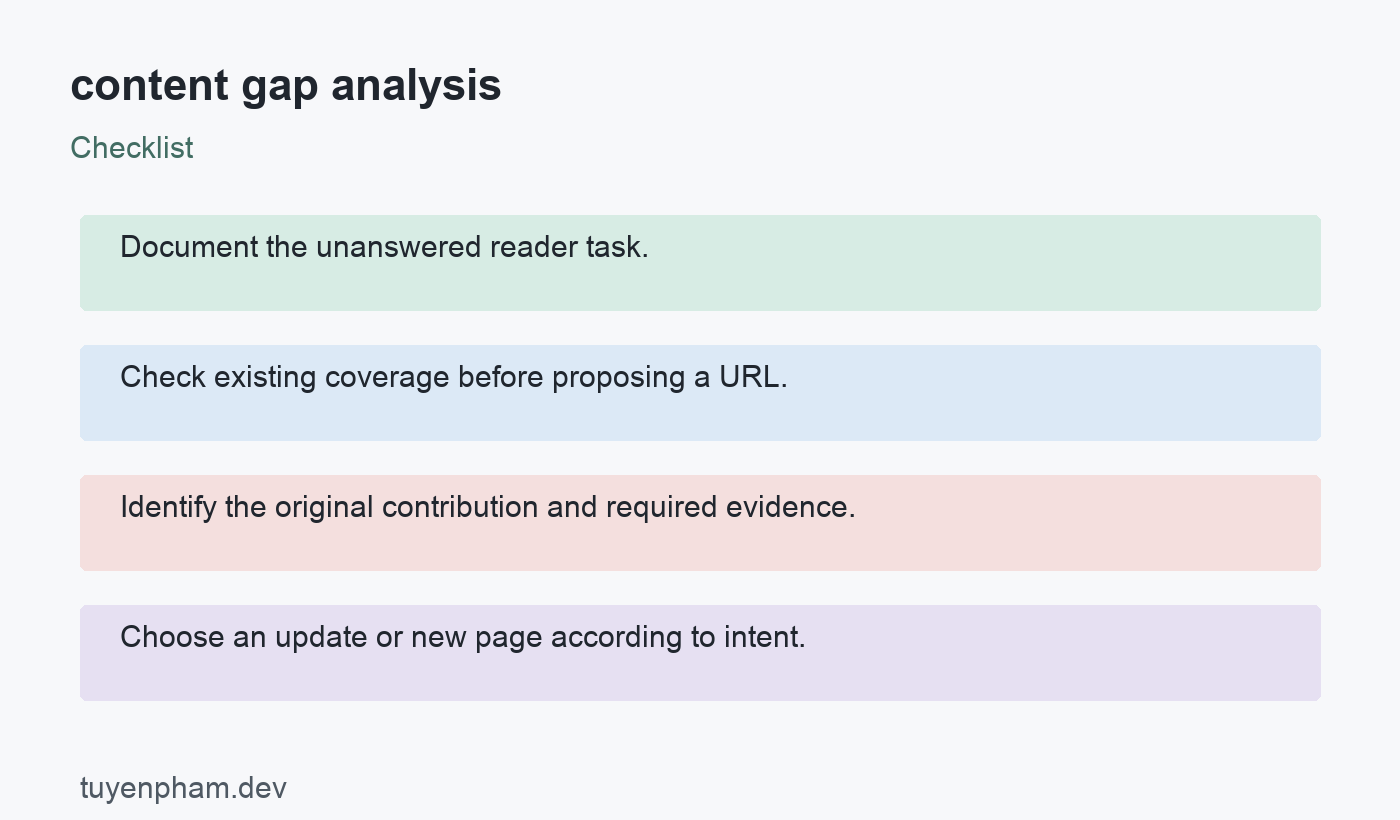
- Document the unanswered reader task.
- Check existing coverage before proposing a URL.
- Identify the original contribution and required evidence.
- Choose an update or new page according to intent.
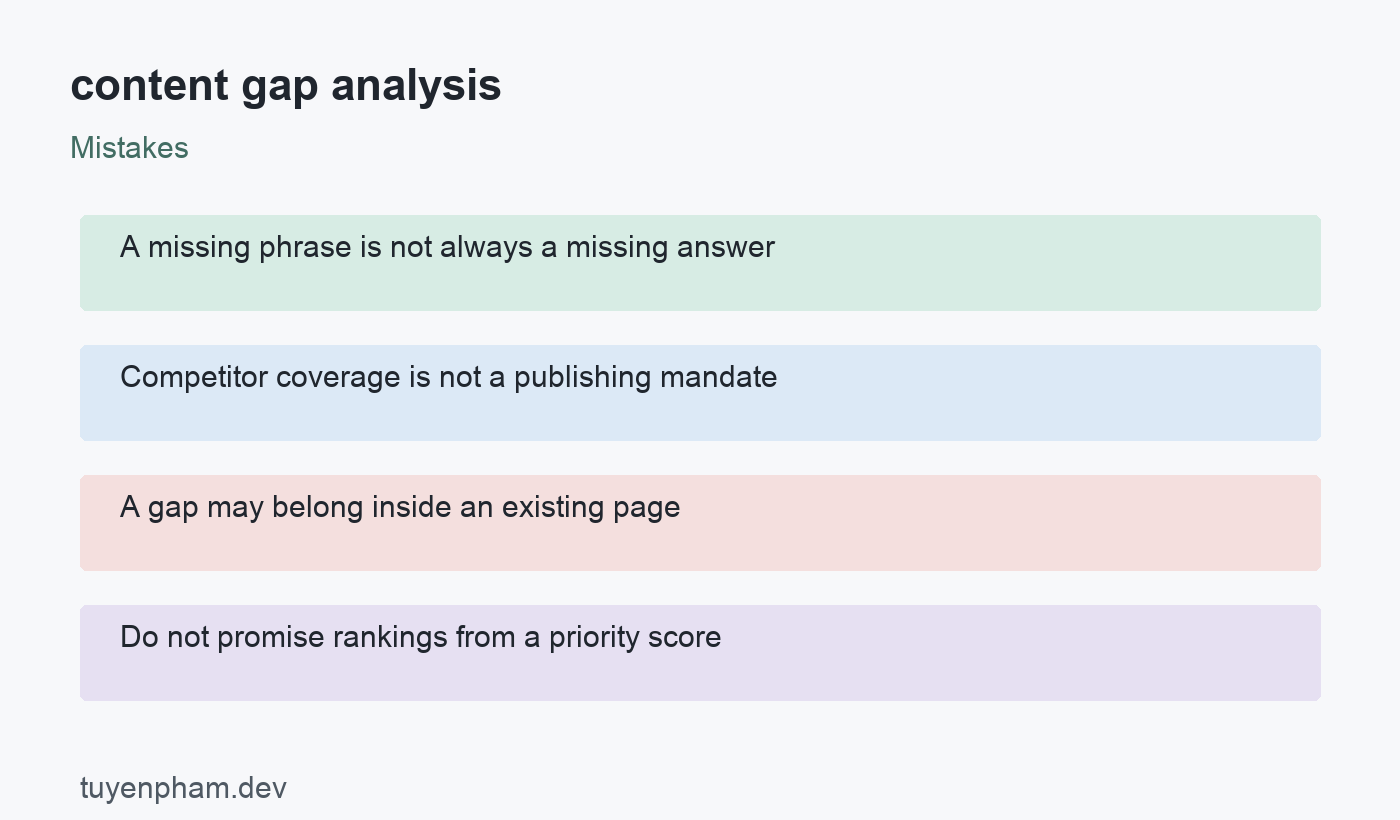
A focused task for your website
Review five resources around one subject. Gather ten questions from readers and relevant search evidence, then map each to the current answer. Mark complete, incomplete, missing, or obsolete coverage. Choose three improvements and specify the intended URL, required examples, and an observable outcome. After publishing, assess task completion, reader feedback, and relevant visits. Avoid attributing every traffic change to the gap work when other releases or demand changes occurred.
References and related reading
Review Google Search Central documentation for the relevant platform guidance, and Rank Math guidance for the related workflow for practical SEO checks. Continue with Topical Authority and the SEO audit checklist to connect this task with the rest of your site review.
Discussion
Join the conversation