Faceted Navigation SEO: Control Filters Without Blocking Valuable Pages

Faceted navigation SEO concerns the URLs created when users filter or sort a collection. A store can produce many combinations of brand, size, color, price, and sort order. Some combinations make useful search landing pages; many others repeat similar results or lead to empty lists. Without a deliberate policy, the URL space can consume crawling and server resources. Classify filters by user value before choosing crawl rules, index controls, canonical signals, or a different interaction design.
faceted navigation SEO: a practical decision process
Follow this sequence: Inventory filters → Select useful landings → Control URL growth → Check crawl behavior. Use it to organize the work, then verify the editorial and technical choices described below. The example is hypothetical and illustrates the decision rather than claiming a measured ranking result.
Inventory how combinations become URLs
List parameters, supported values, ordering rules, and whether links expose combinations to crawlers. Check equivalent states such as reordered parameters or repeated filters. Estimate growth across combinations instead of counting only one filter at a time. Include empty results, price ranges, and sorting options. Server logs and a targeted crawl can reveal which URL families consume requests. A crawl that samples only the main category page may miss the scale of the generated space.
Choose which filtered landings deserve search visibility
A stable category such as waterproof hiking boots may serve a distinct demand, while every price slider position rarely deserves a separate search result. Select landings using audience need, inventory stability, and sufficient unique value. Give chosen pages clear navigation and suitable content without manufacturing long repetitive introductions. Keep ordinary shopping filters useful even when they are not intended as search landings. The policy can differ by parameter rather than forcing the same treatment on all filtered pages.
Distinguish crawling from indexing and consolidation
Robots.txt can prevent crawling, but it does not reliably remove a known URL from search. A crawler must access a page to see a noindex directive. Blocking access while expecting it to read noindex creates a conflict. Canonical signals can express a preferred similar representation, but are not a dependable immediate crawl-control mechanism. Google specifically discusses preventing crawling for faceted URLs that are not needed in search. Plan the treatment of already indexed URLs separately from preventing future URL growth.
Apply WordPress controls at the correct layer
Rank Math documents editing a virtual robots.txt file, but a physical file or server configuration can take precedence. Inspect the public robots.txt response after a change. Match rules to the actual parameter syntax and test valuable URLs against them before deployment. Some filter generation comes from the commerce plugin or frontend rather than the SEO plugin. Canonical output, sitemap inclusion, and internal links also need to agree with the chosen policy. Do not assume one switch addresses all layers.
Handle invalid combinations and monitor resource use
Normalize parameter order where appropriate and avoid generating endless variations for the same state. Follow Google guidance for useless or empty filter combinations, including proper not-found responses where applicable. Avoid redirecting every invalid combination to the homepage, which can confuse users and create misleading signals. Watch crawler requests, discovery of new products, response time, and indexed URL samples after changes. Test real shopping workflows as well: an SEO configuration that breaks filters is not a successful implementation.
Worked example
A shoe store has a valuable /waterproof-hiking-boots/ landing page and a filter interface that creates arbitrary size, color, and price combinations. The selected landing remains linked and crawlable. The incidental combinations receive a deliberate crawl policy based on the site architecture. Before a rule is published, the team tests that it does not block product pages, the chosen landing, or essential resources. Existing indexed filter URLs are reviewed separately because stopping crawling does not automatically erase them.
Implementation checklist
- Separate valuable landings from incidental filter combinations.
- Test rules against products and category URLs.
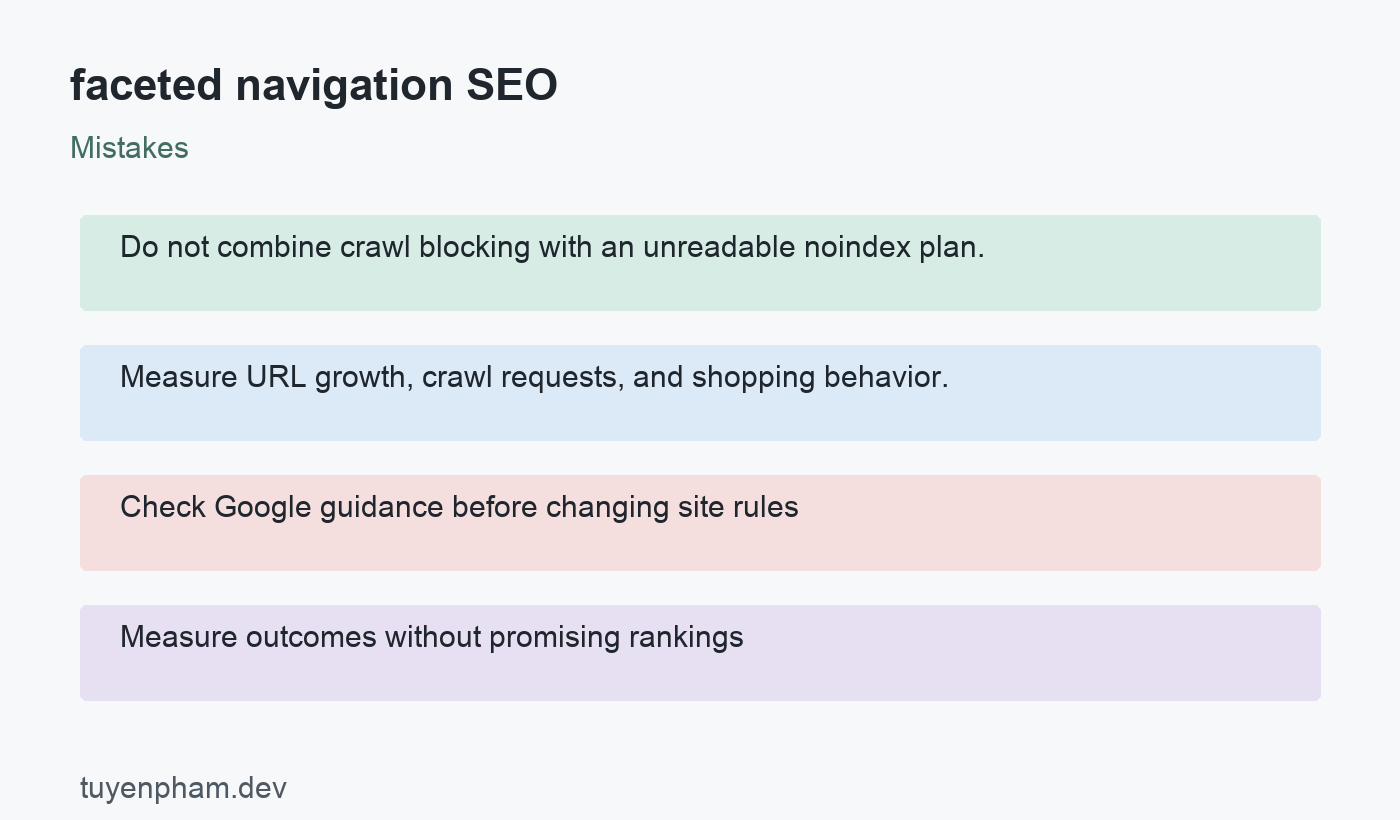
- Do not combine crawl blocking with an unreadable noindex plan.
- Measure URL growth, crawl requests, and shopping behavior.
A focused task for your website
Choose one collection with filters. Map ten representative URLs, including an empty result and equivalent parameter orders. Label each as a search landing, an ordinary user filter, or an invalid state. Write a treatment for each class and test it on a staging site. Inspect the public headers, robots rules, canonical output, and internal links. Keep a rollback plan in case the policy blocks a valuable destination or interrupts product discovery.
References and next steps
Consult Google Search Central documentation for the relevant search requirements and Rank Math guidance on this topic for practical workflows. Continue with Robots Txt Seo and the SEO audit checklist for related implementation checks.
Discussion
Join the conversation