Keyword Mapping: Assign Search Intent to the Right Landing Pages

Keyword mapping connects groups of related queries with the pages intended to answer them. It is an editorial and site-planning tool, not a control that forces Google to display a particular URL. A useful map records reader intent, current coverage, the preferred landing page, and planned improvements. It helps a team avoid drafting several articles for the same task and exposes cases where a service page is being asked to do the work of a tutorial.
keyword mapping: a practical workflow
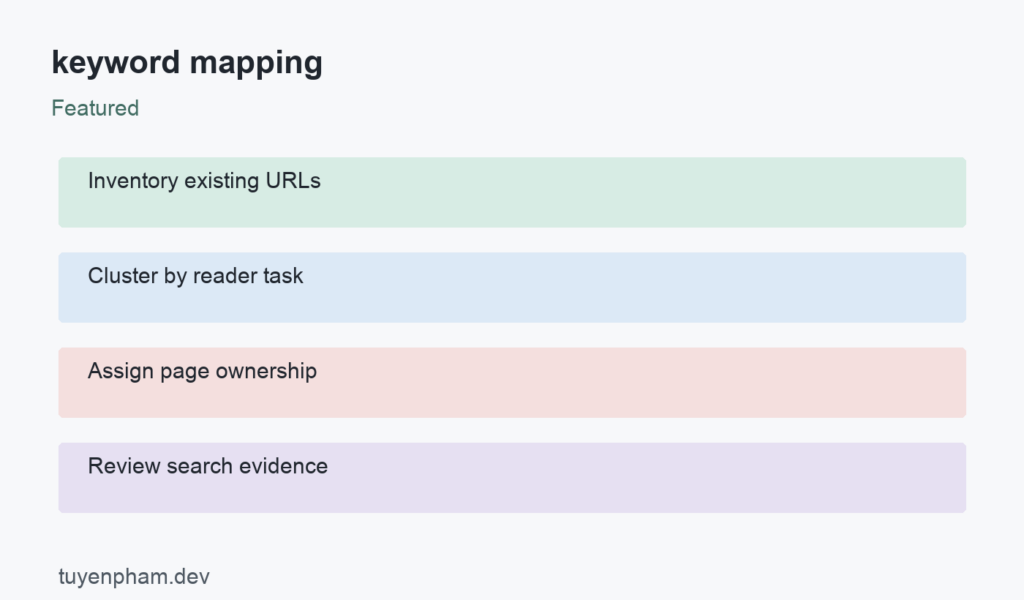
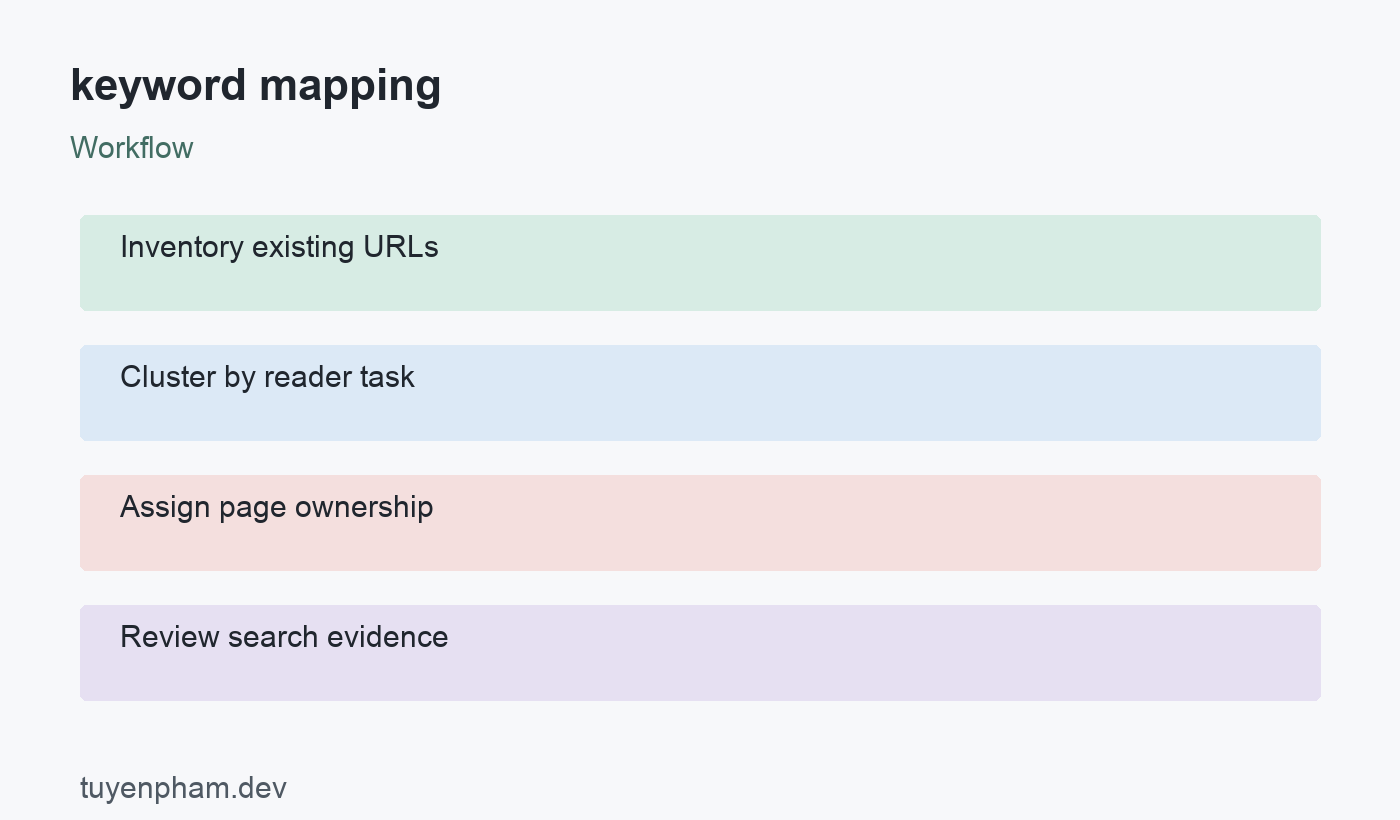
Use this sequence to organize the work: Inventory existing URLs → Cluster by reader task → Assign page ownership → Review search evidence. The sections below explain the evidence, decisions, and limitations at each stage. The worked example is hypothetical and illustrates a process rather than a measured result from this website.
Inventory real pages before planning new ones
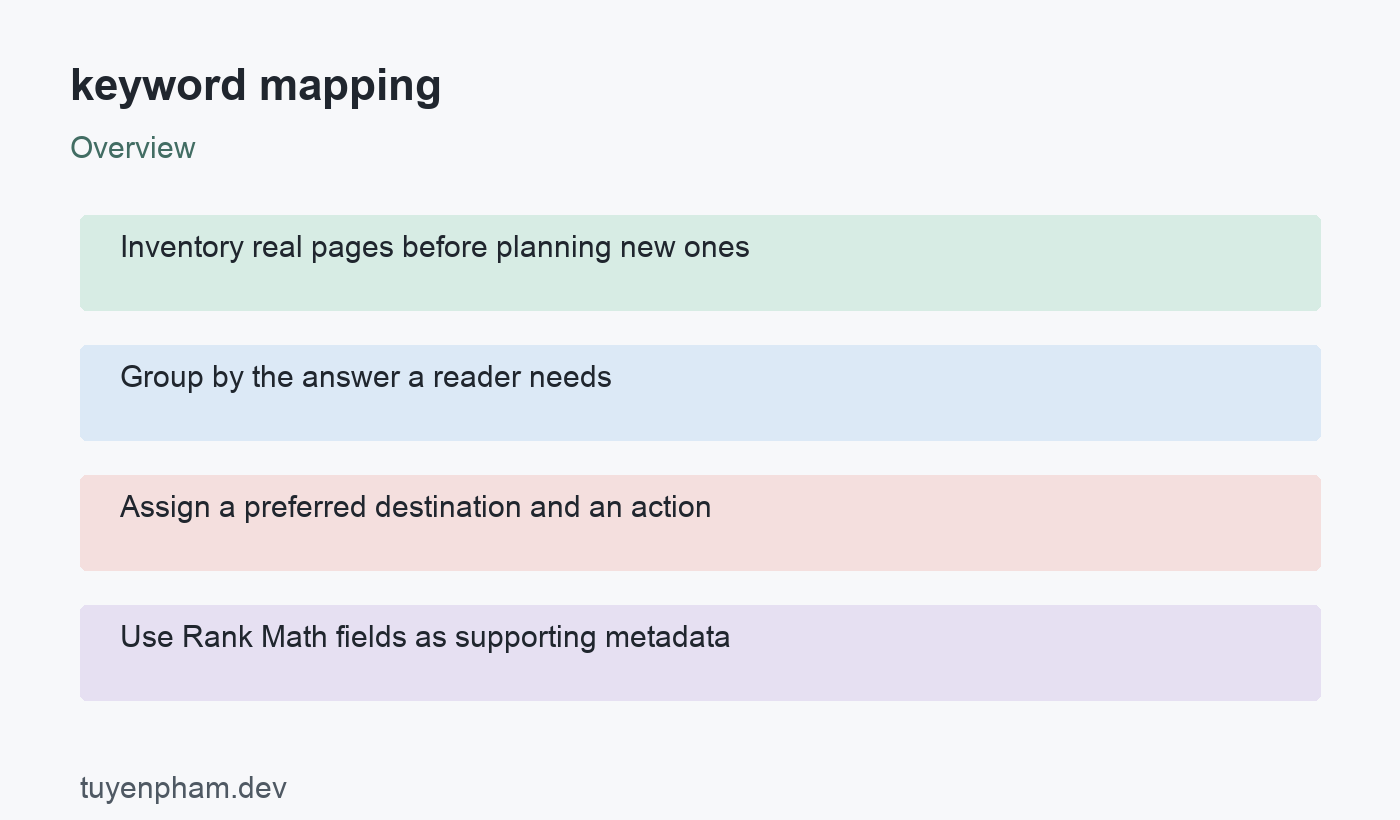
Collect published URLs from the CMS, sitemap, and a crawl, then identify their current purpose and status. Include important service, category, and documentation pages rather than mapping only blog articles. Normalize URL variants carefully so redirects and duplicates do not appear as separate editorial opportunities. Record the existing title and a short description of the task the page serves. A map built only from a keyword spreadsheet can overlook useful content that already answers the question well.
Group by the answer a reader needs
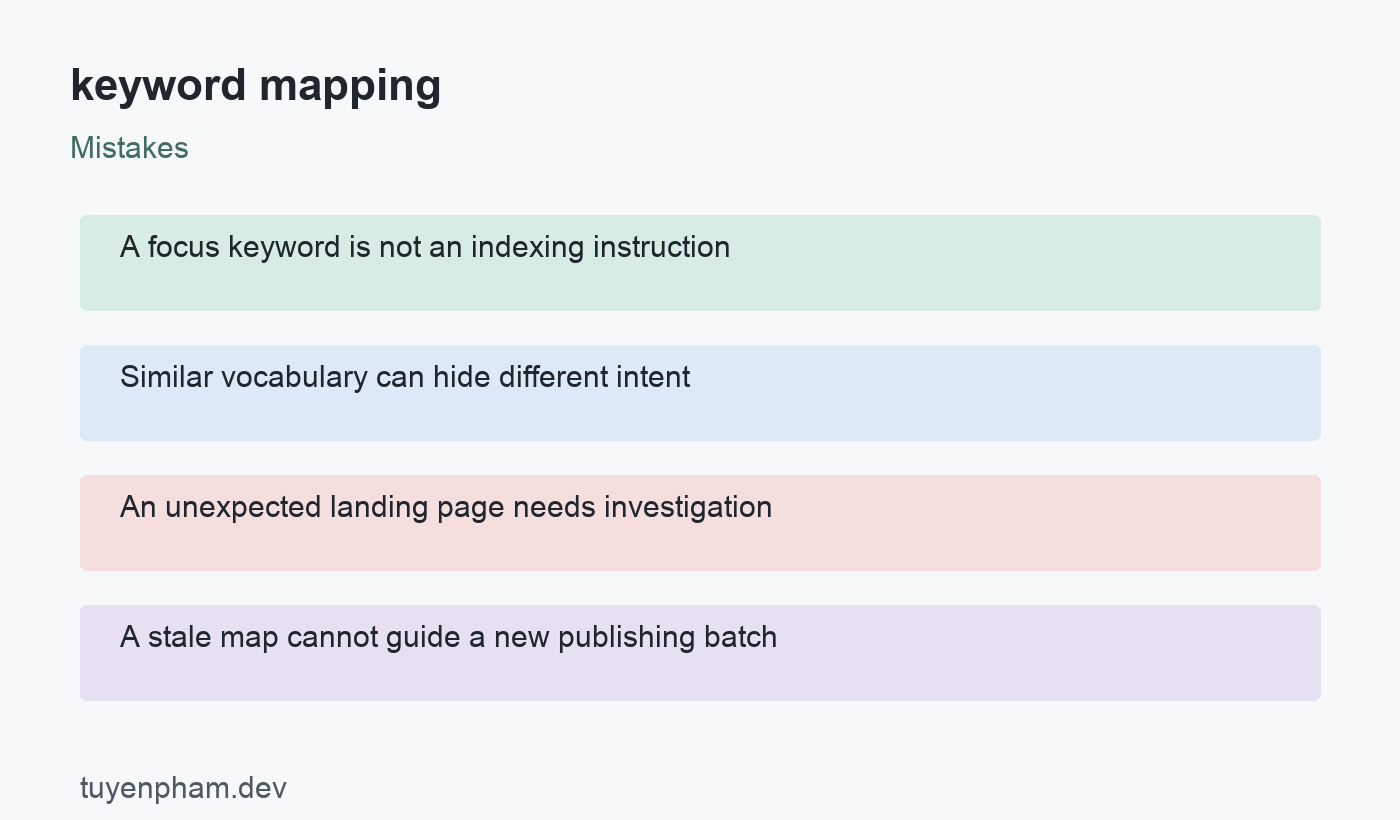
Cluster phrases that share a task and expect a similar type of resource. Use search-result patterns as evidence when the intent is uncertain. Broad shared vocabulary alone does not make two queries equivalent. A pricing comparison, setup tutorial, and error fix can all name the same product while requiring different answers. Give each cluster a brief intent statement and relevant constraints. Avoid assuming that every phrase in a tool export deserves its own page or an exact-match heading.
Assign a preferred destination and an action
For each cluster, choose an existing page, a planned new page, or a section within another resource. Record the reason for the choice and the required work. An existing article might need a missing example rather than a new URL. Two overlapping articles may need differentiation or consolidation. The preferred page is a planning decision, not evidence that all other mentions of the topic are harmful. Supporting pages can legitimately cover related questions and link to the central resource.
Use Rank Math fields as supporting metadata
Rank Math’s keyword research guidance helps establish intent and terminology, while focus keywords and descriptions can keep a writing brief visible in WordPress. Do not mistake a focus keyword for a Google indexing directive or a fixed one-query assignment. Use natural language in titles and content, and keep the page useful for the full query group. Google can match relevant wording variations. A reusable map should also contain ownership, evidence, and status instead of relying entirely on plugin fields.
Maintain the map with actual performance
Periodically compare query groups with the pages receiving relevant impressions and visits. An unexpected landing page may signal unclear intent, but it can also serve a legitimate alternate interpretation. Review the content before changing redirects or canonicals. Update the map when services, navigation, or product versions change. Track completion and reader outcomes alongside traffic. The map is valuable when it guides decisions; an elaborate sheet with stale URLs and no action owner is not a working content strategy.
Worked example
A software site maps "task app pricing" to its pricing page, "compare task app plans" to a comparison resource, and "set up recurring tasks" to documentation. All three mention the same product but serve different decisions. Several wording variations of the setup question stay in one documentation cluster. When search evidence shows comparison queries landing on the pricing page, the team checks whether the comparison resource needs clearer content and internal links before making a structural change.
Verification checklist
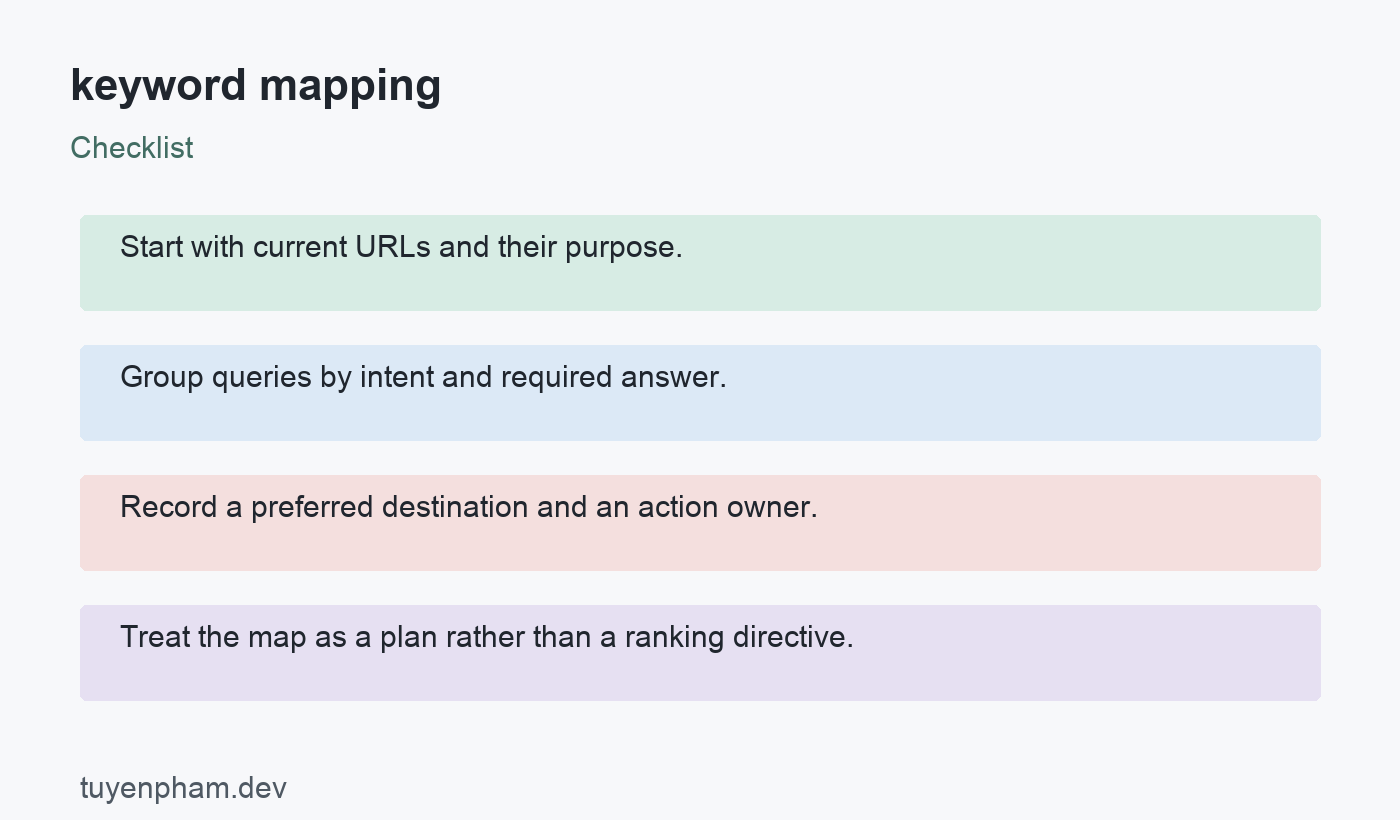
- Start with current URLs and their purpose.
- Group queries by intent and required answer.
- Record a preferred destination and an action owner.
- Treat the map as a plan rather than a ranking directive.
A focused task for your website
Map fifteen relevant queries across an existing topic cluster. Include columns for reader task, preferred URL, current coverage, evidence, next action, and owner. Mark planned new pages only where the task is distinct. Compare your plan with Search Console landing-page evidence and explain mismatches. After the first improvements, update the map and review whether the page paths help readers. Keep a revision date so future writers do not work from obsolete assignments.
References and related reading
Review Google Search Central documentation for the relevant platform guidance, and Rank Math guidance for the related workflow for practical SEO checks. Continue with Keyword Cannibalization and the SEO audit checklist to connect this task with the rest of your site review.
Discussion
Join the conversation