Link Reclamation: Recover Useful References to Moved or Missing Pages

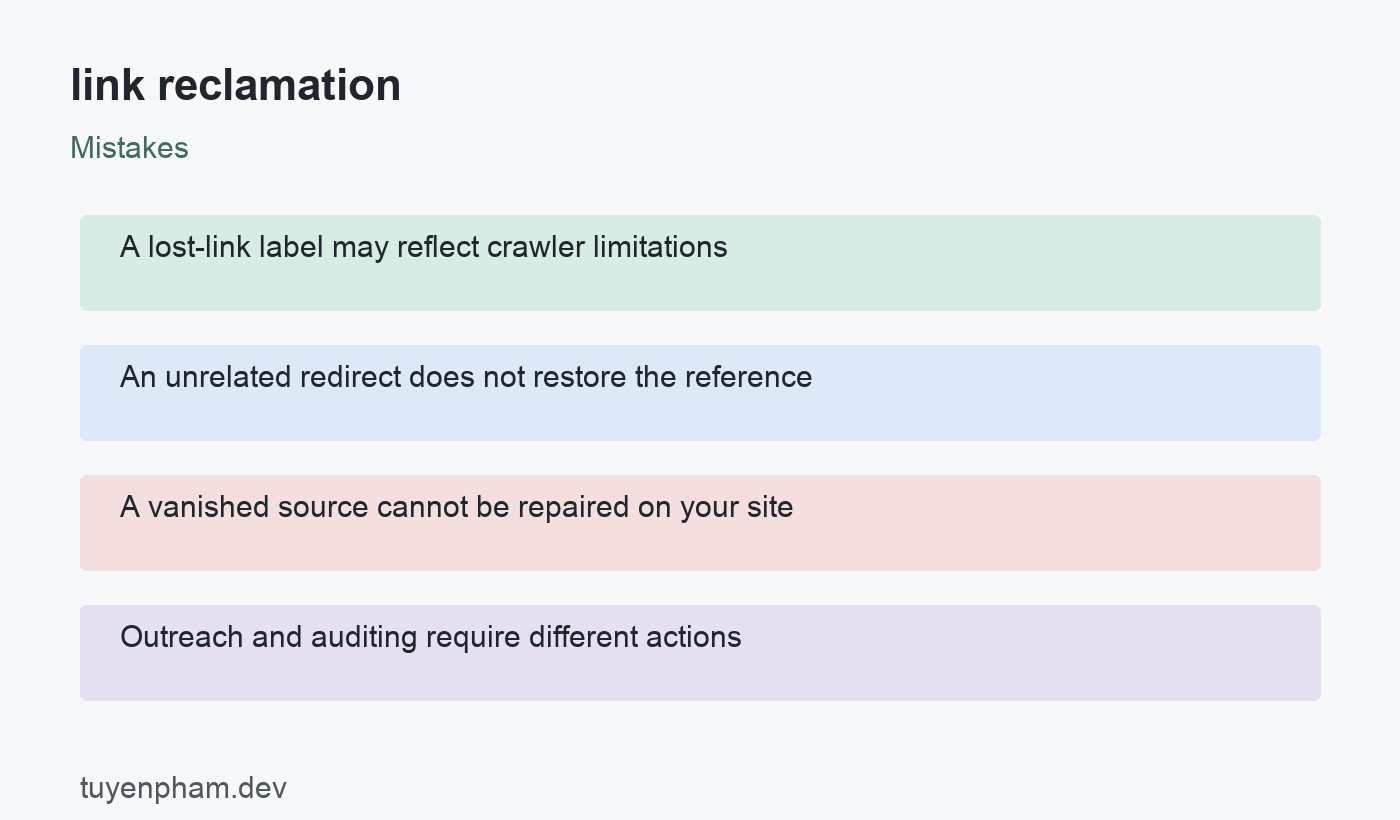
Link reclamation restores useful references that were lost, broken, or misdirected after a site change. It usually concerns an existing relationship between a source page and your content, rather than acquiring unrelated new links. A backlink tool can help find candidates, but its lost-link label is a starting point for investigation. The source may have changed, become inaccessible to the tool, or deliberately removed the reference. Verify the actual source and destination before choosing a remedy.
link reclamation: a practical workflow
Use this sequence to organize the work: Find affected references → Verify source and target → Restore a relevant route → Record the recovery evidence. The sections below explain the evidence, decisions, and limitations at each stage. The worked example is hypothetical and illustrates a process rather than a measured result from this website.
Collect candidates from site history and references
Review old URL inventories, migration maps, referral records, relevant backlink reports, and missing-page requests. Prioritize pages that previously served a useful audience or received credible references. A tool’s discovery date may not equal the date a link was created or removed. Some reports omit pages the tool cannot crawl. Record the source URL, target URL, surrounding context, and reason for the finding. This gives the investigation a stronger foundation than a raw lost-link count.
Verify that the reference still serves the reader
Open the source where accessible and inspect the link and its context. Confirm whether the source still exists, whether the link points to the expected page, and whether the target remains useful. A page about an old event may no longer need the same reference. A technical article may now cite a better maintained resource. Reclamation should not mean pressuring a publisher to restore every removed link. Focus on cases where a broken route is preventing a still-relevant reference from working.
Repair destinations that you control
If your referenced content moved permanently, direct the old URL to its relevant current location. Restore useful content when appropriate and maintain the original URL if that best preserves the resource. Update internal links to final destinations so your site does not keep creating avoidable hops. Google documents permanent redirects as a signal for moved content. A redirect to an unrelated page does not recover the original reader task, even if a backlink report stops labeling the old URL as broken.
Use Rank Math for the redirect implementation
Rank Math provides a redirect module and documentation for mapping source URLs to destinations. Apply it after selecting the correct relationship and check whether infrastructure already handles part of the route. Test old and new URLs, trailing-slash variants, and important query behavior. Avoid broad patterns that capture unrelated paths or create loops. If an external publisher needs to correct a typo, prepare accurate replacement information and use an authorized outreach process. Sending outreach is a separate action from auditing references.
Track recoveries without inflating the outcome
Record the resolved destination, response status, and evidence that the source reference now works. Distinguish a technical repair from a publisher restoring a removed link. Link attributes, source quality, and search systems affect how a reference may be used; not every restored link produces a ranking change. Review referral usefulness and affected page performance over time. Keep the site’s redirect inventory maintained so future moves do not break the same references again. The reliable benefit is restoring access to appropriate content.
Worked example
A documentation page moves during a redesign, while a third-party tutorial continues linking to its old URL. The old path returns 404 even though an equivalent current guide exists. A direct permanent redirect restores the tutorial’s useful reference, and internal links are updated separately. Another reported lost link belongs to a removed source page; changing your own redirect cannot restore that source. The two cases need different classifications rather than being counted as identical opportunities.
Verification checklist
- Verify the live source and its context.
- Choose a genuinely relevant destination.
- Separate controllable URL repairs from publisher actions.
- Record working access without guaranteeing ranking changes.
A focused task for your website
Review five candidate lost or broken references. Record the source, target, current behavior, and whether a relevant replacement exists. Repair one destination under your control after testing the mapping. Prepare a factual note for any external correction that would be useful, but keep outreach subject to its own authorization. Recheck the repaired route and record the evidence. Use the result to improve migration and redirect maintenance rather than treating a tool’s link count as the final measure.
References and related reading
Review Google Search Central documentation for the relevant platform guidance, and Rank Math guidance for the related workflow for practical SEO checks. Continue with Backlink Basics Seo and the SEO audit checklist to connect this task with the rest of your site review.
Discussion
Join the conversation