Log File Analysis SEO: Verify Crawlers and Diagnose Request Patterns

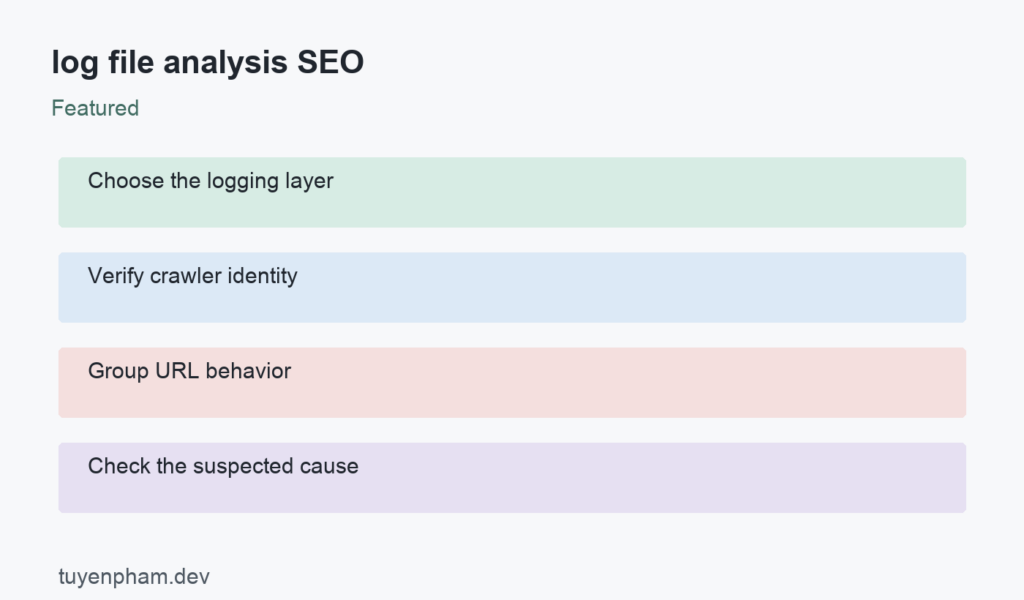
Log file analysis SEO examines request records to understand how crawlers interact with a site. Logs can reveal requested URLs, response codes, timestamps, and request patterns, depending on the system. They do not by themselves show whether a page was indexed or ranked. A useful analysis begins with a concrete question, such as whether a filter family attracts repeated crawler requests or a valuable section experiences errors. Choose the logging layer and verify crawler identity before drawing conclusions from the data.
log file analysis SEO: a practical workflow
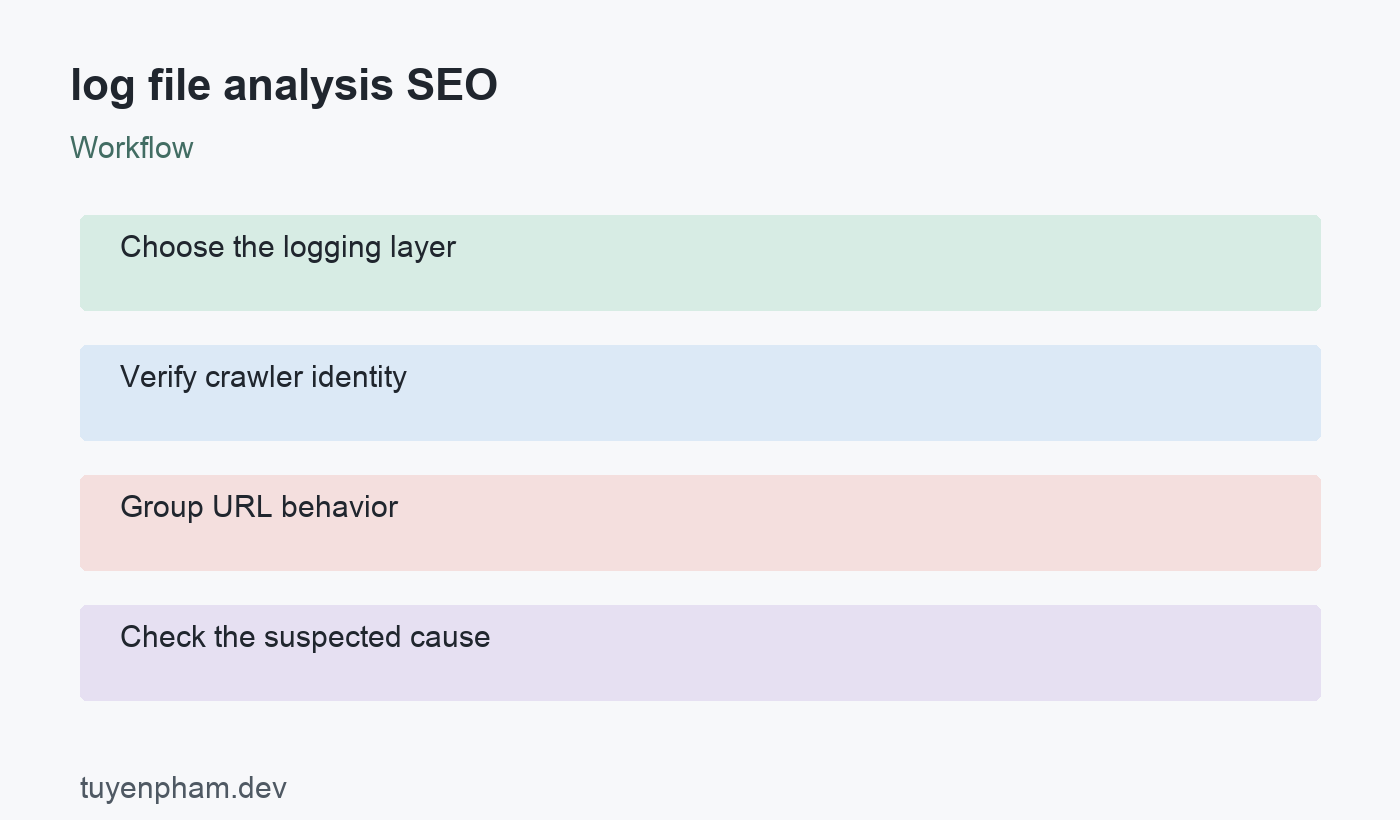
Use this sequence to organize the work: Choose the logging layer → Verify crawler identity → Group URL behavior → Check the suspected cause. The sections below explain the evidence, decisions, and limitations at each stage. The worked example is hypothetical and illustrates a process rather than a measured result from this website.
Know which requests your logs contain
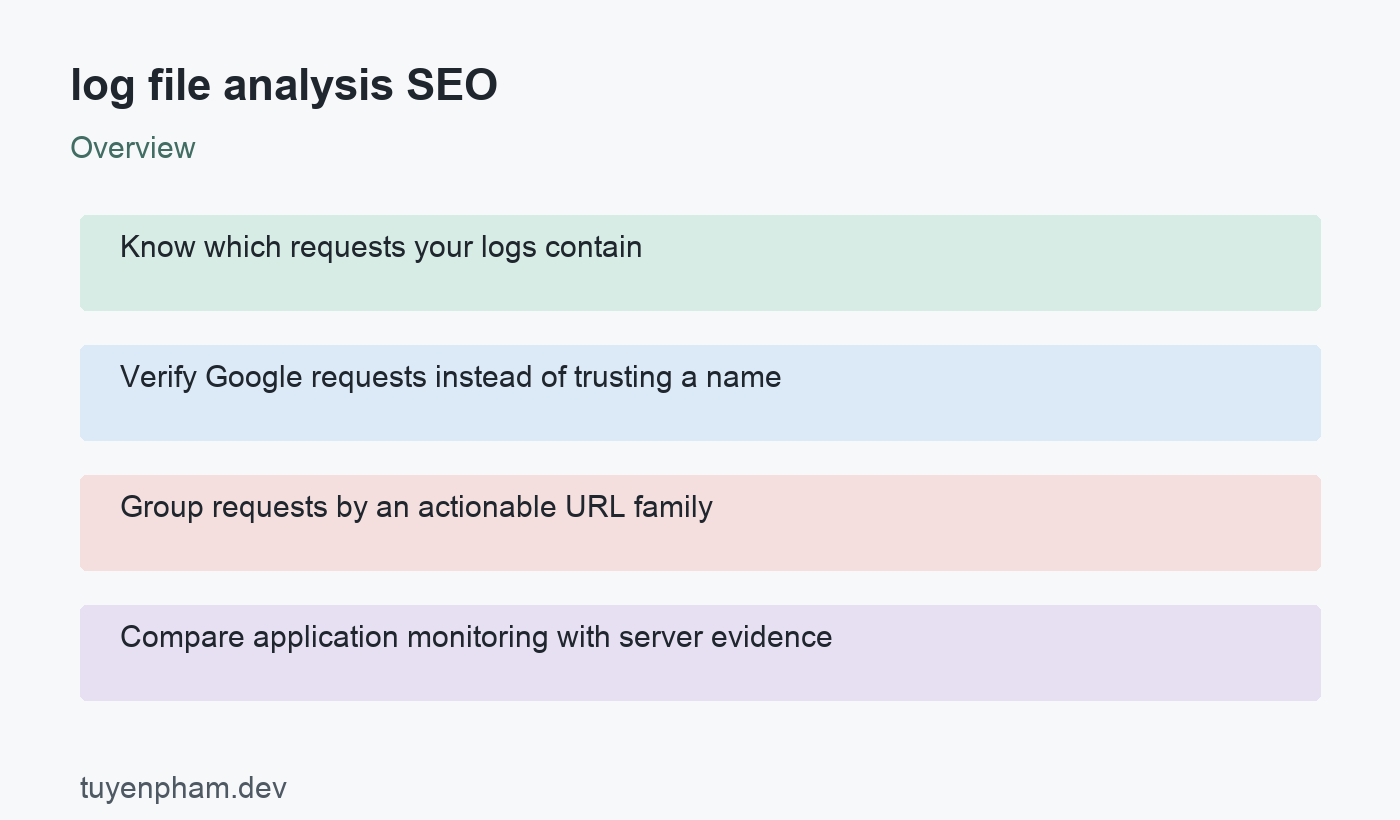
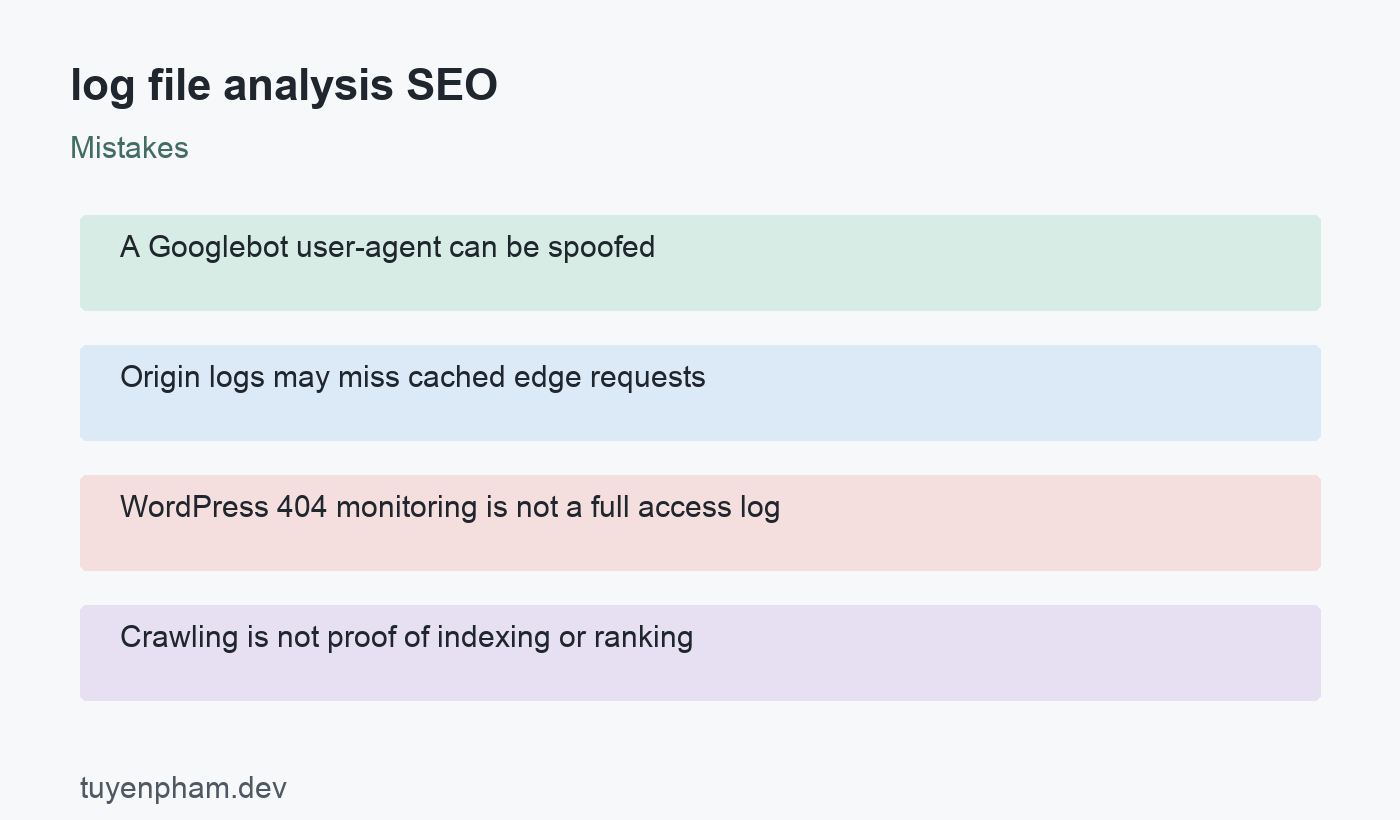
An origin server log may not include requests served entirely from a CDN cache. A WordPress application monitor may miss requests rejected before WordPress runs. Compare coverage and fields across the relevant layers. Record timezone, retention period, sampling, and whether the client address has been derived from trusted proxy headers. Keep a defined analysis window. Missing entries can reflect logging scope rather than a crawler ignoring the page. Do not combine records from several layers without considering duplicate requests.
Verify Google requests instead of trusting a name
A user-agent string claiming to be Googlebot can be spoofed. Google documents verification using its published IP ranges or a reverse DNS lookup followed by a forward lookup that matches the original IP. The expected hostname rules vary for crawler and fetcher categories, so use the current documentation. A string containing google is not enough. Preserve the verification method in your report. Avoid broad security allow rules based only on user-agent text or an unvalidated hostname.
Group requests by an actionable URL family
Classify verified requests by section, parameter pattern, status, and time window. Compare successful responses with redirects, client errors, and server errors. Normalize paths only when the transformation preserves the distinction being investigated. If you collapse all parameters, you can hide a filter problem. A frequently requested URL is not automatically important for ranking, and a less frequently requested page is not necessarily weak. Relate the pattern to the site architecture and the business question you started with.
Compare application monitoring with server evidence
Rank Math’s 404 monitor can help surface WordPress error paths and referrers, but it is not a complete server or CDN request log. Use it as a related diagnostic view, not evidence of every crawler request. If the monitor shows a repeated missing article, inspect the source links and upstream routing. If server logs show 503 responses before application handling, investigate infrastructure rather than expecting a plugin redirect to solve availability. The tools complement one another when their coverage is explicit.
Protect data and test the explanation
Request logs can contain IP addresses, tokens in query strings, and other sensitive information. Restrict access, redact unnecessary fields in shared reports, and follow appropriate retention policies. Check suspected causes against direct URL tests, crawl behavior, and Search Console evidence where available. Annotate deploys and outages. A request after a sitemap update demonstrates access, not successful indexing. Report the pattern, supporting evidence, and next verification step rather than turning request volume into a ranking prediction.
Worked example
Origin logs show few crawler requests for a popular article, but the CDN serves most requests without contacting the origin. The team inspects edge logs before concluding that discovery has failed. A different parameter family generates repeated verified crawler requests and slow responses across both layers. The investigation focuses on filter URL generation and crawl policy. Neither observation alone proves that the article is excluded from the index; indexing requires a separate source of evidence.
Verification checklist
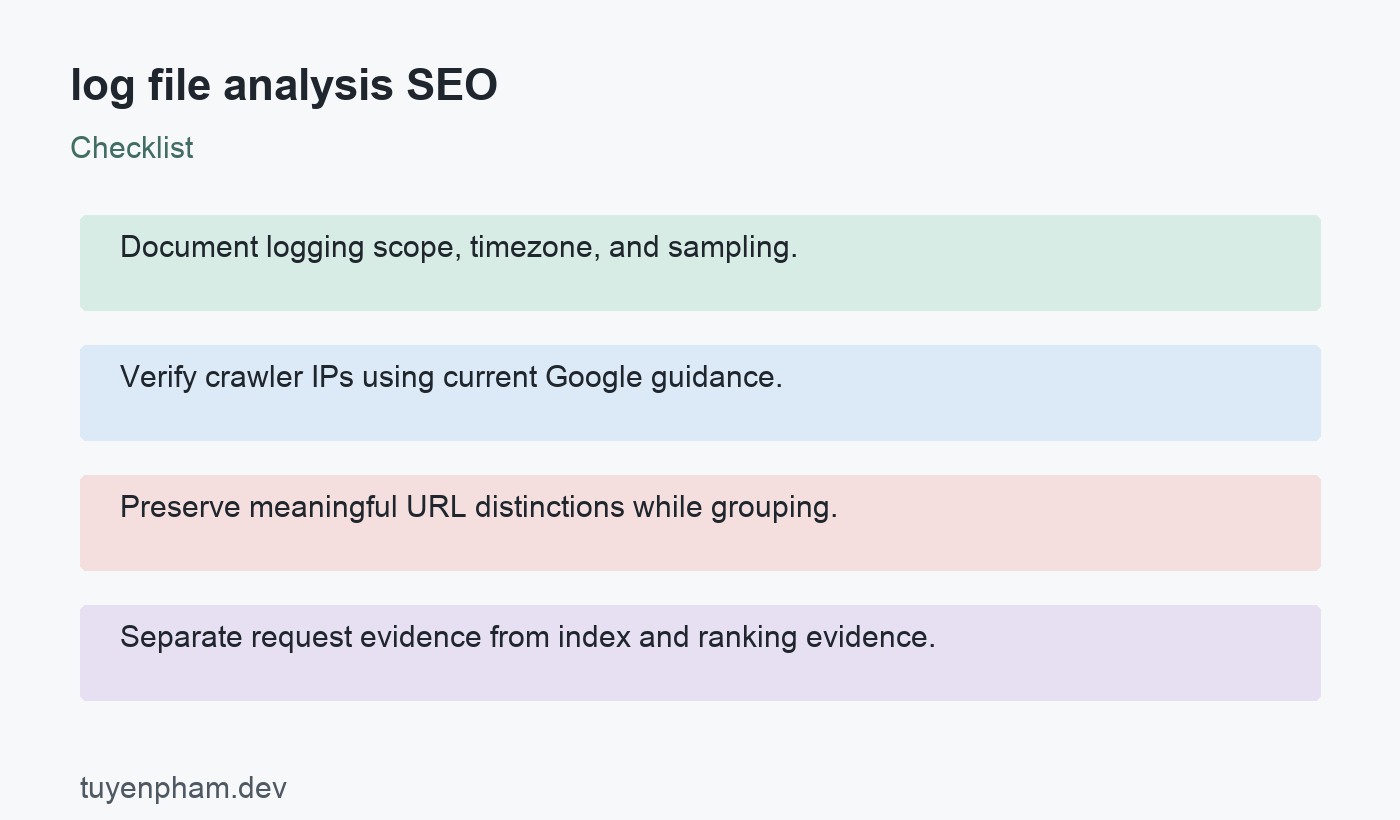
- Document logging scope, timezone, and sampling.
- Verify crawler IPs using current Google guidance.
- Preserve meaningful URL distinctions while grouping.
- Separate request evidence from index and ranking evidence.
A focused task for your website
Choose a seven-day request sample from an authorized test environment or appropriately redacted site logs. Record the layer and fields, then verify a crawler subset. Group requests by useful section and status. Identify one pattern that deserves a direct test and one limitation of the sample. Compare the suspected issue with public URL behavior. Write a short report stating what the logs show, what they cannot establish, and what action follows.
References and related reading
Review Google Search Central documentation for the relevant platform guidance, and Rank Math guidance for the related workflow for practical SEO checks. Continue with Crawl Budget Seo and the SEO audit checklist to connect this task with the rest of your site review.
Discussion
Join the conversation